Turku's most common visitor mistake is to turn the Aura River into a duty march. People hear that the cathedral sits on one end, the castle on the other, and the river in between acts like the city's main stage, so they decide the correct first move is to walk the whole line in one go. That gives you coverage, but it can also flatten the place into a long checklist. The cleaner local move is shorter and more structural. Take Föri across the river, walk the brief connector to the Kakola funicular, ride the hill, and let Turku reveal itself as a city of sides and levels instead of one continuous promenade.[1][2][3][4][6]
That sequence works because the river in Turku is not decorative water with attractions pinned to it. It still organizes how the city speaks about itself. The City of Turku's Föri page repeats the local split directly: the Aura divides the city into "täl puol jokke" and "tois puol jokke," this side of the river and the other side.[1] Visit Turku's river guide says the same thing in visitor language: the older eastern bank is "this side," while the newer western bank is "the other side," and locals still think with that distinction intact.[3] If you skip the crossing and stay linear, you miss the city's basic grammar.
The two machines matter because they make that grammar physical very quickly. Föri is free, takes about 2 to 3 minutes, runs in summer from 06:15 to 23:00 and in winter from 06:15 to 21:00, carries up to 75 passengers, and has been in service since 1904 after being completed in 1903.[1][8] The Kakola funicular is also free; it runs about 1 minute, climbs 30 metres over 130 metres of track, reaches 8 km/h, carries up to 30 people, and runs 04:30-01:00 on weekdays and 05:00-24:00 on weekends.[2][9] Put those facts together and the route stops feeling like a sightseeing trick. It becomes a piece of public logic: cross, rise, reread.
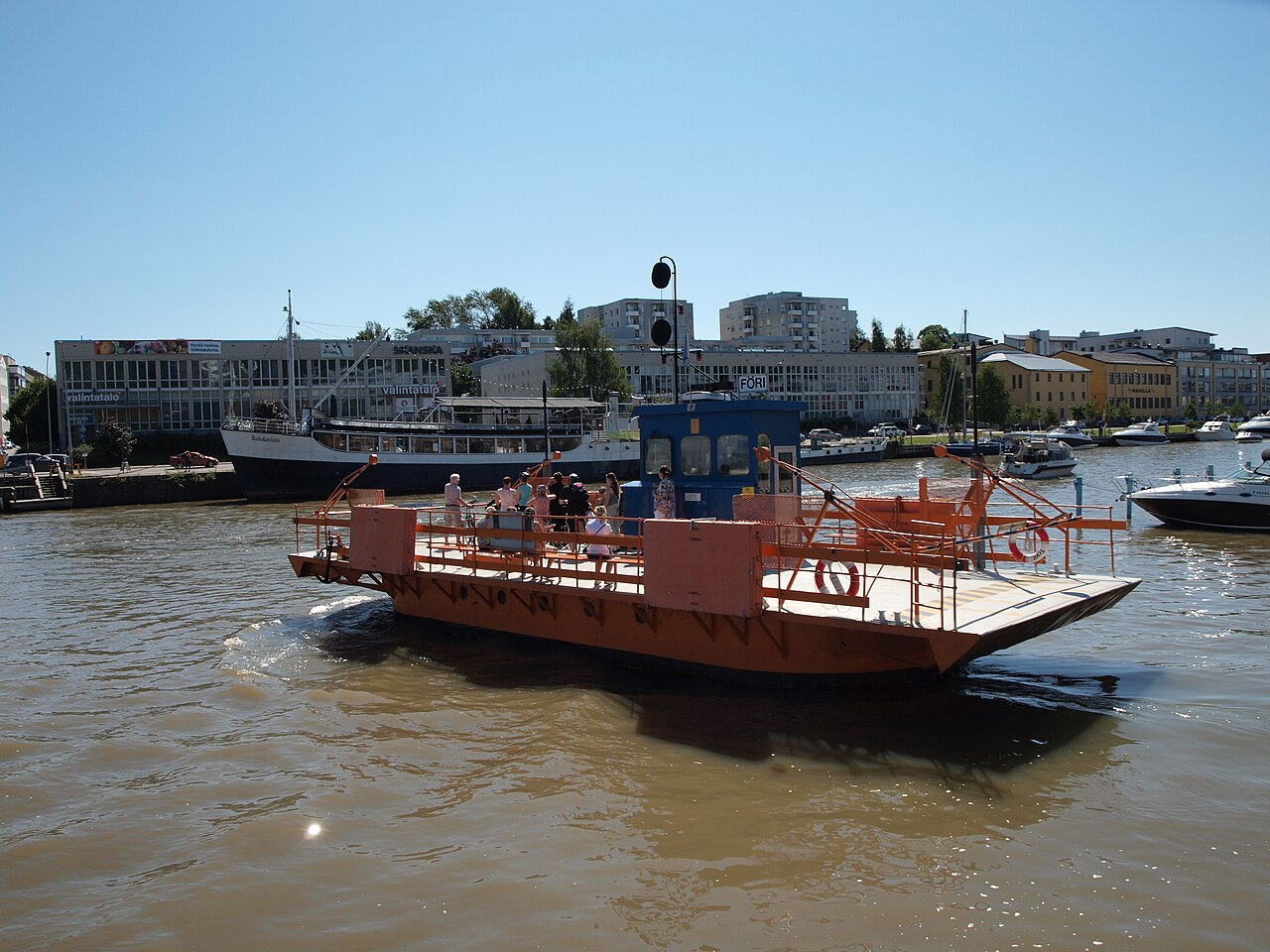
Image context: the cover uses a real documentary photograph of the orange Föri ferry on the Aura. That is the right recognition cue because the article depends on one ordinary-looking object doing an unusually large amount of cultural work for the city.[10]
Why the short loop reads Turku better than the full cathedral-to-castle obligation
The long river walk is real and worth doing. Visit Turku describes the Aura as the heart and soul of the city and says a waterside stroll from the cathedral to Turku Castle gives a broad overview of the urban scene.[3] Local writer Veera Bianca, introducing her hometown to international readers, gives almost the same advice: make your way to the harbour, walk along the river, and the city will show itself.[5] Both are right, but neither source says you must consume the whole river in one stretch to understand it.
For a first pass, the sharper move is to use the river as a hinge rather than a corridor. A local r/turku answer from May 22, 2025 recommends exactly the compact sequence this article is built on: take the funicular at Kakola hill and walk about 100 metres to the city ferry Föri.[6] Another r/turku answer from February 25, 2026 treats the Kakola funicular as one of the natural sights along a river day rather than as some far-off side quest.[7] The pattern in those local surfaces is clear. People who know Turku do not always "complete" the river. They use small mechanical shortcuts to break it into readable pieces.
That is why this short loop lands so well. Föri gives you the side change. Kakola gives you the height change. Once you have both, the Aura stops acting like a pleasant strip with boats on it and starts acting like a city section with history, transport, and neighborhood hierarchy built into it.
Anchor 1: Föri is the fastest way to feel Turku's side logic in your body
Visitors often treat Föri like a cute orange prop. That undersells it badly. The city page is explicit that this is not a themed ride but a working, free crossing between Tervahovinkatu on the eastern bank and Wechterinkuja on the western bank.[1] The official M/S Jaarli information page keeps the same tone: year-round movement, roughly 2-minute crossings, and seasonal hours that change with the calendar rather than with tourism mood.[8]
The historical facts deepen the point. Föri is described by the city as Finland's oldest vehicle still in everyday professional service.[1] It shifted from steam to diesel in 1953, then from diesel to electric in 2017.[1] That is not nostalgia staged for visitors. It is an old working object repeatedly updated so the crossing can remain ordinary. Even the passenger instruction on the city page is given first in Turku dialect before standard Finnish and Swedish.[1] The message is simple: this machine belongs to daily speech before it belongs to postcard culture.
The crossing also teaches you something important about Turku's scale. It is short enough that you never feel you are "going somewhere else" in a dramatic way. You are only changing banks. But that small lateral move reorganizes the whole city. On one side sits the older eastern logic of cathedral and old center; on the other stands the newer bank with castleward movement, library, markets, and the climb toward Kakola.[3] No static viewpoint explains that as efficiently as one free crossing.
Anchor 2: Kakola turns a river city into a hill city in one minute
The funicular does the second half of the work. Its official page calls it Finland's first outdoor inclined urban lift and stresses the practical facts: fully accessible, free of charge, boarding from both upper and lower stations, and no other public transport serving Kakolanmäki itself.[2] That last point matters. The lift is not there to entertain you after the fact. It exists because the hill still needs a public connection.
The best local use of Kakola is not prison fetishism or terrace-hopping. It is topographic correction. Visit Turku's hidden-gems guide says to combine ferry and funicular so you can move from the river to Kakolanmäki, then catch the view down from the old prison wall toward the riverside.[4] That advice is good because it keeps the hill connected to the river instead of treating Kakola as a sealed destination. The funicular's own operating data reinforces the same thing. A 1-minute ride, 130 metres of track, and 30 metres of climb mean you do not lose the city between levels; you simply change the sentence structure.[2]
Kakola's cultural texture helps too. Visit Turku's Kakolanmäki story calls the hill the site of Finland's most notorious prison for decades before its current reuse, and the hill still overlooks the Aura with that hard historical silhouette intact.[4] You do not need to build the outing around prison lore, but you should respect the fact that the rise changes Turku's emotional tone. Below, the river is social and lateral. Above, the city tightens and looks back on itself.
8 local moves that make this Turku loop land properly
- Start with Föri, not with the full promenade. The crossing teaches Turku's east-bank and west-bank logic faster than a long linear walk does.[1][3]
- Board at Tervahovinkatu or Wechterinkuja with no ticket strategy at all. Föri costs EUR0, so there is no fare friction to plan around.[1]
- Treat the ride as a side change, not a photo stop. At 2 to 3 minutes, the point is to move quickly enough that the river keeps its everyday scale.[1][8]
- Use the short walk to Kakola immediately after the crossing. A local
r/turkuanswer puts the gap at roughly 100 metres, which is exactly why this loop works as one gesture.[6] - Ride the funicular both for the lift and for the timing lesson. It is free, takes about 1 minute, and runs much longer than visitors usually assume, especially on weekday nights.[2]
- At the top, stop long enough to turn back toward the river. The hidden-gems guide is right: the view matters when it reconnects the hill to the riverside below.[4]
- Use official status pages if your timing is tight. The city notes weekly, monthly, and annual maintenance windows for the funicular, and both machines publish current operating logic rather than leaving it to rumor.[1][2]
- Let the loop stay short. The local value is compression: cross, climb, reread, then decide whether you actually need more Turku that day.[3][5][7]
Non-local trapline
Mistake 1: treating the Aura as a single mandatory walk from one monument to the next
Better move: break the river with one crossing and one climb. Turku gets clearer when you read its seams instead of trying to finish its axis.[1][2][3]
Mistake 2: taking Föri once because it is famous, then returning to the same bank without learning anything from it
Better move: use the ferry to feel the local side language. The city still thinks in east bank versus west bank, and the crossing is the shortest way into that logic.[1][3]
Mistake 3: treating Kakola as an isolated prison-themed stop or a restaurant cluster detached from the river
Better move: arrive from Föri and use the funicular as a topographic continuation of the same outing. The point is the river-hill sequence.[2][4][6]
Mistake 4: overplanning ticketing, queues, or reservations for a route that works precisely because it stays public and ordinary
Better move: trust the civic machinery. Both rides are free, quick, and part of normal city movement.[1][2]
Concrete go details
- Best window: late afternoon into early evening from May through summer is the cleanest version because Föri is on the long 06:15-23:00 schedule and the river edge is behaving like Turku's public living room; in colder months, remember that Föri shifts to 06:15-21:00 even though the funicular runs later.[1][2][3]
- Expected spend: EUR0 for the ferry and EUR0 for the funicular.[1][2]
- Queue and reservation reality: none in the formal sense; the only real operational caveat is maintenance, especially on the funicular's weekly and seasonal service windows.[1][2]
- Where to stand: on Föri, use the crossing to look lengthwise along the Aura rather than straight at the opposite dock; on Kakolanmäki, turn back toward the river before you continue anywhere else.[3][4]
- Navigation cue:
Tervahovinkatu or Wechterinkuja -> Föri crossing -> short walk to Linnankatu 55b -> Kakola funicular lower station -> Graniittilinnankatu upper station -> look back at the river before choosing whether to descend or continue.[1][2][6][9] - Numeric anchors worth keeping: 0 EUR, 2-3 minutes, 06:15-23:00, 06:15-21:00, 1903, 1904, 75 passengers, 2017, 100 metres, 1 minute, 130 metres, 30 metres, 8 km/h, 30 people, 04:30-01:00, 05:00-24:00.[1][2][6][8]
Turku does not need to be conquered end to end on the first try. It reads better when you let two small public machines do the talking. One takes you across the city's side boundary. The other lifts you just high enough to see why that boundary matters.
Sources
- City of Turku, "Aurajokilautta Föri" (official page covering the Tervahovinkatu and Wechterinkuja landings, current summer and winter hours, free fare, c. 3-minute trip time, 1903/1904 history, 75-passenger capacity, the 2017 electric conversion, and the local "täl puol jokke / tois puol jokke" language).
- City of Turku, "Rinnehissi Funikulaari" (official page covering the Linnankatu 55b to Graniittilinnankatu connection, free fare, weekday and weekend operating hours, 1-minute trip time, 130-metre track, 30-metre rise, 8 km/h speed, 30-person capacity, and the explicit note that no other public transport serves Kakolanmäki).
- Visit Turku, "The Aura Riverside – Turku's Living Room" (official tourism guide explaining the eastern-bank versus western-bank side logic, the river as a local meeting place, and the cathedral-to-castle walk context).
- Visit Turku, "Hidden gems and little-known Turku tips" (official tourism guide recommending the ferry-and-funicular combination to Kakolanmäki and the view back down toward the riverside).
- Veera Bianca, "My Hometown, Turku" (local blog post using the river and Föri as the natural way to show visitors the city).
- Reddit, r/turku, "Fun things to do?" (local/community thread from 2025-05-22 recommending the Kakola funicular and noting the roughly 100-metre walk to Föri).
- Reddit, r/turku, "What to do in a Wednesday" (local/community thread from 2026-02-25 treating the river walk, Kakola funicular, and castleward movement as one normal city day).
- M/S Jaarli, "Föri" (operator information page covering the roughly 2-minute crossing and the normal year-round seasonal schedule windows).
- Google Maps search, "Kakola Funicular Turku" (current community-review and navigation surface for the lower and upper station route check).
- Wikimedia Commons, "File:FI Turku Fori.JPG" (documentary photograph source for the cover image).