Thessaloniki has louder evening zones than this one, yet Nea Paralia is where the city becomes easiest to read after work. The official tourism board calls the redeveloped waterfront one of the city's landmark public projects: opened in 2013, spread across 50,800 square meters, and planted with 1,100 trees along Alexandrou Avenue.[1] The local city-walk guide adds the part that matters on the ground. This is a promenade locals use at all hours, especially on weekends, and the sunset window is when the long sea edge starts paying off.[2]
The useful move is narrower than a generic seafront stroll. Treat the Umbrellas as your meeting cue, not as the whole outing, then keep walking east until the Garden of Water takes over as the quieter second room. That sequence works because the two anchors do different jobs. The Umbrellas gather the city's energy into one visible point. The Garden of Water holds the longer pause once the photo-stop pressure thins out.[1][2]
Recent local reporting makes this evening reading stronger, not weaker. The Umbrellas came back to the waterfront in renewed form in December 2025, with the George Zongolopoulos Foundation describing them as returned, illuminated, and once again facing the sea horizon.[3] In late March 2026, local coverage showed the sculpture lit blue for World Autism Awareness Day.[4] Over the last year the same stretch has also hosted events running from 19:00 to 23:00 and city festivals stretching across the afternoon and evening, which is the clearest signal that Thessaloniki still treats this zone as a civic room rather than a postcard backdrop.[5][6] Current map surfaces still read the Umbrellas as a live waterfront meeting point rather than a retired sculpture stop.[8]
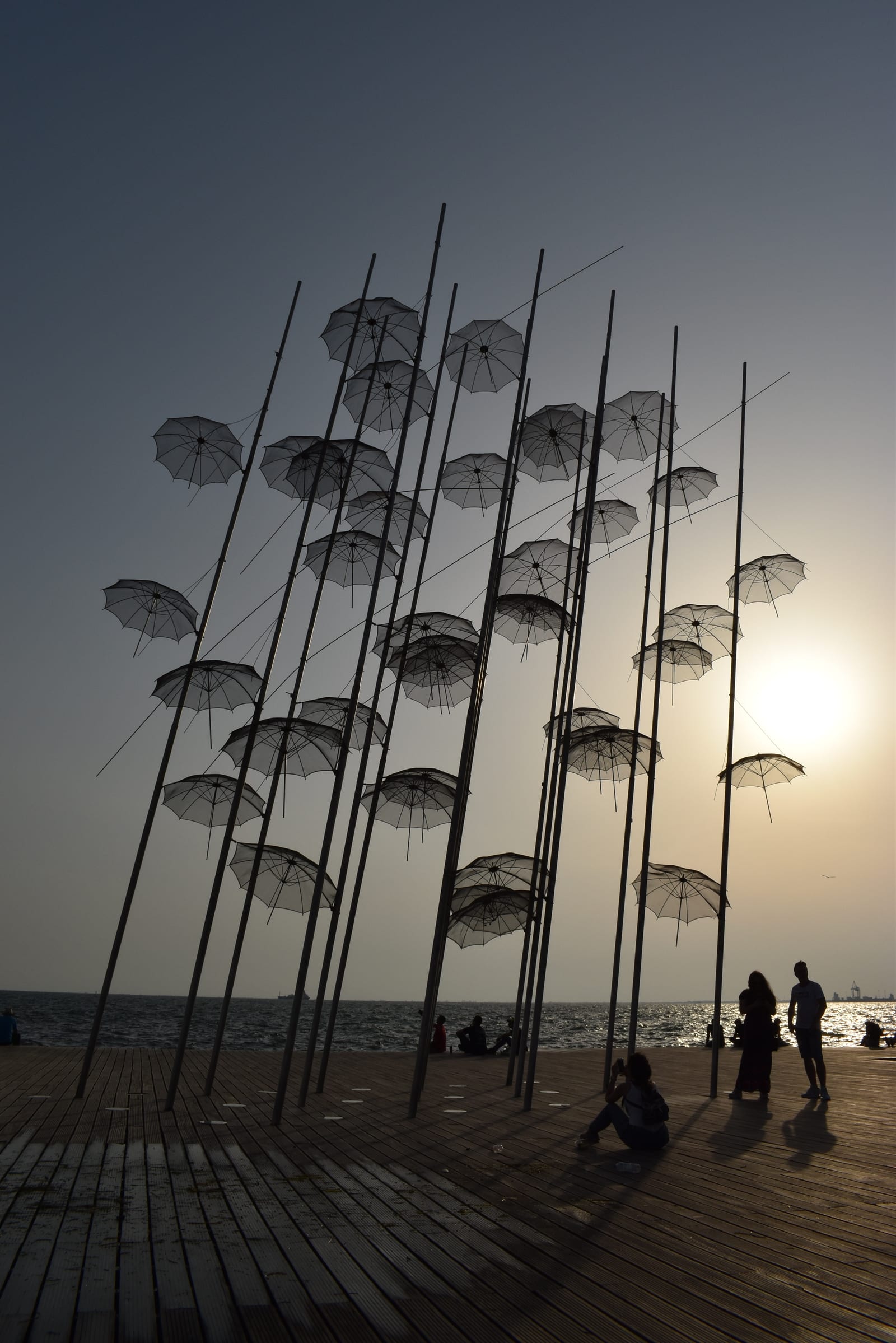
Image context: the cover uses a real documentary photograph of the Umbrellas on the Thessaloniki waterfront. That is the right image for this article because the route depends on recognizing the sculpture as a real public-space hinge, with the Thermaic Gulf immediately behind it, rather than as an isolated art object.[9]
Why the after-work turn is the right Thessaloniki move
The tourism-board version of Nea Paralia is impressive on paper: a large regeneration project, greenery, water, cycle paths, sports areas, and event infrastructure.[1] The local walking guide gives it life. It describes the promenade as a place people inhabit all day and night, with the sunset stretch carrying special weight.[2] Put together, those two sources point to the same practical conclusion. This is a space built for lingering once the heat and office compression start loosening.
That is why the route should begin slightly later than a first-time visitor might expect. The Umbrellas are one of the city's most photographed objects, but local reporting on the sculpture's repair cycle shows exactly what heavy daytime photo behavior can do to it: visitors leaning on the lower elements, touching them for pictures, and even hanging love locks on the work helped accelerate damage before the 2025 restoration.[7] Go when the promenade is active but not frantic, take your image, and then shift the outing toward the broader waterfront logic.
The civic-use pattern matters here too. In September 2025, the Connected We Stand Festival occupied the Umbrellas zone from 11:00 to 23:00, using the stretch from the Alexander statue toward the Karamanlis statue for sports, workshops, and music.[6] In October 2025, a large dog festival ran at the Umbrellas from 10:00 to 20:00.[5] Those events do not mean every evening is a festival evening. They do mean the city keeps returning to this exact strip when it wants a public-facing, open-air room with a broad threshold and easy foot traffic.
Anchor 1: the Umbrellas are for orientation, not for overstay
The Umbrellas deserve their status. The local walking guide traces them back to 1993, when George Zongolopoulos showed the work at the Venice Biennale, before the sculpture was installed in Thessaloniki in 1997 and later moved to its current waterfront platform.[2] Thestival's 2025 reporting gives the physical facts that help you look at it properly: the work stands about 13 meters high, is made of stainless steel, and sits near the statue of Alexander the Great on the New Waterfront.[7]
What visitors tend to miss is that the sculpture works best as a hinge. Arrive here, get your bearings, take in the water and skyline, then keep your body moving. The renewed 2025-2026 coverage makes that reading easier. The work is alive in local use, but it is also vulnerable to being treated as a climbing frame or a lock bridge.[3][4][7] The cleaner move is respect plus motion.
Anchor 2: the Garden of Water is the calmer second room
The eastern continuation is what turns the stop into a real Thessaloniki evening. The local city-walk guide treats the New Waterfront not as one flat path but as a sequence of 12 themed gardens across roughly 76,657 square meters, with the Garden of Water and nearby Umbrellas among the stretch's defining modern cues.[2] That helps on the ground. Once you leave the sculpture behind, you stop reading the promenade as a single landmark and start reading it as a long urban edge with rhythm.
This is where the route gets local. Instead of staying in the tightest photo cluster, you let the promenade widen, the benches matter, and the gulf wind do some of the work. The Garden of Water holds that shift well because it still belongs to the same Nea Paralia composition while giving you a softer landing than the Umbrellas platform itself.[1][2] Thessaloniki, at this hour, feels less like a sightseeing checklist and more like a city using its waterfront correctly.
8 local moves that materially improve the route
- Use the Umbrellas as the meeting point, not the whole itinerary. The sculpture is the cleanest recognition cue on this side of the waterfront, but the outing improves once you continue east.[2][7]
- Aim for the after-work to blue-hour band, when the promenade's everyday local use and its sunset logic overlap.[2][5][6]
- Keep the first stop short. Take the view, register the sea horizon, then walk on before the photo queue becomes your whole memory of the place.[3][4][7]
- Treat the sculpture gently and from a little distance. Recent local reporting makes clear that touching, leaning, and hanging locks on the lower umbrellas has already created avoidable damage.[7]
- Let the Garden of Water hold the longer pause. The promenade reads better when the second room is quieter than the first.[1][2]
- Keep the budget at EUR 0 unless you deliberately add food or drink. The route's strength is public space, not spending.[1][2]
- If you hit an event day around the Umbrellas, pivot east immediately instead of abandoning the promenade. The waterfront is built to absorb that shift.[5][6]
- Use the Alexander-statue side as your navigation cue and the garden sequence as your pacing cue. That prevents the whole evening from collapsing into one crowded platform.[1][2][7]
Non-local trapline: 4 common mistakes and the cleaner alternative
Mistake 1: treating the Umbrellas as a self-contained destination
Better move: use the sculpture as the first hinge, then keep walking to the Garden of Water so the promenade has a second act.[2]
Mistake 2: arriving at the most crowded daylight hour and staying pinned to the platform
Better move: use the after-work and blue-hour window, when the waterfront's local rhythm and sea light line up more cleanly.[2][5][6]
Mistake 3: touching, leaning on, or decorating the sculpture for photos
Better move: respect the repair history and keep the work in view without turning it into furniture.[7]
Mistake 4: assuming an event around the Umbrellas means the route is spoiled
Better move: absorb the event as proof of the promenade's civic life, then walk east and let the quieter garden sequence carry the rest of the evening.[5][6]
Concrete go details
- Best time window: the after-work turn into blue hour, when local promenade use, sunset, and lighting all start aligning.[2][4][5][6]
- Expected spend: EUR 0 for the core route.[1][2]
- Queue and reservation reality: none for the promenade itself; the main friction is crowd density around the Umbrellas on event nights or peak-photo moments.[5][6][7]
- Where to stand or sit: stand briefly at the Umbrellas platform, then shift your longer pause to the Garden of Water stretch.[2]
- Navigation cue:
Alexandrou Avenue -> Umbrellas near the Alexander statue -> continue east on Nea Paralia -> Garden of Water.[1][2][7] - Numeric anchors worth keeping: 2013, 50,800 m², 1,100 trees, 1993, 1997, 13 meters, 12 gardens, 76,657 m², 19:00-23:00, 10:00-20:00.[1][2][5][6][7]
Thessaloniki's waterfront gets flatter when you treat it as one long generic walk. It sharpens when you let one landmark gather the city and another quieter stretch release it again. The Umbrellas give you the public signal. The Garden of Water gives you the room after the signal fades.
Sources
- Thessaloniki Tourism, "Nea Paralia - Seaside Promenade" (official page on the 2013 redevelopment, 50,800 square meters, 1,100 trees, and public-space design).
- blog.thessaloniki.travel, "City Walks: Nea Paralia - Vasilissis Olgas Avenue" (local guide on the promenade's all-day local use, sunset value, the Umbrellas, and the 12 themed gardens).
- George Zongolopoulos Foundation, "The Umbrellas of Zongolopoulos have returned" (published 2025-12-04; foundation note on the sculpture's renewed, illuminated return to Thessaloniki's waterfront).
- Thestival, "Thessaloniki: the White Tower and Zongolopoulos' Umbrellas light up blue for autism awareness" (published 2026-03-31; recent local confirmation that the renewed sculpture is active in the city's public-lighting calendar).
- Thestival, "Thessaloniki: Nea Paralia fills with dogs in a festival of shows and games" (published 2025-10-18; local report on a free 10:00-20:00 civic event staged around the Umbrellas).
- Thestival, "Thessaloniki: Connected We Stand Festival on the New Waterfront" (published 2025-09-19; local report on an 11:00-23:00 event using the Umbrellas and adjoining promenade zone).
- Thestival, "Thessaloniki: the famous Umbrellas continue to be dismantled for repair" (published 2025-10-30; local report on restoration, 13-meter height, 1997 installation, and damage from touching or hanging locks).
- Google Maps search, "Umbrellas by Zongolopoulos Thessaloniki" (current community-review and place-status surface; accessed 2026-04-16).
- Wikimedia Commons, "File:Umbrellas in Thessaloniki (art).jpg" (documentary photograph used for the cover image).