Tbilisi's old city is easiest to misuse when every sight becomes a separate stop. The better night-room version is smaller: start in Abanotubani, let the sulfur bath be the warm interior, then step back into the open air and climb toward Narikala or Kartlis Deda while the city changes temperature around you.[1][3][4]
That sequence works because Abanotubani is not decorative background. Georgia Travel ties the city's name to tbili, meaning warm, and to the hot springs around which the founding legend of Tbilisi gathers.[1] The same guide describes the bath district's brick domes as working architecture: they vent heat while giving the neighborhood its recognizable roofline.[1] If you only photograph the domes from outside, you get the postcard. If you enter a bath first and walk the hill afterward, you understand the old city through heat, stone, water, stairs, and air.
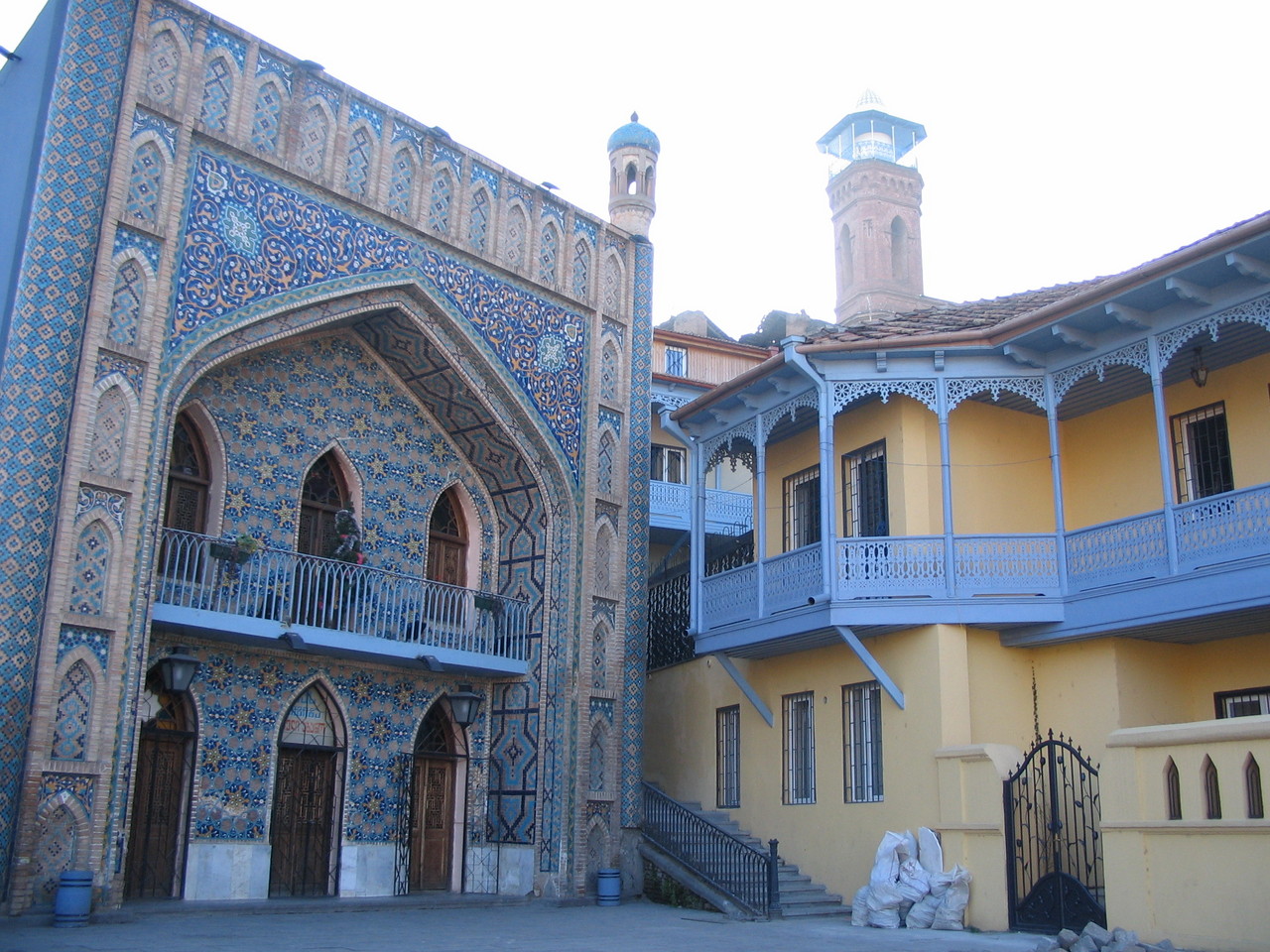
The cover image keeps that route grounded in a real place rather than a generic Caucasus mood. It shows Abanotubani's domes and tiled bathhouse facade from the district itself, with the hillside close behind.[8] That visual matters because this route depends on proximity. The bathhouses, Jumah Mosque, narrow lanes, Narikala, Kartlis Deda, and the cable-car ridge are not scattered itinerary points. They are one compact room with different temperatures.
Start with the bath, not the viewpoint
The strongest version begins with a booked bath slot, then lets the walk happen after. Georgia Travel notes that most working sulfur baths remain in Abanotubani, with fewer than a dozen operating today, and that schedules differ by bathhouse: some close by 23:00, while others work past midnight.[1] It also gives the current practical range: public baths commonly sit around 10-30 GEL per person per hour, private rooms can range from 80 to 600 GEL, and a traditional kisa scrub often adds 10-20 GEL.[1]
That spread is the whole trick. Visitors often think the choice is "best bathhouse." The better first decision is whether the outing needs a public hall, a simple private room, or a high-design room that costs more because it has become part spa, part landmark. Chreli Abano's official page makes the premium end explicit: several rooms are listed at 200 GEL per hour, smaller rooms at 130-160 GEL, the VIP apartment at 500 GEL, and the Royal Apartment at 600 GEL; its traditional peeling service is 30 GEL, with the glove priced separately at 10 GEL.[2] Those are useful numbers because they stop the evening from drifting. Decide the comfort level before you arrive.
The local/community surface points in the same direction. A current r/tbilisi bathhouse thread from April 2026 treats Gulo's and Chreli Abano as the familiar private-room options while warning that room pricing makes more sense for a small group splitting the cost.[5] A live Google Maps search for Abanotubani keeps the current place-review layer close at hand, which is useful for checking entrances, temporary closures, and crowd feel before committing to a room.[6] That is the practical local read: do not confuse "authentic" with underplanning. If you want a calmer night-room sequence, book or arrive early, use the bath as the core experience, and stop chasing every dome from the sidewalk.
Use the ridge as the cool-down
After the bath, the route should change surface. Step out through Abanotubani, give yourself 10-15 minutes before any climb, and let the sulfur smell, damp hair, and cooler street air do their work. From there, you have two clean choices. The energetic version takes the stairs and lanes upward; Georgia Travel's Kartlis Deda page describes the Betlemi Street stairway as steep in places but paved and scenic, passing Jumah Mosque and the Abanotubani bathhouses on the way.[4] The lighter version crosses to Rike Park and uses the cable car.
The cable car is useful when treated as a tool rather than a theme-park add-on. Georgia Travel's aerial-tramway page says the Rike Cable Car links Rike Park with Narikala, runs on a 500-meter line, uses seven gondolas, and carries up to eight people per cabin.[3] Its Kartlis Deda guide gives the operating pattern to check against your night: generally 10am to 10pm, with longer peak-season hours when demand supports it, and around a two-minute ride from Rike Park to the hilltop near Narikala.[4] The same page puts Kartlis Deda about five minutes from the upper station.[4]
This is why the bath-first order works. If the cable car is still running, you get an easy cold-air lift after the steam. If it is closed, the walk remains coherent because Abanotubani already sits under the hill. Either way, Narikala functions as the cool exterior. Georgia Travel's Narikala page locates St. Nicholas Church inside the fortress, above the historical center, and notes the rebuilt church's archaeological layer: remains found in 1966, the current incarnation built in 1997, on a site tied to a 13th-century church.[7] That history should stay in the background of the walk. The main point at night is not to consume the fortress as a fact file; it is to let the warm bath district and the open ridge answer each other.
8 local moves that keep the night clean
First, choose bath format before choosing bathhouse. Public room, simple private room, and ornate private room create different evenings and different price behavior.[1][2][5]
Second, book peak-time private rooms rather than hoping the prettiest facade will be available. Georgia Travel says advance booking is recommended at peak times because even a few guests can fill limited room stock.[1]
Third, keep the bath to one hour unless the room itself is the whole plan. The posted pricing is hourly, and a compact soak-scrub-shower rhythm leaves enough attention for the hill afterward.[1][2]
Fourth, carry small cash for the scrub layer. Chreli's own service page prices the traditional peeling separately from room rental and lists the glove separately too.[2]
Fifth, use heat carefully. Chreli's rules explicitly warn that sulfur baths are not recommended for pregnant guests or people with pressure or heart problems.[2] That is practical trip design, not medical decoration.
Sixth, walk after bathing before deciding on the cable car. Ten quiet minutes in Abanotubani tells you whether stairs sound good or whether the Rike lift is the better exit.[3][4]
Seventh, treat Kartlis Deda as a ridge marker, not another checklist stop. From the upper cable-car station, the statue is close enough to use as orientation, and then the night can end.[4]
Eighth, leave the restaurant decision outside the route. Abanotubani and the old city are full of adjacent temptations, but this route is about temperature, topography, and timing. Food can follow; it should not steer the bath-ridge sequence.
Non-local trapline: 4 common misses and the better alternative
Mistake 1: only photographing the domes
Better alternative: book or enter a bath first, then photograph the district after you understand what the domes are doing architecturally and bodily.[1][8]
Mistake 2: paying for a premium room because it is famous
Better alternative: decide whether the evening needs a landmark room or just a clean private soak. Current prices run from modest public options to rooms at 500-600 GEL, so the comfort decision belongs before the counter.[1][2]
Mistake 3: assuming the cable car solves every late-night exit
Better alternative: check the operating window before committing to the Rike Park version. The normal public guidance is 10am-10pm, with possible peak-season extension, so the stairs-and-taxi fallback should stay visible.[4]
Mistake 4: climbing too fast after hot water
Better alternative: use a short decompression walk through Abanotubani before the ridge. The sequence gets better when the body changes pace between the pool room and the hill.[1][4]
Go details
- Best time window: book a bath for early evening, then walk or ride toward Narikala while the old city is lit but before late fatigue turns the hill into a chore.[1][4]
- Expected spend: 10-30 GEL for many public-bath patterns; 80-600 GEL for private rooms depending on bathhouse and amenities; Chreli's listed rooms currently run 130-600 GEL per hour.[1][2]
- Queue and reservation reality: book ahead for peak private-room slots, especially at popular bathhouses and in summer or early autumn.[1][5]
- What to bring: water, sandals or bath footwear if your chosen house does not provide them, and cash for scrub/glove extras.[2][5]
- Navigation cue: Abanotubani bath -> short cooling walk -> Betlemi-side climb or Rike Park cable car -> Narikala/Kartlis Deda ridge -> stop before adding another old-city loop.[3][4]
- Weather cue: if rain or wind makes the ridge unpleasant, keep the night inside Abanotubani and use the bathhouse exit as the endpoint rather than forcing the view.[4]
Tbilisi's old city does not need a bigger evening here. It needs a sequence that respects how close everything is. Steam first, then stone and air. The night becomes legible when the bath district is allowed to stay warm and the ridge is allowed to stay cool.
Sources
- Georgia Travel, "Exploring Tbilisi's Sulfur Baths: Georgia's Ancient Wellness Tradition" (official tourism guide to Abanotubani history, bath formats, peak times, prices, and booking guidance).
- Chreli Abano, "Sulfur Bath & Spa" (official room pricing, kessa service pricing, reservation link, rules, and health cautions).
- Georgia Travel, "Aerial Tramway" (official tourism page for Tbilisi cable-car lines, including the 500-meter Rike-Narikala line, seven gondolas, and eight-passenger cabin capacity).
- Georgia Travel, "Kartlis Deda - Mother of Georgia Statue" (official access guidance for Rike Park cable car, Betlemi stair route, operating-window note, and ridge orientation).
- Reddit, r/tbilisi, "Bathhouses in Tbilisi" (April 2026 local/community thread on Gulo's, Chreli Abano, group room-price logic, and late-opening bath options).
- Google Maps search, "Abanotubani Sulfur Baths Tbilisi" (current community-review and place-status surface for entrances, nearby bathhouses, and temporary-status checks; accessed April 20, 2026).
- Georgia Travel, "Narikala Fortress & St. Nicholas Church" (official historical context for the hilltop church, archaeological remains, 1997 reconstruction, and cable-car access).
- Wikimedia Commons, "File:Abanotubani Tbilisi.jpg" (documentary photograph used for the cover image; depicts Abanotubani bath architecture in old Tbilisi).