Tallinn is easy to misread if you keep all your attention inside the Old Town walls. The usual first-visit pattern is medieval lane, viewing platform, another medieval lane, then a slow loss of scale once the center starts feeling over-resolved. The local correction is to go east. Start in Kadriorg Park, keep walking instead of turning back at the palace axis, and let the Song Festival Grounds finish the route where Tallinn stops feeling sealed and starts feeling coastal again.[1][3][4][5]
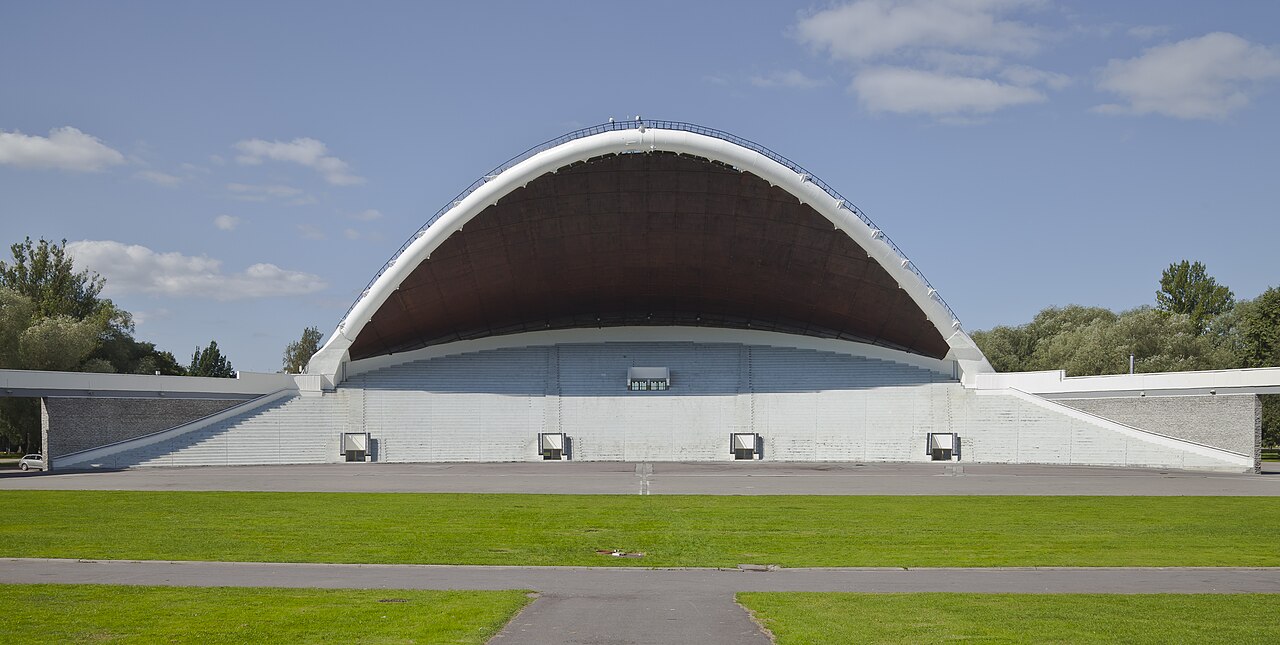
That ritual works because the two anchors do different jobs. Kadriorg Park gives you Tallinn in a controlled register first: Peter the Great's 1718 park project, a public green space open 24 hours a day, and a formal landscape big enough to slow the city down before you ask it for a view or a story.[1] Visit Tallinn describes the park as the most outstanding palatial and urban park in Estonia, covering around 70 hectares, while the wider Kadriorg district page places the whole neighborhood inside a 300-year imperial and cultural layer of villas, summer houses, museums, and tree-lined streets.[2][3] The Song Festival Grounds give you the release. The official attraction page calls them a symbol of Estonian national pride, says the current site was completed in 1960, and notes capacity for nearly 15,000 singers and up to 100,000 spectators, with a 42-meter-high lighthouse that can be climbed by advance booking.[5]
The city-specific texture is what happens between those two scales. Visit Tallinn's Kadriorg guide says the park remains one of Tallinn's favorite places for a stroll, then tells you exactly what to do next: walk east along the Pirita promenade and you reach the country's most hallowed event venue, the birthplace of the 1988 Singing Revolution.[4] The same guide adds the larger festival numbers: up to 34,000 performers and 200,000 spectators during the five-year cycle of the Estonian Song and Dance Celebration.[4] That is why this route feels more precise than a generic park walk. You begin in a baroque, imperial room and end in a civic bowl where modern Estonian memory still gathers in the open air.
Image context: the cover uses a real 2012 Wikimedia Commons photograph of the Song Festival Grounds. It fits this article because the route is not about decorative greenery alone. It is about arriving at one large public hillside where Tallinn's sea edge, concrete modernism, and mass civic memory lock into the same frame.[10]
Why east is the right correction
The community surface points the same way. In a recent r/Eesti thread about experiencing Tallinn fully, one local answer told visitors to take the tram to Kadriorg and treat it as a serious cultural district rather than a side errand.[6] A recent r/europe thread on Tallinn did something simpler but equally useful: when someone asked what mattered beyond the Old Town, one of the first concrete answers was that Kadriorg is beautiful in summer and worth the museum-and-park time.[7] Those remarks are not exotic insider revelations. They matter because they show how locals and repeat visitors rank the area: not as overflow scenery, but as one of the city's cleanest outside-the-core moves.
The review layer adds the practical part. Tripadvisor's Kadriorg Park page still describes the park as about a 20-30 minute walk from the center and easy to reach by public transport, which is a useful reminder that you do not need to overengineer the approach.[9] Tripadvisor's Song Festival Grounds page keeps the venue grounded in everyday reality too: not just a giant symbolic field, but a place people still visit between major events because it carries Estonia's singing tradition and open-air concert life in the same space.[8] Read together with the official pages, the route stops looking like two separate attractions and starts looking like one eastward easing of pressure.
8 local moves that make the ritual land
- Start in Kadriorg, not in the Old Town. This route works by changing Tallinn's scale early, not by adding one more stop after the center has exhausted you.[1][3][6]
- If you are starting central, use the tram or a short transfer instead of burning attention on the approach. The point is to arrive with the park still doing the first calming job, not to use up the route before it begins.[3][9]
- Read the formal park first, then keep going east. Kadriorg's value here is not only the palace axis but the way it slows your eye before the city opens toward the sea.[1][2][3]
- Do not let the museums swallow the walk unless that is your whole day. Kadriorg can support a full cultural itinerary, but this ritual is stronger when the park remains a moving threshold rather than a museum district checklist.[3][6][7]
- Treat Russalka and the seafront as connective tissue, not the finish. The useful move is to keep walking until the Song Festival Grounds give you the real public-space release.[4]
- Use the grounds as open civic space, not only as an event venue. The official page says the parkland is open for walking and sports all year, 24h, and entry is free.[5]
- If the lighthouse is open and you booked ahead, count it as an optional spike, not the reason for the walk. The main reward is the hillside and the stage bowl; the 42-meter tower is an extra, not the route's core.[5]
- End with one slow sit on the slope before turning back. This route gets its full effect only when you let the final public room hold you for a few minutes instead of tagging it and leaving immediately.[4][5][8]
Non-local trapline: 4 common mistakes and the better alternative
Mistake 1: keeping Tallinn inside the Old Town wall logic
Better move: shift east before the day gets dense. Kadriorg and the Song Festival Grounds give you the city's imperial, seaside, and modern civic layers in one continuous line.[3][4][5]
Mistake 2: walking Kadriorg as far as the palace, then turning back
Better move: keep the park moving eastward. The official Kadriorg guide itself points you onward along the promenade to the Song Festival Grounds.[4]
Mistake 3: assuming the Song Festival Grounds only matter when there is a ticketed event
Better move: treat them as public terrain first. The grounds are open 24h, free, and explicitly framed as a park for walking and sports even outside major performances.[5]
Mistake 4: trying to force every Kadriorg museum and every festival-site feature into the same loop
Better move: pick the walk over coverage. This ritual works because it keeps two anchors clear: one park, one civic amphitheatre, and the sea-edge line between them.[3][4][5]
Concrete go details
- Best window: late afternoon into early evening, when Kadriorg still reads clearly and the Song Festival slope feels like a destination instead of a transit edge.[4][5]
- Expected spend: free if you keep it to the walk itself; the park and the grounds are both open-access public spaces.[1][5]
- Approach logic: if you are already central, Kadriorg is roughly a 20-30 minute walk from the center, but the tram keeps the sequence cleaner.[3][9]
- Queue reality: ordinary walking days have no meaningful access friction; event days are a different city and should be treated separately.[5][8]
- Where to slow down: first inside Kadriorg once the formal layout has done its work, then on the Song Festival hillside once the arch and sea light come into alignment.[1][4][5]
- Navigation cue:
Kadriorg Park -> east edge -> short promenade continuation -> Song Festival Grounds slope -> one sit -> return on your own energy level.[4][5] - Numeric anchors worth remembering: 1718, 300 years, 70 hectares, 1960, 15,000, 100,000, 34,000, 200,000, 42 meters, 24h, 20-30 minutes.[1][2][3][4][5][9]
Tallinn does not always need another tower or another medieval lane. Sometimes it needs one park, one eastward line, and one great public bowl where the city remembers how to face the sea together.
Sources
- Kadriorg Park, official park site (Peter the Great's
1718foundation and current24 hours a dayaccess). - Visit Tallinn, "Kadriorg Park" (official page noting that the park covers around
70 hectares). - Visit Tallinn, "Kadriorg" (official neighborhood page on the district's
300-yearhistory, villas, wooden houses, and retro-style trams). - Visit Tallinn, "Kadriorg - Elegant park & fine art" (published 2025-07-07; official guide connecting Kadriorg to the Pirita promenade and the Song Festival Grounds, with Singing Revolution and festival-scale context).
- Visit Tallinn, "Tallinn Song Festival Grounds" (official page covering the
1960completion date, capacity for nearly15,000singers and up to100,000spectators, the42-meterlighthouse,24haccess, and free entry). - Reddit / r/Eesti, "Tips for experiencing Tallinn to the fullest" (recent local/community advice treating Kadriorg as a tram-worthy cultural district rather than an afterthought).
- Reddit / r/europe, "Tallinn, Estonia" (recent community thread recommending Kadriorg for summer park-and-museum time beyond the Old Town).
- Tripadvisor, "Tallinn Song Festival Grounds (2026)" (community review page keeping the grounds tied to Estonia's song tradition and live event use).
- Tripadvisor, "Kadriorg Park (2026)" (community review page noting the park's half-hour-from-center practicality and public-transport ease).
- Wikimedia Commons, "File:Tallinn Song Festival Grounds, Tallinn, Estonia, 2012-08-12, DD 09.JPG" (documentary cover photograph source).