Lyon gets flattened when visitors let Vieux Lyon and Fourvière do all the work. The city has another hill, and it asks for a different kind of reading. The stronger close-up is to start below at Place des Terreaux / Hôtel de Ville, take Montée de la Grande-Côte on foot, and let Le Gros Caillou finish the ascent on the Croix-Rousse plateau.[1][4][8] That short climb explains the city in a way the bigger monuments do not. You move from lower-city density into the hill that worked, with Fourvière's monumental logic left for another outing.
The official tourism framing is already pointing you there if you read it carefully. Visit Lyon describes Croix-Rousse as a UNESCO-listed slope-and-plateau district where Lyon's silk story took on real scale in the early 19th century, with tall buildings, steep gradients, and the memory of the Canut revolt still built into the neighborhood's atmosphere.[1] The same page insists on its village logic from top to bottom: families, long-time residents, artists, and small shops mixed into a quarter where people rarely feel the need to "go down" to Presqu'ile.[1] That mood matters, because this is not a checklist climb. It is a district whose pace changes as you rise into it.
Montée de la Grande-Côte is the right street because it carries the hill's older grain directly under your feet. The heritage dossier at Patrimoine-Lyon calls it the oldest passage on the slope, lined in its central section with 16th- and 17th-century houses.[4] It also reminds you how important this steep street once was: until 1750, Grande-Côte and Grande-Rue served as the main artery linking Lyon upward toward the Dombes, the Bresse, Franche-Comté, Alsace, and Switzerland.[4] By 1788, the same hill counted nearly 705 looms, and the route became inseparable from the daily movement of silk workers and from the Canut uprisings of 1831 and 1834.[4] This is why the climb feels denser than a pretty staircase. The slope was a traffic system, a work system, and a labor history before it became anyone's favorite walk.
The upper half of the route clarifies the spatial payoff. Ville de Lyon's page on the Grande-Côte esplanade and garden says the "window" above the steps is designed to frame both the climb and the city spread below, and it notes that the present garden totals 6,179 m2.[3] Then the endpoint arrives in a form only Lyon could turn into neighborhood identity. Ville de Lyon describes Le Gros Caillou as an Alpine glacial moraine discovered during the excavation of the Croix-Paquet funicular tunnel, installed on the spot in 1891, and now treated as one of the quarter's symbols; the same page gives the simple operational fact that matters most if your legs are done: Metro C, Croix-Rousse station is right there.[2]
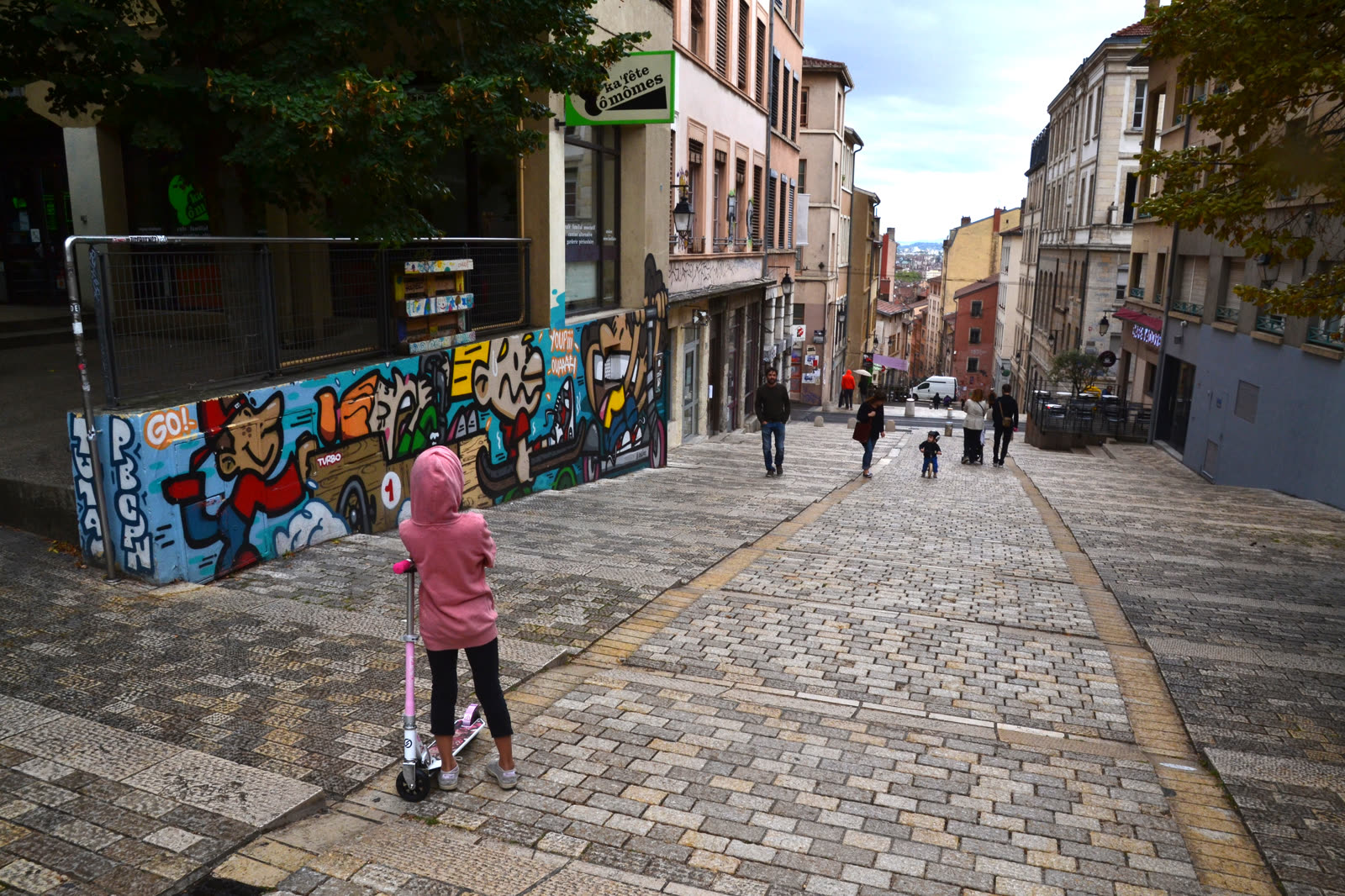
Image context: the cover uses a real Wikimedia Commons documentary photograph taken on Montée de la Grande-Côte. That is the correct visual for this article because the route depends on the long, sloped approach that makes the Croix-Rousse plateau feel earned and sequential.[10]
Why late day is the useful clock
This route is stronger in the late-day shoulder than in the middle of the morning. Morning belongs to errands, stalls, and neighborhood routine. Lyon Secret notes that the boulevard markets run every morning except Monday, with a fair-style market on Tuesdays, and it describes Croix-Rousse as a place whose village life still feels active rather than staged.[7] That can be great if you want market traffic. It is less good if you want the hill itself to read clearly.
Local community advice pushes the route toward the evening band. In a recent r/Lyon thread, one local answer tells a day-tripper to start at Hôtel de Ville / Place des Terreaux and make their way up to Croix-Rousse for the view.[8] Another local thread is even more specific: if you want Croix-Rousse to feel like itself, do it in the evening and let the neighborhood's smaller theaters and street life take over once the climb is done.[9] That sequence fits the hill perfectly. You get the stone slope while there is still light on the paving, the esplanade while the city remains legible, and the plateau at the hour when it stops feeling like a heritage lesson and goes back to being lived space.
8 local moves that make the hill read correctly
- Start below, at Terreaux or Hôtel de Ville, not on the plateau. The whole value of Grande-Côte is that it changes Lyon gradually instead of delivering the top as a teleport.[1][4][8]
- Let the climb stay on Grande-Côte for most of the ascent. This is the historic line of passage, not just one steep street among many.[4]
- Use the traboules as side glances, not as a scavenger hunt. Visit Lyon is right to mention them, especially around the Canut fabric of the quarter, but if you disappear into every passage you lose the clarity of the main rise.[1]
- Keep your first real pause for the Grande-Côte esplanade. That framed opening over the city is where the slope finally explains what it has been doing to you.[3]
- Hold Le Gros Caillou for the end, not the middle. The rock works as a finish because it turns geology, transport history, and neighborhood identity into one last object.[2]
- If you want the quarter lively without full market clutter, aim for early evening on a weekday. Morning is for stalls; the late band is for the hill itself.[7][9]
- If your legs flatten out, use Metro C as the clean bailout. The station is right by Gros Caillou, and TCL's network remains useful from 5 a.m. to midnight for this kind of short urban correction.[2][5]
- Do not pad the route with too many extra targets. This microcosm gets weaker when you start adding museums, major restaurant detours, or another hill before you have let Croix-Rousse finish its own argument.
Non-local trapline: 4 common mistakes and the better alternative
Mistake 1: doing Fourvière, declaring the hill problem solved, and skipping Croix-Rousse entirely
Better move: give Lyon one second hill. Fourvière explains monumentality. Croix-Rousse explains labor, slope, shops, and the city's more ordinary vertical intelligence.[1][4]
Mistake 2: taking Metro C straight up to the plateau and then claiming you have "done" Grande-Côte
Better move: save Metro C for fatigue, weather, or the ride back. The point of this route is not only the top. It is the change in neighborhood texture while you climb.[2][5]
Mistake 3: treating Grande-Côte like a workout segment and rushing through it
Better move: take two deliberate pauses only, one at the esplanade and one by Gros Caillou. The climb wants rhythm more than speed.[2][3][4]
Mistake 4: choosing market morning by accident and then complaining that the quarter feels crowded
Better move: decide what version you want. Go in the morning if stalls are the point. Go in the late-day band if the slope, the history, and the village atmosphere are the point.[7][9]
Concrete go details
- Best window: 17:30-19:30 on a weekday in spring or early autumn if you want the climb in light and the plateau as evening starts; choose market morning only if the stalls are part of the plan.[7][8][9]
- Expected spend: EUR 0 if you walk the full route; if you need a transit assist or ride back, current TCL 1-trip fares start at EUR 1.60 and work across the network.[6]
- Queue and reservation reality: none. The friction is slope, not ticketing. Your only real timing decision is whether you want market energy or evening neighborhood energy.[5][7]
- Where to stand: keep the longer first pause at the Grande-Côte esplanade "window," then take the ending pause by Le Gros Caillou once the plateau opens out.[2][3]
- Navigation cue:
Place des Terreaux / Hôtel de Ville -> Montée de la Grande-Côte -> esplanade window -> Boulevard de la Croix-Rousse -> Le Gros Caillou.[2][3][4][8] - Numeric anchors worth keeping: 16th century, 17th century, 1750, 705 looms, 1788, 1831, 1834, 1891, 6,179 m2, 5 a.m.-midnight, EUR 1.60.[2][3][4][5][6]
Lyon is often sold through its grander hill and older postcard. This route works because it trusts the city's working slope instead. One long rise, one framed overlook, one glacial rock at the top: that is enough to make Croix-Rousse stop feeling like a district name and start feeling like a mechanism.
Sources
- Visit Lyon, "Croix-Rousse" (official tourism page, published 2026; silk-industry context, "hill that works" framing, UNESCO slopes, traboules, and village atmosphere).
- Ville de Lyon, "Le Gros Caillou" (official city page on the Alpine glacial rock, its discovery during the Croix-Paquet tunnel works, its installation in 1891, address, and Metro C access).
- Ville de Lyon, "Le jardin et l'esplanade de la Grande Côte" (official city page describing the framed panorama, summer meeting use, and the Grande-Côte garden/esplanade site).
- Patrimoine-Lyon, "Montée de la Grande Côte" (local heritage dossier covering the street's status as the oldest passage on the hill, 16th/17th-century houses, pre-1750 trade role, 705 looms in 1788, Canut history, and the 6,179 m2 esplanade/garden).
- TCL, "Visit Lyon" (official transport page covering the network's 5 a.m.-midnight operating span for reaching the main sites of Lyon).
- TCL, "Fares" (official fare page covering 1-trip tickets starting at EUR 1.60).
- Lyon Secret, "Croix-Rousse: (re)discover Lyon's emblematic district" (local city guide covering the Grande-Côte climb, village atmosphere, and neighborhood markets every morning except Monday, with a fair-style market on Tuesdays).
- Reddit / r/Lyon, "Your best tips for a day in Lyon" (published 2026-05; local/community advice to start at Hotel de Ville / Place des Terreaux and walk up to Croix-Rousse for the view).
- Reddit / r/Lyon, "In Lyon for 72h" (published 2025-08; local/community advice that Croix-Rousse works especially well in the evening, with neighborhood theaters and street life after the climb).
- Wikimedia Commons, "File:Montée de la Grande Côte (48744928271).jpg" (documentary cover photograph source by Jeanne Menjoulet, taken 2019-09-08).