The useful Taipei move is not to treat Maokong as a generic mountain half-day with one gondola photo and one tea-house stop. The stronger version is narrower: ride the Maokong Gondola all the way to the top, step off at Maokong Station, and keep moving for 5 to 10 minutes until the city loosens into Zhangshu Trail. One anchor gives you transit, elevation, and city views; the second gives you the quieter agricultural logic that explains why this hillside matters in the first place.[4][7][8]
As of March 28, 2026, this sequence also rewards a little operational discipline. The gondola runs 09:00-21:00 on weekdays and 09:00-22:00 on holidays, but it is normally closed on Mondays, with additional announced suspensions on March 30, 2026, April 13-17, 2026, and June 8-28, 2026 for maintenance work.[1][2] That is the first local lesson: Maokong is not a "show up whenever" postcard. It is a city system with a real maintenance calendar.
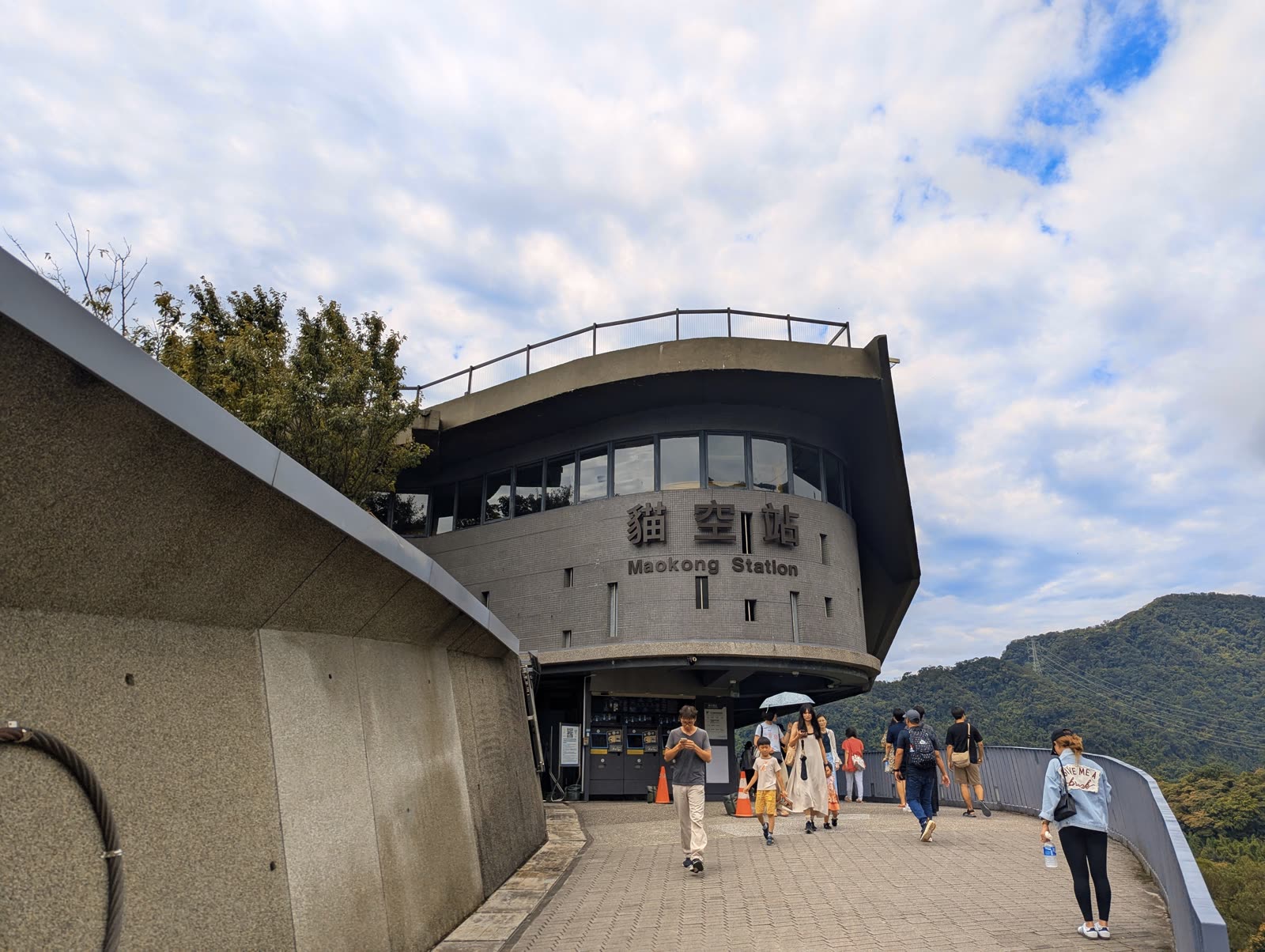
The cover image captures the right recognition cue. It is a July 26, 2025 documentary photograph of Maokong Station, the point where most first-time visitors pause, photograph the platform, and drift toward the nearest tea terrace.[10] The better move is to treat the station as a transfer, not a finale.
Anchor 1: ride the gondola as transport, not spectacle
The line itself is already a good piece of Taipei infrastructure. The Maokong Gondola is 4.03 kilometers long, has four stations, and usually takes about 20 to 30 minutes one way; the operating regulations give a wider technical band of 17 to 37 minutes depending on system speed.[1][4] If you start at MRT Taipei Zoo Station, the walk to Maokong Gondola Taipei Zoo Station is about 5 minutes, which makes this one of the cleanest city-to-hills transitions in Taipei.[7]
The mistake is to over-romanticize the ride and under-plan the ticket. The current fare table is plain: NT$180 for a single journey, NT$300 for a one-day pass with unlimited rides, and NT$50 extra per person if you upgrade to the glass-floor Crystal Cabin; regular cabins hold 8 people and crystal cabins hold 5.[3] That pricing nudges a simple rule. If you are doing one up-and-down run with a walk in between, the single ticket is enough. If you know you will add a second ride or loop more aggressively, the day pass becomes the cleaner choice.[1][3]
Maokong also works because it is not only a lookout. Taipei Travel's own background material still frames the district through tea. This was once the city's biggest tea-growing area, shaped by late-nineteenth-century migrants from Fujian's Anxi region, and the hills still produce more than 60 tons of tea a year.[7] That agricultural afterlife is exactly why the outing improves when the ride ends in a trail instead of a restaurant table.
Anchor 2: Zhangshu Trail is the decompression chamber
Zhangshu Trail is the right second anchor because it changes the pace without demanding a full hike. Taipei Travel describes it as a path originally used both for moving local produce and for walking, with a gentle grade suitable for all ages.[5] Local trail writers keep landing on the same practical description: this is the soft route in Maokong, roughly 1.2 kilometers, essentially stair-free, and easy to reach from the gondola side.[8][9]
The time-and-distance logic is strong. A recent UDN Taipei outing note places the trail about a 5-10 minute walk from Maokong Station.[8] Once you are on it, the next extension points are simple rather than fussy: Zhangshan Temple is listed at 1.05 km from the trail page, and the Taipei Tea Promotion Center for Tie Guanyin Tea and Baozhong Tea sits 723 m away.[5] If you need a short route that still feels specific to Taipei, this is enough structure.
Seasonality is part of the local rhythm, but it should guide timing rather than dominate the day. Taipei Travel's Wenshan hiking itinerary flags January to February, May to June, and September to October as the flower windows for Zhangshu Trail.[4] Local 2025 coverage around lupines and other flower runs confirms that these seasonal bursts pull people uphill fast.[8][9] On those weeks, the clean move is to value flow over novelty: regular cabin if the crystal queue is long, straight walk from the station, trail first, tea second.
8 local moves that materially improve the run
First, start from MRT Taipei Zoo Station and budget the 5-minute transfer walk deliberately. Maokong feels smoother when the ride begins as part of a metro-to-hills chain instead of a taxi drop-off.[7]
Second, use the ticket that matches the shape of the day. One ride up and one ride down points to the NT$180 single ticket; extra loops or a weather hedge point to the NT$300 day pass.[1][3]
Third, treat the Crystal Cabin as optional, not default. The glass floor costs NT$50 extra per person and the cabin only carries 5 people, which makes it the easiest place to burn time on busy flower weeks.[3][8][9]
Fourth, stay on until Maokong Station unless you specifically want the Zhinangong stair-and-temple route. For this ritual, intermediate stops only dilute the clean city-to-trail transition.[4][7]
Fifth, walk straight to Zhangshu Trail once you exit the station. Local coverage and Taipei Travel agree that the useful threshold is close: about 5-10 minutes from the station to the trail zone.[5][8]
Sixth, keep the trail as a gentle loop rather than a performance hike. Zhangshu exists because produce once moved through it; it works best when you walk it at rural speed.[5][9]
Seventh, use the same-day Maokong Tour Bus transfer when weather, knees, or timing start fighting you. Passengers who ride the gondola can transfer for free on the same day, and the right-line bus stops at the North Entrance of Camphor Tree Trail, Zhangshan Temple, and other easy continuation points, with 10-15 minute weekday frequency and 7-10 minute weekend frequency before the late-evening taper.[6]
Eighth, check the closure calendar before you leave the city center, not after you reach the station. On this exact publishing date, the next routine suspension is Monday, March 30, 2026, followed by the rope-cut work in mid-April and the long annual inspection block beginning June 8, 2026.[2]
Non-local trapline: 3 common mistakes and better alternatives
Mistake 1: paying for the crystal cabin by reflex
Better move: pay the extra NT$50 only when the queue is short and the transparent floor is genuinely the reason you came. Most first visits gain more from getting onto the hill faster and spending that time on the trail.[3][8][9]
Mistake 2: treating Maokong Station as the destination
Better move: use the station as a transfer point. The outing sharpens once you turn the platform arrival into a 5-10 minute walk toward Zhangshu Trail.[5][8]
Mistake 3: arriving without checking the maintenance calendar
Better move: read the official suspension list before departure. In Maokong, one missed calendar detail can flatten the whole day.[1][2]
Concrete go details
- Best structure: gondola first, trail second, tea or temple third if you still have energy.[4][5][7]
- Ride length: about 20-30 minutes one way; technical operating band 17-37 minutes.[1][4]
- System size: 4.03 km, 4 stations.[4]
- Opening window: 09:00-21:00 weekdays; 09:00-22:00 holidays.[1][2]
- Current must-know closure dates from the official bulletin: March 30, 2026; April 13-17, 2026; June 8-28, 2026.[2]
- Ticket reality: NT$180 single, NT$300 one-day pass, NT$50 crystal-cabin surcharge per person.[3]
- Queue/reservation reality: no reservation layer; the real decision is whether the crystal-cabin line is worth your time.[3][8][9]
- Walk threshold from Maokong Station to Zhangshu Trail: roughly 5-10 minutes.[8]
- Trail character: gentle, all-ages, and locally remembered as the easy Maokong path; local writeups place it around 1.2 km.[5][9]
- Short extension options: Zhangshan Temple 1.05 km or Tea Promotion Center 723 m from the trail listing.[5]
- Backup mobility option: same-day free transfer to the Maokong Tour Bus after riding the gondola.[6]
Taipei has many harder climbs and many more famous viewpoints. Maokong earns its place differently. It gives you a clean city-to-hill transfer, a tea-growing backstory that still lives in the landscape, and one trail that is gentle enough to make the whole outing feel like a local rhythm instead of an excursion project.[5][7]
Sources
- Maokong Gondola, "Stipulations for Operation Service of the Maokong Gondola System" - opening hours, Monday maintenance rule, running speed, running time, and ticket-use framework.
- Maokong Gondola, "Hours of Operation" - weekday/holiday hours and the announced 2026 suspension dates including March 30, April 13-17, and June 8-28.
- Maokong Gondola, "Fares" - NT$180 single ticket, NT$300 day pass, crystal-cabin surcharge, and cabin capacities.
- Taipei Travel, "Mountain and Forest (Wenshan District): A Quiet Hiking Tour through Wenshan" - 4.03-km system length, four stations, 20-30 minute ride, and Zhangshu seasonal flower windows.
- Taipei Travel, "Maokong Zhangshu Trail" - trail character, all-ages suitability, 24-hour access, and nearby-distance cues for Zhangshan Temple and the Tea Promotion Center.
- Maokong Gondola, "Maokong Tour Bus" - same-day free transfer after gondola use, right-line stops, and operating frequency.
- Taipei Travel, "That's the Tea: How to Spend a Perfect Day in Maokong" - 5-minute MRT-to-gondola transfer, tea-history background, and Maokong's continuing tea production.
- UDN Travel, "2025貓空、指南宮山林漫遊!粉色櫻花、金黃魯冰花盛開美景一次收藏" - current local routing note that places Zhangshu Trail about 5-10 minutes from Maokong Station.
- pou阿寶的部落格 on PIXNET, "貓空 樟樹步道魯冰花..." (2025-03-03) - local walking note describing Zhangshu Trail as a gentle, stair-free 1.2-km route and logging the entrance and loop pattern.
- Wikimedia Commons, "File:2025.07.26 Maokong Station.jpg" - documentary photograph used for the cover image.
Editor’s Pick Review
This piece takes today’s merged standard/add-on editor-pick slot because it wins the 24-hour pool on execution quality where city-travel pieces usually break: it keeps a tight two-anchor structure, grounds decisions in official operations plus local-route evidence, and carries concrete timing, fare, transfer, and closure numbers all the way into a usable outing sequence. The cover visual stays strictly within the updated image policy—immersive, place-specific, and documentary—with no analytical fallback assets. The Chinese version also preserves the same decision spine with natural cadence, stable term mapping, and clear local-context transitions, so bilingual readability stays high without losing precision.