Do Split in the wrong order and it becomes a cruise-port blur: Riva first, photos second, palace lanes third, lunch wherever the crowd has already settled. The cleaner move is smaller and earlier. Enter Diocletian's Palace before the day fully loads, stand in the Peristyle long enough to understand it as a working room, then exit to the Riva only after the stone has reset your pace.[1][3][4][5]
This is a non-food street microcosm even though cafes and restaurants will keep trying to become the story. The point is the handoff between two public rooms. The first is ancient, inward, and vertical: columns, steps, cellars, cathedral tower, tight passages, apartments, laundry, tour groups, and residents sharing the same inherited shell. The second is open, flat, and maritime: palms, port light, promenade traffic, ferry noise, terrace seating, and the wide Adriatic edge directly outside the palace wall.[1][4][5]
The reason to begin inside the palace is historical but also practical. UNESCO describes the protected site as a historic complex where the ruins of Diocletian's Palace, built between the late third and early fourth centuries, remain throughout the city, with later medieval, Gothic, Renaissance, and Baroque layers folded into the same urban fabric.[1] That is the key local fact. You are not visiting a sealed ruin with a single entrance and exit. You are walking through a city center that absorbed an imperial retirement compound and kept living inside it.
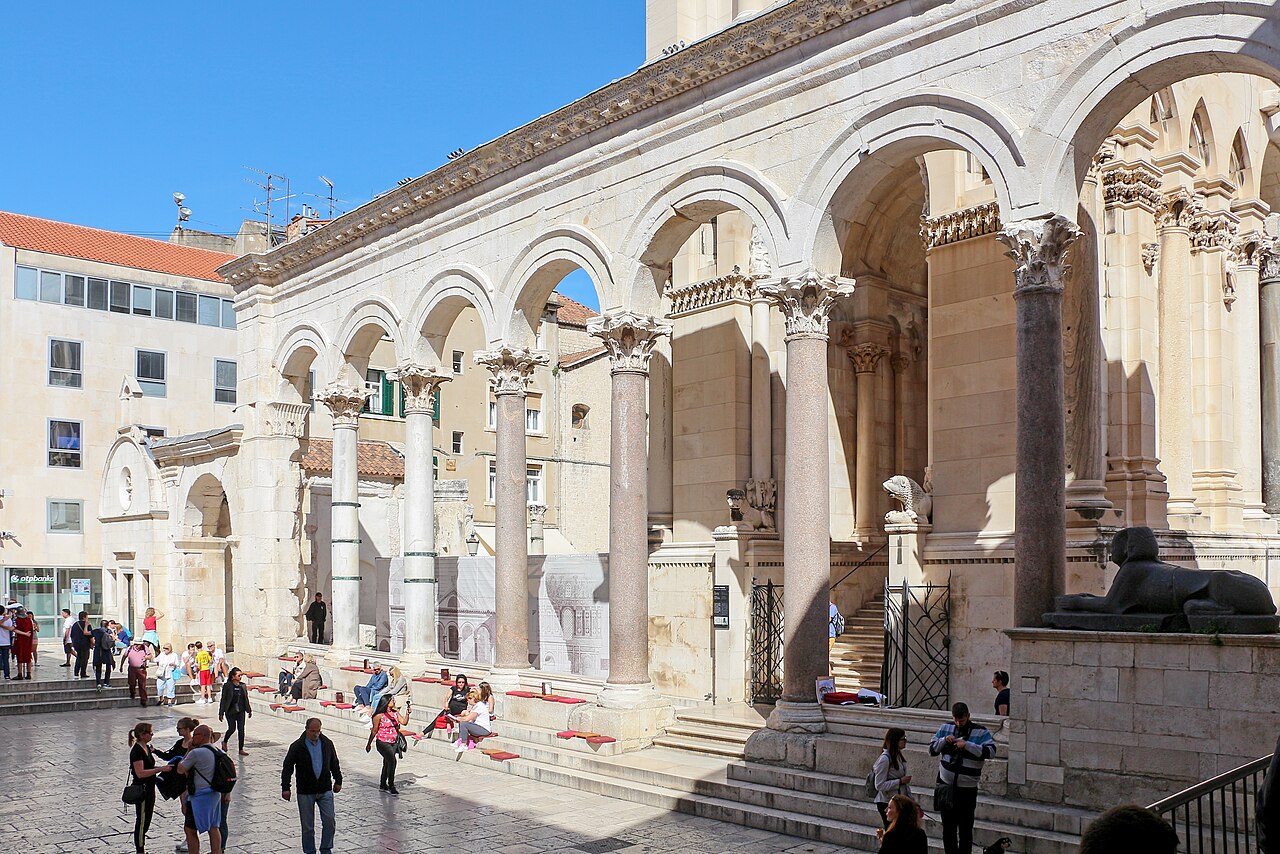
The Peristyle is where that becomes visible fastest. Britannica's palace overview helps explain the scale of the inheritance: Diocletian's retirement complex is the main part of the UNESCO site and one of the great surviving examples of Roman palatial architecture.[2] The photograph used for this article shows why the space works at street level: not as an empty archaeological court, but as stone steps, arcades, cafe tables, people, shadow, and passage routes all pressed together.[8] If you arrive before the strongest tour wave, the square still has enough silence between movements to read the architecture before it turns into a queue backdrop.
Use 07:15-08:45 as the best first window in warm months. You do not need every paid site open yet. The inhabited palace fabric is accessible as city space, while individual attractions run their own hours; Visit-Croatia's current guide notes that the palace complex itself has no ordinary opening or closing time because it is the historic center, while paid interiors such as the cathedral, bell tower, and cellars use separate schedules.[5] That means the early route is not about beating a ticket office. It is about seeing Split before the Riva-to-Peristyle flow hardens.
The route should stay short: 60 to 75 minutes if you are disciplined. Start from the Bronze Gate/Riva side if you are arriving from the port or bus station, pass through the southern palace threshold, come up toward the Peristyle, pause, then loop through one or two side lanes before returning to the waterfront. A licensed local Split guide's 2026 cruise-stop advice gives the scale clearly: the main cruise port is roughly 500 metres, or 5-10 minutes on foot, from the old town along the Riva, and the palace is the highest-value use of a short stop because it is right there rather than inland somewhere else.[3]
That convenience is also the trap. When everything is five minutes away, visitors start treating the whole center as one frictionless object. Do not. The first local move is to stand at the edge of the Peristyle before entering the middle. Let other people cross. Watch where guides gather, where cafe seating occupies the steps, where the cathedral side pulls attention, and where the narrow lanes release pressure. If you step straight into the center for a photo, you become part of the clog you were trying to avoid.
The second move is to use the palace as lanes, not as a checklist. The full historical complex rewards wandering, but this route is not trying to finish Split. Choose one short inner loop and keep enough attention for the waterfront handoff. The third move is to delay coffee until after the first palace pass. A terrace can be pleasant, but sitting too early lets the square perform at you while you stop learning its movement.
The fourth move is to exit toward the Riva once you understand why the palace opens south. Absolute Croatia's recent Riva guide is useful because it describes the promenade in spatial terms: a public waterfront directly in front of Diocletian's Palace, about 250 metres long and 55 metres wide in its central space, free to use, and best in early morning or around sunset.[4] The Riva is not a separate attraction. It is the palace's public exhale.
The fifth move is to walk the Riva once before choosing any seat. Keep the palace wall and facades behind you, the harbor in front, and the ferry/port movement to one side. If you sit immediately, you risk reducing Split to a menu. The sixth move is to treat Riva prices and behavior as part of the local contract. Use the Riva's live map and review surface as a status check, not as a command to sit at the first terrace with a harbor view.[7] That is the difference between using the city's main room and behaving as if it were a resort corridor.
The seventh move is to keep early morning and late evening separate in your head. Morning is for spatial clarity. Evening is for social density. The Peristyle's live map and review surface is useful for same-day status, but it should not design the walk for you.[6] For this specific route, borrow the principle: early Split is not empty; it is readable.
The eighth move is to avoid making the Riva your food plan by default. If you want a meal, choose it after the walk, preferably one or two lanes inland, where the old town's smaller scale returns. The Riva is better as a promenade, meeting point, and orientation plane. It is not where this route should spend its budget.
The non-local trapline is straightforward. Trap one: starting with a Riva terrace because the sea is right there. Better: palace first, Riva second, so the waterfront feels like a release rather than a waiting room.[4][5] Trap two: treating the Peristyle as a ruin photo. Better: stand aside and watch how residents, cafe staff, guides, musicians, and visitors share one inherited square.[2][6][8] Trap three: assuming all crowd pressure comes from "tourists" in the abstract. Better: check your own timing. Cruise visitors can walk from ship to palace in minutes, so midmorning compression is built into the geography.[3] Trap four: trying to solve Split with one giant route. Better: make this a narrow threshold walk and leave Marjan, beaches, museums, or ferries for another block of the day.
Expected spend for the core route is EUR 0. Add money only if you choose a paid interior, coffee, or a later meal. Queue reality is low if you only walk the public palace fabric and Riva; it rises when you add the bell tower, cathedral, cellars, or a group tour.[3][5] Where to stand: at the Peristyle edge first, not in the center; on the Riva, pause near the palace-facing side before committing to a waterfront seat. Navigation cue: Bronze Gate / Riva edge -> palace threshold -> Peristyle edge -> short lane loop -> Peristyle return -> Riva full pass -> leave inland or onward by port.
The city-specific texture is that Split refuses the normal separation between monument and daily life. UNESCO's protected-area language, Britannica's architectural frame, local cruise-stop timing, Riva coffee culture, current place-status surfaces, and the Peristyle photograph all point to the same conclusion from different angles: the valuable thing is not that Split has Roman remains near the water. It is that the city still uses those remains as streets, courtyards, shortcuts, backdrops, and meeting rooms.[1][2][3][4][6][7][8]
End on the Riva, but do not let the Riva overwrite what came before it. Look back at the palace side once before leaving. The best version of this short walk makes Split feel less like a pretty Adriatic stop and more like a city with one unusual operating system: palace first, waterfront second, daily life running through both.
Sources
- UNESCO Multimedia Archives, "A Town Founded on A Roman Ruin: Historical Complex of Split with the Palace of Diocletian" - official UNESCO page carrying the World Heritage description of the palace ruins and later urban layers.
- Encyclopaedia Britannica, "Palace of Diocletian" - overview of the palace's construction, retirement-palace function, UNESCO status, and architectural significance.
- Ana Marendić / Time Walk Split, "Cruise Stop in Split: What to Do in 4-8 Hours (2026 Guide)" - recent local licensed-guide advice on port distance, palace priority, Riva approach, and short-stop timing.
- Absolute Croatia, "Split Riva Promenade: Waterfront Guide + Local Tips" - recent guide to the Riva's public role, location, approximate dimensions, free access, and best timing.
- Visit-Croatia.info, "Diocletian's Palace - Tickets, opening hours and useful info" - current practical guide to palace access, paid-site hours, crowd timing, and approach gates.
- Google Maps, "Peristyle Split Croatia" - current community-review and place-status surface for the Peristyle area.
- Google Maps, "Riva Split Croatia" - current community-review and place-status surface for the Riva promenade.
- Wikimedia Commons, "File:Diocletian's Palace - Peristyle.jpg" - documentary photograph by Bernard Gagnon, taken April 28, 2019, used for the article image.