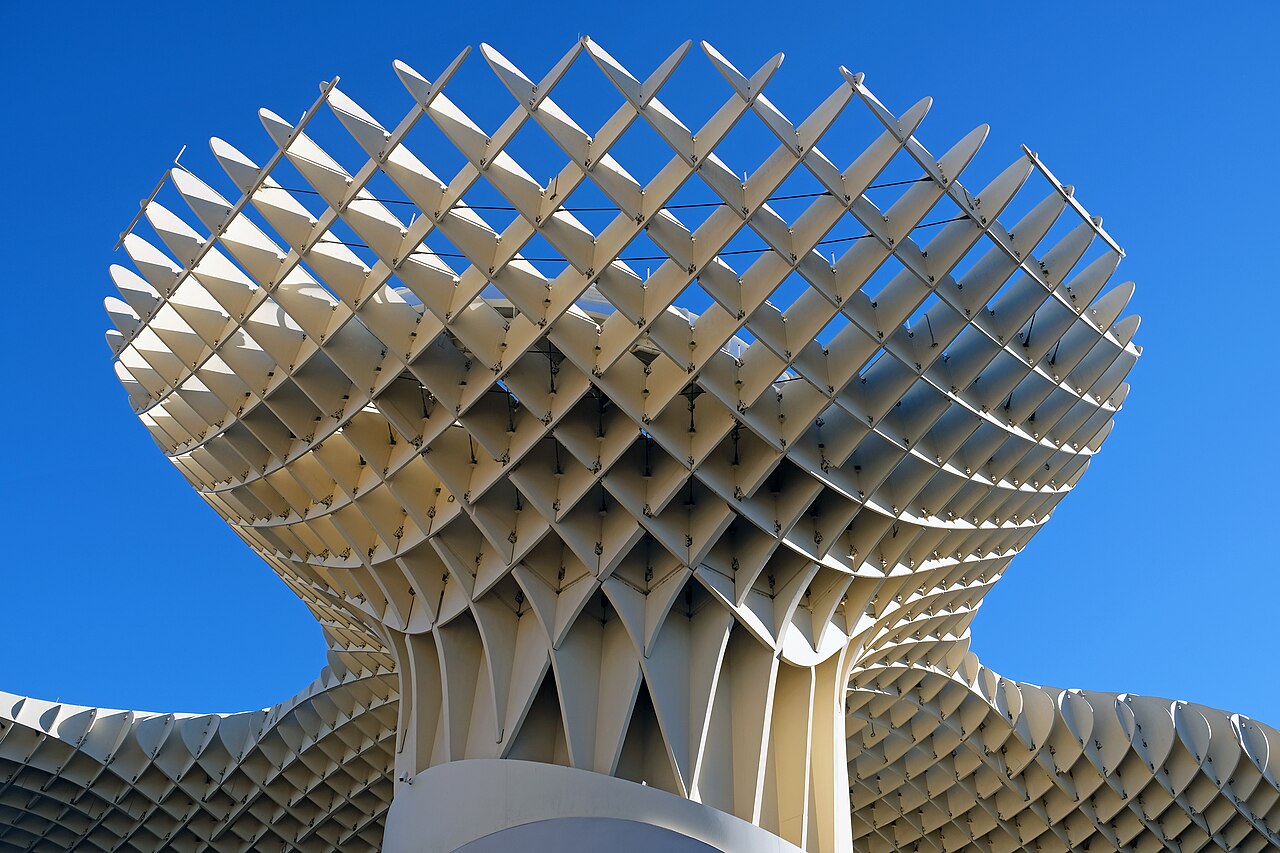
Seville has grander monuments than this, but not many places that explain the city so quickly once you read them in the right order. Plaza de la Encarnacion works best as a vertical stack: first the Antiquarium below grade, then the market layer that still keeps local hours, then the Setas roof loop once the light starts helping instead of flattening everything.[1][2][3][4] The complex is official modern Seville and old Seville at the same time. The tourism board's current page, published in April 2026, describes it as a contemporary icon inaugurated in 2011, designed by Jürgen Mayer, and built around the market, the underground archaeological museum, and the panoramic viewpoint.[1]
That order matters because visitors keep treating the Setas as one isolated selfie machine. The stronger reading is civic and layered. The same tourism page says the complex joins the traditional Encarnacion Market, the Antiquarium with Roman and Andalusian remains uncovered during construction, and the elevated 360-degree viewpoint into one single urban renewal project.[1] Setas de Sevilla's own monument page adds the historical weight under your feet: the Antiquarium preserves the city's largest Roman-era remains site, with material from the 1st century.[4] Once you know that, the square stops behaving like a detachable attraction and starts behaving like Seville in section.
Local guidance sharpens the timing. Visita Sevilla's practical notes say the market on the ground floor is not open in the afternoons, while Setas de Sevilla's official hours keep the upper levels open every day from 09:30 to 00:30, with last entry at 23:45.[1][2] That creates a very useful split that most first-time visitors miss. Morning lets you hold market, archaeology, and roof in a single clean run. Evening lets you use the structure for air, distance, and skyline once the daytime market function has already ended.[1][2][5]
The square's neighborhood seam matters too. A local Seville guide from Singular Apartments describes Encarnacion as a lived-in hinge between the old core and Alameda de Hercules, and it is very direct about the Setas: locals call them that colloquially, and the best moment to go up is around sunset, when the city changes color and the heat loosens its grip.[5] That is the right practical correction to the official monument language. The Setas are not only something to see. They are something to time.
Image context: the cover uses a real Wikimedia Commons documentary photograph of the Setas structure itself.[7] It belongs here because the article's main claim is architectural before it is touristic: this square becomes useful once you understand the canopy as a recognition device for three different layers of city life, not as a decorative roof over a plaza.
Why this Seville stack works better than treating the Setas as one quick lookout
The first advantage is compression. The current Visita Sevilla page gives you almost the whole thesis in one paragraph: market, archaeology, and viewpoint all share one address, and the structure rises only 26 metres while stretching 150 metres across the square.[1] Those numbers matter because they explain why the stop feels bigger than it is. The Setas cover enough ground to change the neighborhood without requiring a whole half-day monument campaign.
The second advantage is that the square still obeys local working rhythms. Official information from Visita Sevilla says the market runs Monday to Saturday from 08:00 to 15:00.[1] The Setas official site keeps the upper structure available much later, all the way to 00:30 with the 23:45 cutoff.[2] That means one layer of the place is still about errands, produce, and daytime circulation, while another layer is built for the long view after the sun drops. If you arrive at 16:30 expecting the whole complex to feel equally alive, you are already half a step off the city's rhythm.
The third advantage is access. Setas de Sevilla's own directions page says that if you come from Sevilla Santa Justa, the complex sits about a 20-minute walk away, and if you come by bus the useful destination is Calle Larana / Imagen, with Line 27 leaving you a 1-minute walk from the square.[3] That is exactly the kind of detail that changes outcomes. The Setas are central enough that you do not need to spend taxi money or mental energy solving the approach. The right move is to arrive on foot with the neighborhood already unfolding, not to materialize at curb level and wonder where the actual entry logic begins.
Read the square bottom to top, not top to bottom
Start with the lower layer whenever you can. Visita Sevilla's practical advice says access to the viewpoint is handled on the ground floor, while the actual route up begins on level -1, beside the Antiquarium and ticket office.[1] This is a surprisingly important detail. It means the complex asks you to acknowledge the archaeological layer before it lets you turn the city into a panorama.
That bottom-first order also keeps the square's history from feeling like an appendix. Setas de Sevilla's history page notes that the site grew out of the demolition of the old Encarnacion market and the later selection of Jürgen Mayer's Metropol Parasol design, which took inspiration from Seville's ficus trees and cathedral vaults.[6] The tourism board version is cleaner but says the same essential thing: what looks futuristic at plaza level is also the result of excavation and replacement inside one of the old center's most contested sites.[1][6]
Once you go up, the value is not simply "a nice view." The current local Encarnacion guide makes the more useful point: around sunset, the roof gives you color shift, relief from street-level heat, and a clearer sense of how the old center spreads beyond the square.[5] That is why a late window around 20:45-23:00 usually beats a flat mid-afternoon climb. You are not only buying altitude. You are buying timing.
8 local moves that make this stop work
First, use the square as a sequence, not a single queue. Start with the Antiquarium and only go up once you have decided whether this is a market-hour visit or an evening view visit.[1][2][4]
Second, do not show up in the late afternoon expecting the market to animate the plaza. Official tourism guidance is explicit: the Encarnacion Market is not open in the afternoons, and its published hours are 08:00-15:00, Monday through Saturday.[1]
Third, if you want the full three-layer version, arrive near opening. The roof opens at 09:30, which lets you combine the market's active morning window with the quietest circulation on the upper walkways.[1][2]
Fourth, buy or resolve your ticket downstairs before you drift into photo mode. Visita Sevilla says the ticket is bought on the ground floor and that viewpoint access starts on level -1 next to the Antiquarium.[1]
Fifth, if you are coming from Santa Justa, just walk it. The official directions page gives the route a simple scale: about 20 minutes on foot.[3] In Seville's center, that is often cleaner than waiting for a transfer just to save a few blocks.
Sixth, if you are approaching by bus, think in terms of Larana / Imagen, not a vague old-town drop-off. The same official page points to Line 27 and a 1-minute walk from the stop.[3]
Seventh, treat sunset and late evening as different products. The local Encarnacion guide favors sunset for color and atmosphere, but the official final-access rule gives you a second, quieter band after that, all the way until 23:45.[2][5]
Eighth, save your longest pause for after the roof, at plaza level facing the neighborhood seam rather than the ticket zone. The local guide is right that Encarnacion only makes full sense once you let it connect onward toward Calle Regina and Alameda de Hercules.[5]
Non-local trapline: 4 common mistakes and the better move
Mistake 1: taking the lift up first and leaving without touching the lower layers
Better alternative: begin with the Antiquarium side of the complex, because the whole point of this square is that archaeology and viewpoint share one vertical route.[1][4]
Mistake 2: arriving after lunch and wondering why the market layer feels dead
Better alternative: respect the published market window of 08:00-15:00 and split your visit accordingly: morning for the market, evening for the roof.[1][2]
Mistake 3: assuming the entry decision happens at the top
Better alternative: buy or settle the ticket on the ground floor and remember that access to the viewpoint begins from level -1 beside the Antiquarium.[1]
Mistake 4: treating the Setas as detached from the neighborhood around it
Better alternative: use Encarnacion as a hinge, not an endpoint. The square reads better once you let it open toward Regina and the Alameda side instead of snapping a roof photo and disappearing.[5]
Concrete go details
- Best time window: 09:30-11:00 for the full bottom-to-top version while the market is still active, or 20:45-23:00 for the stronger light-and-air version before the 23:45 final access cutoff.[1][2][5]
- Expected spend: EUR 16 general admission for the full Setas experience, EUR 13 if you qualify for the reduced ticket; plaza-level browsing without going up costs nothing.[2]
- Queue and reservation reality: this is a same-hour timing problem more than a long-planned reservation problem. The practical decision point is the ground-floor ticket office / level -1 access zone, not the top of the structure.[1]
- Where to stand or sit: keep moving while you are in the ticket-and-lift zone, do your longest pause after the roof loop, and let the square reopen toward the Regina side before you leave.[5]
- Navigation cue:
Sevilla Santa Justa -> Imagen / Larana approach -> ground-floor ticket -> level -1 access by the Antiquarium -> roof loop -> plaza edge toward Calle Regina.[1][3][5] - Numeric anchors worth keeping: 2011, 1st century, 26 metres, 150 metres, 08:00-15:00, 09:30-00:30, 23:45, 20 minutes, 1 minute, EUR 16, EUR 13.[1][2][3][4]
Seville has older stones and more famous facades, but very few places stage the city's layers this efficiently. Plaza de la Encarnacion works because market routine, buried history, and skyline distance are still forced to share one address. Read it vertically, and the square starts making decisions for you.
Sources
- Visita Sevilla, "Metropol Parasol & Encarnacion Market" (published April 2026; current tourism-board overview, practical tips, market hours, dimensions, and access notes).
- Setas de Sevilla, "Prices & Times" (official opening hours, final-access time, and current ticket prices).
- Setas de Sevilla, "How to get" (official access guidance for Santa Justa, Calle Larana / Imagen, and Line 27).
- Setas de Sevilla, "The monument" (official monument overview and Antiquarium / Roman-remains context).
- Singular Apartments, "The basics of one of the coolest neighborhoods in Seville: the Encarnacion" (local neighborhood guide used for the Encarnacion-to-Alameda seam and sunset timing note).
- Setas de Sevilla, "History and construction" (official project background on the old market site and Jürgen Mayer's winning design).
- Wikimedia Commons, "File: Metropol Parasol Plaza de la Encarnacion 1.jpg" (documentary photograph used for the cover image).
- Google Maps community listing, "Setas de Sevilla, Seville."