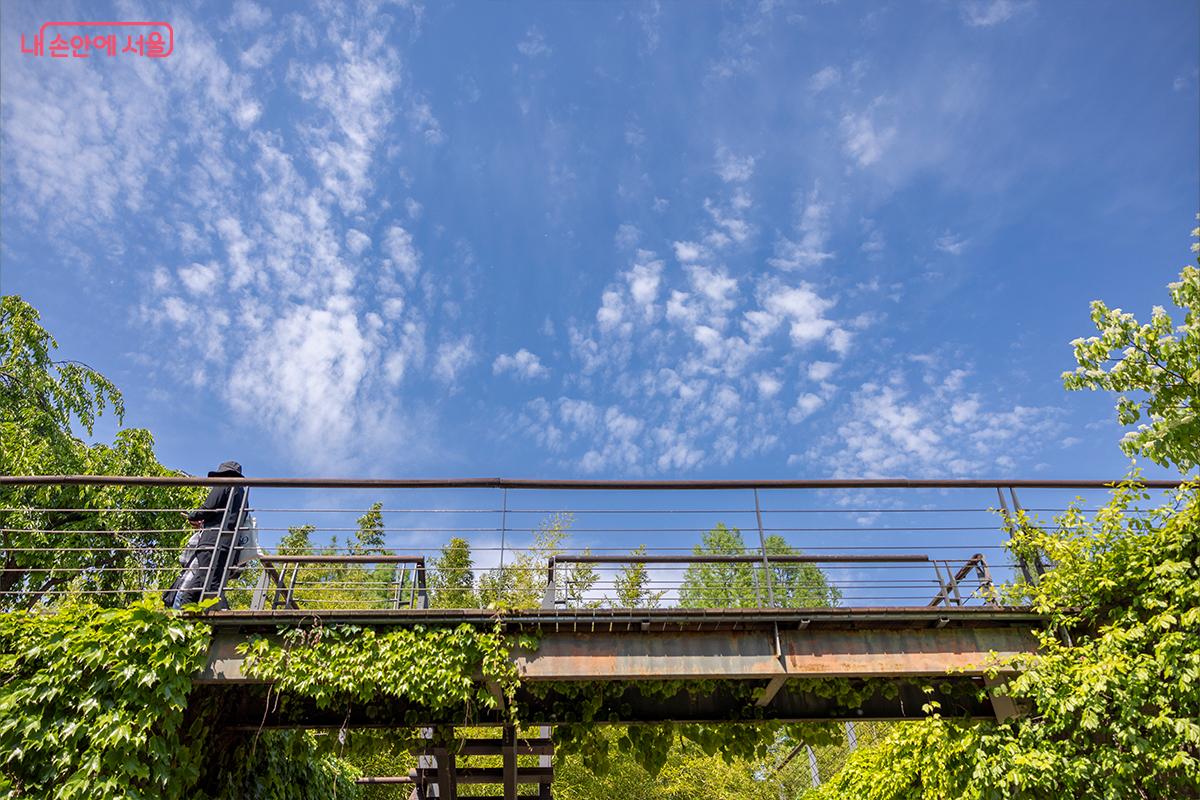
The columns in Seonyudo Park have outlived their ceiling. In this garden on an island in Seoul’s Han River, rows of concrete supports stand open to the sky, with climbing plants taking advantage of the structure. They belonged to a reservoir. Nearby, former treatment basins hold gardens that can be seen from walkways above and paths below.[1] The pleasure of the place is discovering how much a wall changes when you walk down beside it.
Start with that small change in viewpoint. Seonyudo rewards a visitor who pauses over a tank’s edge, then follows the public path into the space they have just surveyed. From above, the planting has a readable arrangement. Lower down, the concrete interrupts the view and the next corner becomes a discovery. Seoul-based writer Hallie Bradley describes precisely this alternation between looking over the old waterways and walking among their ivy-covered walls.[2]
An island that used to be a hill
The waterworks were one stage in a longer transformation. Reporting on a May 9, 2026 guided walk, citizen reporter Jang Sin-ja recounts how the former Seonyubong was quarried and reduced through successive construction projects before becoming the flat island visitors know. From 1978 to 2000, its treatment plant supplied drinking water; the park followed in 2002. Landscape architect Jeong Yeong-seon and architect Jo Seong-ryong retained the plant’s structures as the basis of the new public space.[3]
That history gives the concrete a different weight. These walls were built to contain and process water for the surrounding city. Walking between them now turns infrastructure into something intimate: a boundary beside your shoulder, a frame around a tree, a reason for a path to bend. The garden lets you experience the dimensions of an essential urban service that would ordinarily remain out of sight.
Find the right Seonyudo
Save Seonyudo Park, 343 Seonyu-ro, Yeongdeungpo-gu, Seoul, before setting out. Bradley explicitly warns against confusing it with the coastal island of the same name near Gunsan.[2][5] A search result full of beaches is a cue to check the city, not to plan a ferry ride.
Use Line 9’s Seonyudo Station for the approach. The official Seoul tourism listing, revised July 6, 2026, gives Exit 3 and 782 metres to the park.[4] Allow 15–20 minutes as a comfortable planning margin for finding the crossing and stopping to look; that is an allowance, not a measured walking time. Keep the pedestrian Seonyugyo Bridge as your landmark. SEOUL Magazine describes the garden sequence when arriving from this bridge, while Bradley distinguishes the pedestrian approach from the traffic-side walk across Yanghwa Bridge.[1][2]
Driving onto the island is another avoidable mistake. Bradley recommends public transport; the Korea Tourism Organization specifies that the park’s parking is limited to accessible spaces and directs other drivers to the Yanghwa Hangang parking area.[2][5] Arriving by train keeps the crossing part of the visit instead of making parking its opening problem.
Walk the garden at two heights
In the Garden of Time, also called the Garden of Transition in older English coverage, follow the relationship between the upper walkways and the planting below. SEOUL Magazine’s account describes paths through the former settling basin with walkways built into the old concrete channels overhead.[1] Staying entirely on the upper route gives you an overview but misses the enclosed experience Bradley describes below.[2] Where the public paths permit, see the same section from both levels.
Then find the Garden of Green Columns. The former reservoir’s roof has been removed, leaving the supports in place.[1][3] Stand to one side of a row and look along it: the repetition makes the former building legible. Shift a few steps and leaves begin to break up that order. For a photograph, wait in a wider part of the path so other visitors can move through the view. A person passing between the columns gives their scale more clearly than an empty frame.
Bring the expectation of a garden walk. In a local recommendations thread, a contributor who identifies as a resident praises Seonyudo’s paths and botanical-garden character; another recalls the architecture as the reason they loved visiting while living in Seoul.[6] Treat those accounts as individual preferences. They make a better guide to the park’s appeal than a promise that it will always be empty.
Give the concrete some daylight
My suggested window is 09:30–11:00 on a Tuesday–Friday, with 60–90 minutes on the island. This is a daylight plan that leaves room for an unhurried second look, not a verified quiet-hour forecast. If the columns are busy, continue through the gardens and return instead of forming a photo queue.
Access checked September 22, 2026: the park is open 06:00–24:00 daily. The exhibition hall has a separate schedule: 09:00–18:00, shortened to 17:00 in winter, and closed on Mondays.[4] Visit the hall before the gardens if its displays are important to you; a late park closing does not mean late indoor access.
Budget ₩0 for ordinary admission. This self-guided walk needs no timed ticket; separately organized programs can carry fees, so the free park entry should not be read as a promise about every activity.[5] Bring water, keep the walk simple, and leave a few minutes to look back from the bridge. After moving through the old basins, the island’s greenery has acquired an underlying shape: the dimensions of the waterworks are still there, holding a different kind of city life.
Sources
- Charles Usher, SEOUL Magazine, “Seonyudo Station,” November 6, 2013 — local architectural walk; pedestrian-bridge approach, garden levels and former reservoir columns.
- Hallie Bradley, The Soul of Seoul, “Seonyudo Park: One Of The Best Kept Secrets In Seoul,” updated April 4, 2024 — Seoul resident’s visit account; island-name confusion, public transport and views above and below the old structures.
- Jang Sin-ja, Seoul Metropolitan Government’s citizen-reporter portal, “From a peak where immortals played to an ecological park: Seonyudo Park’s remarkable story,” May 15, 2026 — Korean-language report of a May 9 visit; landscape history, designers and article photograph.
- Seoul Tourism Organization, “Seonyudo Park,” revised July 6, 2026 — official park and exhibition-hall hours, station exit and walking distance; checked September 22, 2026.
- Korea Tourism Organization, “Seonyudo Park” — official address, free general admission, separate program fees and parking restrictions; checked September 22, 2026.
- r/koreatravel, “When my friends visit, this is where I take them,” 2025 — local recommendations and discussion of Seonyudo’s garden paths and remembered industrial architecture.