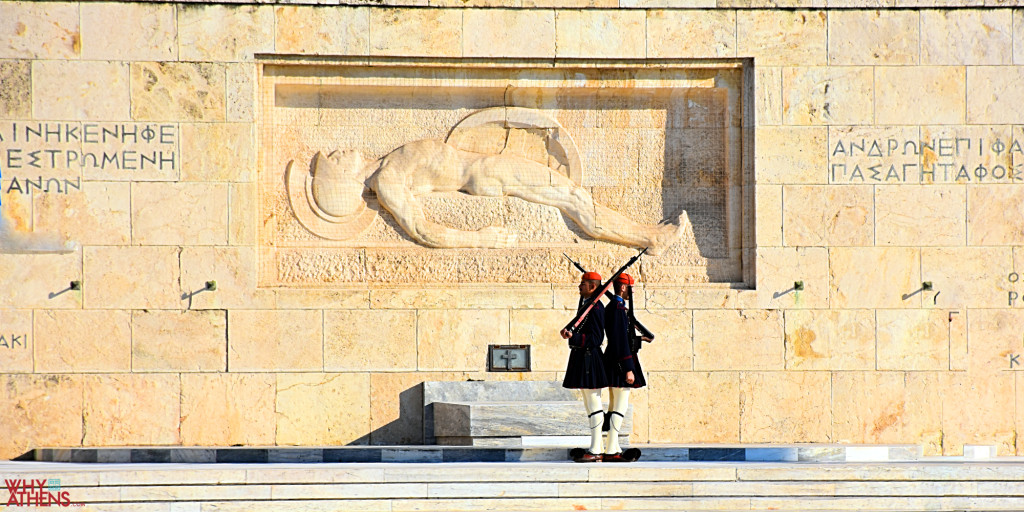
A raised leg, a suspended step, a shoe meeting stone: the changing of the guard at Syntagma asks you to notice movements that an ordinary walk makes invisible. The Evzones’ slow, synchronized march is only half the encounter. The other half is the stillness on either side of it, sustained by soldiers trained to remain motionless at their posts. Arrive before the change and that stillness becomes something you have spent a little time with, rather than a photograph collected in passing.[1][8]
The place matters as much as the uniforms. Beneath the Hellenic Parliament, two sentries keep watch at the Tomb of the Unknown Soldier, inaugurated in 1932 to commemorate Greek soldiers who died in combat without being identified. Look past the guards to the relief of a fallen soldier on the wall. The body in the stone gives the living bodies in front of it their purpose: this is an act of remembrance carried out in public, hour after hour.[2]
Choose the scale of your visit before choosing the time. Athens guide Why Athens distinguishes the change every hour, on the hour, from the Sunday ceremony at 11 a.m., when the procession and military band make the event much larger. Its photographs also show why a visitor expecting the ceremonial white fustanella on every visit may be surprised by seasonal service dress. An ordinary change lets you concentrate on the movements of the pair; Sunday adds the sight and sound of a formation arriving together.[1][2]
For a first Sunday visit, I would aim to reach the viewing area between 10:15 and 10:30 a.m. Athens24’s September 2, 2026 guide recommends a 30–45-minute lead. A December 2025 GreeceTravel community post suggests 10:45 and, usefully, asking police where to watch. Take the earlier window if your view matters; use the community’s question once you arrive. At an ordinary hourly change, Athens24 recommends getting there 10–15 minutes beforehand. Turning up at eleven and then beginning to look for a position spends the best part of the approach negotiating other people’s shoulders.[3][4]
Navigation is simple once the destination is precise: the tomb is on the Parliament side of Syntagma, facing the square. Take Metro Line 2 or 3 to Syntagma; the operator lists an Amalias / National Garden exit as well as exits into the square. Use the Parliament building to orient yourself, then follow the permitted pedestrian approach to the memorial. The station’s name carries another layer of the setting: syntagma means constitution, recalling the 1843 demand for a constitution outside what was then the royal palace. You emerge from a transport interchange into a place where the relationship between people and state has a long, visible history.[5]
There is no admission charge or reservation for watching. The practical queue is the gathering audience, not a ticket line.[3] For an adult making this a short outing from central Athens, allow €0–€2.40 for access and local transport: walk both ways for nothing, or budget two €1.20 urban fares. Each standard ticket is valid for 90 minutes from first validation; the airport journey is excluded. That range covers getting there and back, not refreshments. On Sunday, two separate fares are a more comfortable budget than trying to make the wait, ceremony and return fit one ticket’s validity.[6]
Once there, find a place you can keep without obstructing anyone. Athens24 points to the side sidewalks along Amalias as an alternative to the densest frontal view. Ask the supervising personnel where you may stand and keep the guards’ route clear. A side position can still let you follow the raised leg through to the landing; a tightly packed central position may leave you watching somebody else’s phone. The common mistake is treating the front row as the only successful view. Choose enough room to watch the movement unfold.[3][4]
The person worth noticing next is the accompanying soldier. Athens Insider describes this assistant tending the sentries and intervening when visitors try to distract them for photographs. It is a small detail that changes the scene: the apparent isolation of each motionless guard depends on another person’s attention. Watch for that support rather than trying to become the interruption that finally wins a reaction. A camera can record patience without testing its limits.[7]
Photography is permitted, according to Why Athens, but that does not turn the post into a posing booth.[1] Follow instructions, avoid touching the guards and never cross their marching path.[3] The city’s official account describes handmade uniforms, paired service and special training for the controlled march; it also draws attention to the nailed soles of the shoes. Let the sound pull your attention down from the famous pleats to the feet. Fabric, balance and impact belong to the same carefully maintained action.[8]
Stay long enough for movement to settle back into stillness. Sunday offers a procession worth planning around; an ordinary hour offers the chance to look closely with fewer ceremonial elements competing for attention. Either visit becomes more satisfying when you have watched the pause as well as the change. The memorial remains after the audience begins to leave, and the next watch has already started.[1][2]
Visitor details checked September 23, 2026. Times are local to Athens; follow on-site directions if official events change access.
Sources
- Why Athens, “Changing of the Greek Guards” — hourly and Sunday schedules, seasonal uniforms, photography guidance, and the credited photograph used here.
- This is Athens, “Tomb of the Unknown Soldier” — official city guide to the memorial’s purpose, relief, inauguration and ceremonies.
- Athens24, “Insider Timing and Best Views for the Changing of the Guard in Athens,” September 2, 2026 — recent local confirmation, arrival buffers, free access, side viewing and etiquette.
- r/GreeceTravel, “Recommended itinerary on first Sunday of each month in Athens in winter (all free),” December 1, 2025 — community advice to arrive before the Sunday ceremony and ask police about viewing positions.
- STASY, “Syntagma” — transit operator’s station entrances, connecting lines and account of the square’s name.
- OASA, “Prices of Products” — €1.20 urban ticket, 90-minute validity and airport exclusions; the article’s €2.40 return budget is calculated from two single fares.
- Athens Insider, “To Be an Evzone,” October 26, 2020 — local magazine account of the assisting soldier’s care for sentries and response to distracting visitors.
- This is Athens, “The Greek Evzones” — official city account of stillness, synchronized movement, handmade uniforms, paired service and the sound of nailed soles.