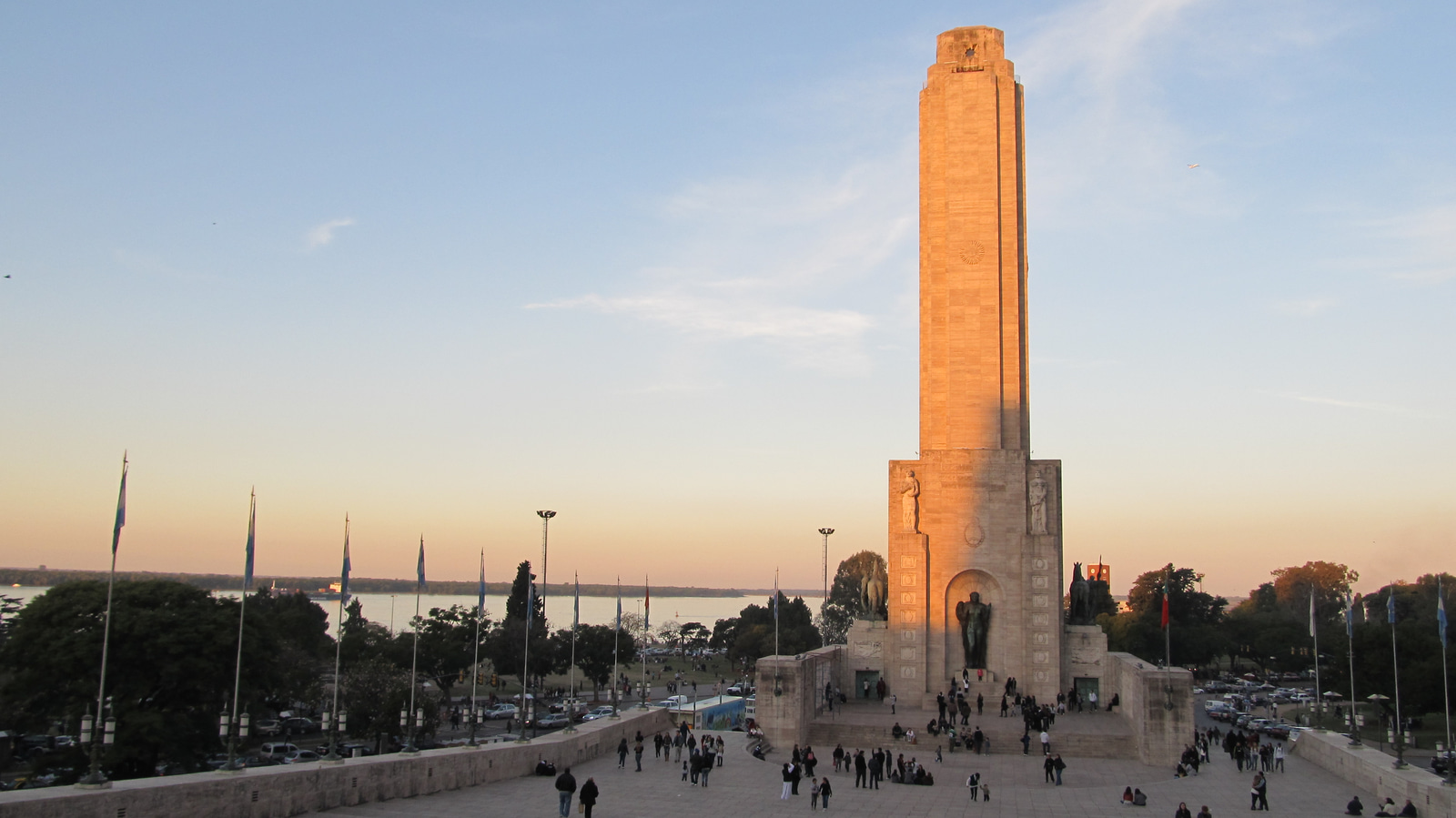
Rosario's National Flag Memorial reopened its tower lookout on June 20, 2026, after months of work on the lift, viewing galleries, doors, and safety rails.[3][4] That makes the obvious move possible again: buy a ticket, rise above the city, take the panorama. It is also the fastest way to misunderstand the monument.
The useful visit begins on the ground, behind the tower. Approach from Plaza 25 de Mayo through Pasaje Juramento, let the long stone axis gather itself, and only then turn toward the lift. From that direction, the memorial stops looking like a large vertical marker beside the Paraná. It becomes what its designers intended: a civic vessel pointed toward the river, with a tower growing from its prow, a courtyard holding the middle, and the Propileo closing the stern.[2]
Give that sequence 75 to 90 minutes. The tower is the visual payoff, but the object is the whole route. Rosario's current visitor page lists the lookout at ARS 2,000, the crypt and Gallery of Honor at ARS 0, and different opening rhythms for weekdays, weekends, and holidays.[1] The best version therefore is not “go up the monument.” It is “walk the ship, then earn the height.”
Why the stone points toward the Paraná
The site carries two different dates. On February 27, 1812, Manuel Belgrano raised the new Argentine flag near the Libertad battery on this riverbank. The memorial that now fixes that event in stone came much later: the winning Invicta design was selected in 1940, and the completed complex opened on June 20, 1957.[2] The gap matters. This is not preserved fabric from the independence era. It is a twentieth-century act of national memory placed over an earlier military and river landscape.
Architects Ángel Guido and Alejandro Bustillo, working with sculptors José Fioravanti and Alfredo Bigatti, organized the complex as a longitudinal narrative. The tower rises above a giant symbolic prow facing the Paraná. Behind it, the Civic Courtyard and monumental stair carry the route toward the Propileo, the votive flame, and the Gallery of Honor of the Flags of the Americas. The City of Rosario describes roughly 10,000 square metres of San Juan travertine, while the national monuments authority reads the three-part ensemble as architecture, sculpture, and national history composed together.[1][2]
That sounds grand because it is grand. The local correction is that the space does not remain solemn and empty. Rosario's own page describes the Civic Courtyard as a room for concerts and mass gatherings, and current review surfaces repeatedly note people sitting, talking, and looking toward the river.[1][6] The monument is not merely where the city explains the nation. It is also where Rosario gives a crowd somewhere to become visible.
The June restoration sharpened both roles. Local reporting documented renewed viewing platforms, restored bronze doors, a modernized lift, and safer stainless-steel barriers; the lookout returned with four viewing positions and a lift holding 10 people.[3][4] The result is not a new attraction pasted onto an old memorial. It restores the final movement of the original object: ground, prow, tower, horizon.
Nine moves that make the object legible
1. Enter from the city, not from a car at the river edge. Start at Plaza 25 de Mayo and take Pasaje Juramento between the Cathedral and the Palacio de los Leones. This puts the monument at the end of a civic corridor instead of dropping you beside an unexplained tower. The navigation cue is simple: Plaza 25 de Mayo -> Pasaje Juramento -> Tower and Crypt -> Civic Courtyard -> Propileo -> river edge.[1][2][5]
2. Use the weekday overlap. Tuesday through Friday, aim for 13:00–14:30. The lookout and crypt are open 13:00–18:00 on weekdays, while the Gallery of Honor runs 09:00–18:00 Tuesday through Sunday. Monday is narrower because the gallery does not open until 13:00; weekends split lookout access into 09:00–13:00 and 14:00–18:00.[1] The early-afternoon weekday window removes the one-hour weekend pause and gives every part of the object a chance to be open together.
3. Read the approach before photographing the tower. At the west end of Pasaje Juramento, stop to see how the corridor aligns old civic Rosario with the river-facing monument. Then keep moving; this is a passage, not a portrait studio. One wide photograph is enough. The point is to notice the shift from the intimate passage to the exposed scale of the prow.
4. Separate free access from paid height. The crypt and Gallery of Honor currently cost nothing; the lookout costs ARS 2,000, with free ascent for children under five and people with disabilities.[1] Prices can change, so check the live municipal page on the day. Do not let a tower ticket turn the free rooms into waiting areas. They explain what the height is for.
5. Buy the ascent before the final half-hour. Official ticket sales stop 30 minutes before closing, and the renewed lift carries only 10 people.[1][3] No timed online-reservation system is listed on the city page, so treat the lookout as a same-day, capacity-limited visit: arrive early in the session, ask about the current queue, and do not build the entire day around a 17:29 purchase.
6. Treat the crypt as commemoration, not a tomb. The bronze figure honors Belgrano, but his remains are not here; they rest at the Santo Domingo complex in Buenos Aires.[2] That distinction changes the room. Rosario holds the place associated with the flag's first raising, not the body of its creator. The crypt is one layer in a symbolic ship, not proof that every national story has been gathered into a single site.
7. At the top, look east before you look for yourself. The four restored viewpoints divide the panorama into tasks.[3] Begin with the Paraná and its wetland horizon; then turn back toward the city grid and the straight line of the memorial. This order preserves the reason the prow points where it does. A panorama selfie taken first reverses the relationship: the river becomes background to the visitor instead of the geographic force that organized Rosario.
8. Descend before reading the stern. Return to the Civic Courtyard and walk toward the Propileo after the lookout. From above, the stair and courtyard looked like geometry. At ground level, their scale belongs to bodies, ceremonies, and crowds. Stand to one side rather than in the central route, then find the votive flame and the transition into the Gallery of Honor.[1][2]
9. Let the river release the visit. Exit toward the Paraná only after completing the city-to-river axis. Give the edge 10 quiet minutes, then stop. Local recommendations consistently treat the riverfront as Rosario's connective tissue, but this article has one anchor, not an excuse to absorb the entire costanera into a checklist.[5][6] The monument works because it compresses city, nation, and river into one object; adding five more sights immediately only dilutes that reading.
The visitor trapline
The first mistake is trusting a saved review that says the lookout is closed. Early-2026 community reviews correctly described scaffolding, shut areas, and restoration work; local reporting then documented the lift's return on June 20.[3][4][6] The better alternative is to check the live city page, which now publishes current hours and price.[1] Here, a dated review can be honest and still be wrong for today's visit.
The second mistake is entering at the tower, riding up, and leaving by the same door. That produces a view but erases the composition. Begin at Plaza 25 de Mayo, cross Pasaje Juramento, move through the tower and courtyard, and finish at the river. The direction is editorial: the memorial was designed as an axis, so visit it as one.[1][2]
The third mistake is arriving at 13:30 on a Saturday. The weekend lookout closes from 13:00 to 14:00 even though other parts of the complex have different hours.[1] Either arrive early enough to finish the ascent before 13:00 or make 14:00 the deliberate start. On weekdays, 13:00 is the cleaner all-sections overlap.
The fourth mistake is choosing a major civic date when the goal is quiet architectural attention. June 20 is the memorial's defining public day, and the courtyard is built to receive mass events.[1][2] That can be the right visit if ceremony and crowd are the subject. For the object itself, choose an ordinary Tuesday through Friday and let the stone hold the scale without a stage programme competing for it.
The clean visit, in one card
- Best window: Tuesday–Friday, 13:00–14:30.[1]
- Time budget: 75–90 minutes, including the approach, free rooms, lookout, and river-edge pause.
- Expected spend: ARS 2,000 for one adult lookout ticket; the crypt and Gallery of Honor are free. Confirm the live price before going.[1]
- Queue reality: same-day access, a 10-person lift, and ticket sales ending 30 minutes before closing; no advance public reservation is listed.[1][3]
- Where to stand: begin at the Plaza 25 de Mayo end of Pasaje Juramento; at the top, take the Paraná-facing view first; in the courtyard, keep to the side of the main ceremonial line.
- What to carry: a compact day bag and a payment method accepted at the current ticket desk; leave enough hands free for stairs, railings, and the narrow transition into the lift.
- Fallback: if the lookout closes unexpectedly, keep the visit. The approach, crypt, courtyard, Propileo, Gallery of Honor, and river-facing geometry are the monument's substance, not consolation prizes.[1][2]
Rosario does not need the tower to prove that the memorial is large. It needs the tower to complete a sentence begun at street level. The city narrows into Pasaje Juramento; the passage opens into travertine; the stone becomes a ship; the ship points at the Paraná; only then does the lift turn that direction into a horizon. Go up, certainly. Just do not start there.
Sources
- Municipality of Rosario, "Monumento Nacional a la Bandera" — current official hours, ticket price, free-access areas, address, material, scale, principal sections, and the Civic Courtyard's public use.
- Argentina's National Commission of Monuments, "Monumento Nacional a la Bandera: el legado arquitectónico que honra a Belgrano" (June 20, 2026) — official account of the 1812 site, 1940 design, 1957 opening, ship symbolism, longitudinal composition, artists, and Belgrano's burial place.
- RosarioPlus, "Reabre el mirador del Monumento a la Bandera con nuevas vistas panorámicas" (June 16, 2026) — local reporting on the June 20 reopening, four viewpoints, 10-person lift, access route, renewed barriers, and current admission.
- La Capital, "Obras del Monumento: a partir del 20 de junio se habilita el ascensor para subir al mirador" (June 10, 2026) — local confirmation of the reopening and the restoration context behind the renewed ascent.
- Google Maps, "Monumento Histórico Nacional a la Bandera" — live navigation, place-status, and community-review surface for same-day checks.
- Wanderlog, "Monumento Histórico Nacional a la Bandera" — aggregated recent visitor reports used to distinguish the free ground-level experience, the paid ascent, and restoration-era observations from current post-reopening logistics.
- Wikimedia Commons, "File:Monumento Nacional a la Bandera - vista panorámica.jpg" — source page for IrishHeartbeat's June 10, 2012 documentary photograph used as the article image.