Porto’s Palácio de Cristal begins with a small act of imagination. The name belongs to a glass-and-iron exhibition palace that has disappeared; the dome occupying its place is a later sports pavilion. Porto guide Sara Riobom calls the replacement “the UFO” and describes the city’s lingering attachment to the vanished building.[1] Arrive expecting a surviving glass palace and the first impression will be bewilderment. Arrive for the gardens, and the name becomes part of their story.
The original palace opened for an international exhibition in 1865. Its landscape, designed by Émile David, combined formal gardens with looser woodland and outlooks above the Douro.[1][2] That combination still makes the visit. You move from a composed entrance into shade, then towards terraces where the river changes position beneath you. The pleasure is in letting the view arrive a little at a time.
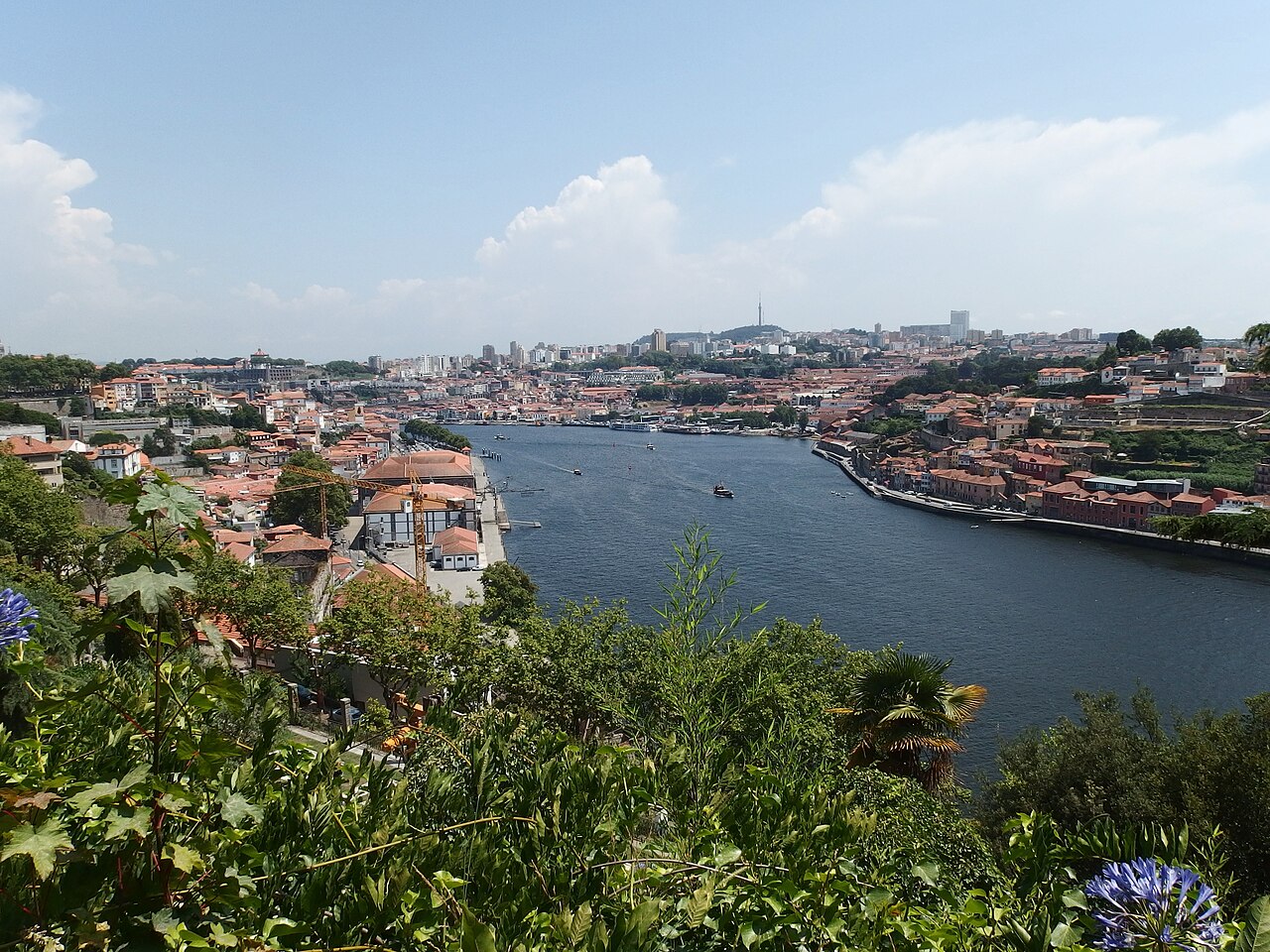
Enter from Rua de D. Manuel II. The Jardim Émile David, with its fountains and statues, is the first garden inside the gates.[2][3] Give it a circuit, then keep going. Porto Secreto’s local guide describes several distinct gardens within the grounds; treating the entrance as the whole visit misses the changes of scale that make the place rewarding.[3]
For a first October visit, I would choose 16:00–17:30, allowing the 90 minutes suggested by Visit Porto for the grounds.[5] This is a suggested daylight window, not a forecast of empty paths or an exact sunset appointment. The municipal parks department lists 08:00–19:00 from October through March, extending to 08:00–21:00 from April through September; these hours were checked on 17 October 2026.[2] Let the seasonal closing time govern how far you wander.
Ordinary garden admission is free, with no sightseeing reservation needed.[2] Set aside €0–5 per person, excluding transport: zero covers the walk; the upper end is an optional personal allowance for a drink or snack, not a quoted café price. Nothing about this afternoon requires a table booking. Bring water and leave enough room in the schedule to sit down when you find a view you like.
Follow the avenue, then look below it
Use Avenida das Tílias, the lime-tree avenue, as your spine through the grounds. Porto Secreto places the Almeida Garrett library, the Concha Acústica bandstand and the Carlos Alberto chapel along this route.[3] They are useful landmarks within the garden. You can follow the avenue without turning every doorway into another appointment.
The Portuguese gardening blog Bucólico Anónimo, written by a regular visitor, offers a more intimate way to read the slope. Just beyond the bandstand, beside the small pond with the horsewomen sculpture, it identifies a viewpoint towards the Douro and the Arrábida Bridge. Farther along, a turn left at the chapel opens another outlook across the lower gardens towards Miragaia, the river and Gaia.[7] Pause at the upper viewpoints before descending. From there, the terraces become part of the scene you are about to enter.
Below, the Jardim dos Sentimentos brings the composition closer to the ground. The same local account describes crossing patterns of Portuguese paving, lawns and Teixeira Lopes’s sculpture Dor.[7] It is worth looking back uphill after reaching a lower terrace: the garden has a vertical dimension that a single river photograph leaves out. Choose one lower section to explore slowly, and reserve 10–15 minutes of your own visit allowance for returning towards the entrance. That is a planning buffer, not a measured walking time for every path.
Stay on open paths and use the viewpoint edges without blocking other people’s passage. The peacocks that feature in Porto Secreto’s account are another reason to slow down; let them pass instead of following them for a closer photograph.[3] A garden shared with birds, readers and people taking a break works best when a visitor leaves room for those ordinary uses.
Make room for an ordinary afternoon
The attraction is still part of Porto’s everyday recommendations. In a 15 September 2026 r/porto discussion, someone arriving alone for a birthday asked for a special afternoon. Several replies suggested these gardens, including a recommendation to enjoy sunset here.[6] These are individual community suggestions, not a guarantee of solitude. Their appeal is that an occasion can be made from a walk and a place to linger.
The third easy mistake, after looking for the vanished palace and stopping at the first garden, is assuming that greenery guarantees quiet. In a June 2026 r/porto discussion about viewing Air Invictus, contributors pointed out that a beer festival would coincide with the aerial event; the original poster then recalled seeing the festival setup.[8] The practical lesson is to check the day’s garden and pavilion programme before planning a contemplative visit. Those June events are past, but the grounds’ capacity to host a crowd remains relevant.
There is no need to make sunset the afternoon’s finish line. Find a seat or an unobstructed place at a viewpoint while you still have time to enjoy it. The exhibition palace once gathered visitors to look at things brought into Porto. Its gardens offer the opposite direction of attention: outward, across the city, from a succession of places where you can stop.
Sources
- Sara Riobom, “The History of the Crystal Palace gardens in Porto,” Portoalities, 15 September 2016 — local guide’s account of the vanished palace, the 1865 exhibition and the pavilion’s “UFO” nickname.
- Câmara Municipal do Porto, “Jardins do Palácio de Cristal,” Ambiente — landscape history, free access, Rua de D. Manuel II entrance and seasonal opening hours; checked 17 October 2026.
- Carolina Bessa, “Conheces os diferentes recantos que compõem os Jardins do Palácio de Cristal?”, Porto Secreto, 26 August 2024 — local guide to the entrance garden, avenue, landmarks and peacocks.
- Palickap, “Porto, vista da Jardim do Palacio de Cristal,” Wikimedia Commons — photograph taken 6 July 2017; CC BY-SA 4.0.
- Visit Porto, “Jardins do Palácio de Cristal” — official destination listing and suggested 90-minute visit; use the municipal parks department’s seasonal schedule rather than the listing’s generic daily-hours display.
- r/porto, “O que fazer no Porto para celebrar o meu aniversário de forma especial? (Amanhã!),” 15 September 2026 — recent local-community recommendations for visiting the gardens and enjoying sunset; anecdotal evidence.
- Konigvs, “Jardins do Palácio de Cristal,” Bucólico Anónimo, 16 October 2016, subsequently edited — regular visitor’s illustrated account of the avenue, viewpoints and lower terraces; used for spatial description, not current access conditions.
- r/porto, “Air Invictus,” 20 June 2026 — local discussion of the beer festival setup and expected crowding during the aerial event; historical event-specific observations, not a current crowd forecast.