The ticket window is worth your attention before the train arrives. On Budapest’s Gyermekvasút, the Children’s Railway, schoolchildren check tickets and carry out guard duties while adults drive the locomotives. Local magazine We Love Budapest makes that division clear: the children have jobs within the railway, and the railway carries passengers through the Buda Hills.[1] Buying a ticket gives you a small part in that exchange. You state a destination; someone works out what you need.
The line has involved children since 1948, according to its operator.[2] That continuity changes how to look at the uniforms and formal procedures. They belong to a Budapest institution that successive generations have learned to operate. Give the transaction its ordinary dignity: address the young member of staff, have your destination ready, and let the work happen at its own pace. The forest can wait a moment.
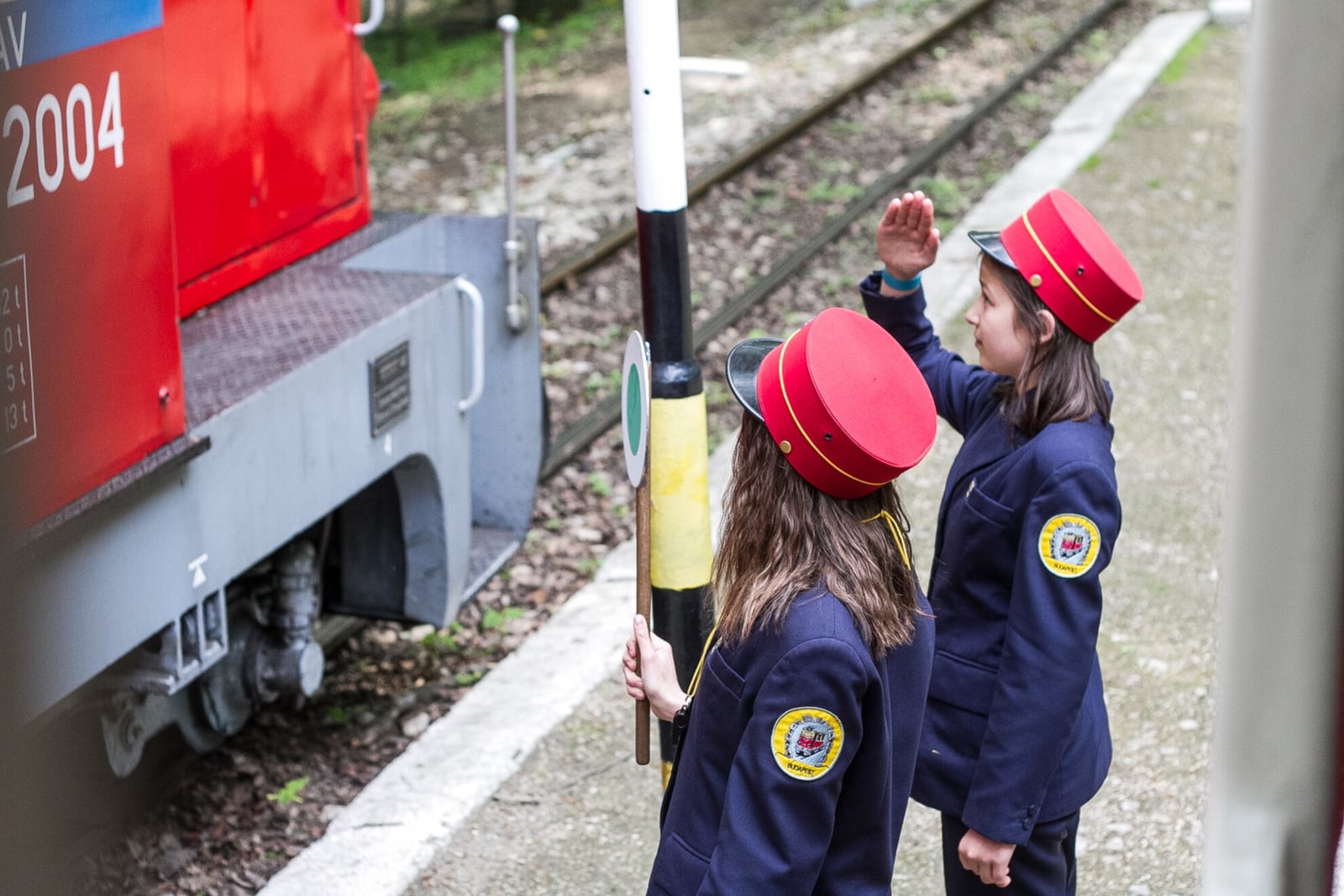
Find the railway above the tram
Hűvösvölgy makes a straightforward starting point. In a local r/budapest discussion, a contributor directs visitors to take tram 61 from Széll Kálmán tér to the terminus, then walk up to the Children’s Railway. BKV, the city transport operator, confirms that tram connection.[3][4] Follow signs for Gyermekvasút after leaving the tram; the tram platform is not your final destination.
For a first visit, I would choose a departure between 10:00 and noon, with 15–20 minutes at the railway station beforehand. Those are planning allowances for finding the ticket office and watching the platform, not measured queue times. The operator puts the end-to-end journey at 40–50 minutes. Allow roughly 2–3 hours at the railway for a ride to Széchenyihegy and back, depending on the selected return service, and add your travel from central Budapest separately.[5]
Open the operator’s calendar for your actual date before fixing that plan. Its regular pattern excludes Mondays from September through April, and the heritage trains have their own dated allocations.[5] A steam locomotive in somebody else’s photograph does not tell you what will haul your train.
The timetable itself rewards a small piece of local instruction. A r/budapest commenter explains how to choose the direction first, locate your departure along the station row, then follow one train’s column to your destination.[3] Reading sideways through successive departure times will not tell you how long your journey takes. For an out-and-back ride, repeat the exercise in the opposite direction before buying the ticket.
What the paper actually buys
A visitor in another local discussion asks whether a Budapest 24-hour transport pass includes this railway. The answer is no; the current operator tariff also excludes city-pass discounts.[6][7] Budget separately even if your tram journey is already covered.
As checked on October 17, 2026, an adult single costs HUF 1,000 for one uninterrupted journey. The HUF 1,800 transfer ticket covers two journeys that day: a return without intermediate stopovers, or a one-way outing broken once. A heritage service adds HUF 400 per adult per journey. For the straightforward return proposed here, budget HUF 1,800–2,600 per adult, excluding city transport and refreshments.[7]
Say whether you intend to return or get off along the way. Buy at the ticket office when it is open. Ordinary tickets are sold on the day, without advance purchase; leave time for the transaction. Bring forint cash, ideally small denominations, as local contributors recommend.[6] Card payment is now advertised at Hűvösvölgy and Széchenyihegy, so older blanket cash-only advice is outdated.[7]
This is where the little ticket earns its place in the visit. A line through the woods invites spontaneous stops, but a ticket describes particular journeys. Work out which kind of freedom you want before stepping aboard.
Watch the work, then the window
Once seated, keep the ticket handy and leave the aisle usable. Watching a young guard complete a task is more interesting when nobody is interrupting it for a photograph. The roles described by We Love Budapest offer a useful way to pay attention: who checks, who gives instructions, who drives.[1] The pleasure is in seeing those separate responsibilities join up into a departure.
Choose an available window seat and let the view arrive in sections. The operator singles out the Panorama Curve between Hárshegy and Szépjuhászné, where the line rounds the slope and the trees open onto Budapest.[8] From Hűvösvölgy, watch for those station names. There is no need to spend the entire ride searching for a skyline; the wooded stretches are part of the experience, and the brief opening feels different because of them.
The same August 2026 notice reports the Elizabeth Lookout closed for renovation.[8] If an old guide tempts you to add a tower stop, check its current status first. For this visit, staying with the railway leaves room to notice its smaller events: the pause at a platform, the ticket inspection, the change from buildings to trees and back again.
Before lingering at the far terminus, check your return departure once more. In a July 2024 r/budapest account, a parent describes arriving in time for a train, delaying without realizing it was the last one, and discovering that no further services remained.[9] Their experience illustrates a very ordinary mistake: treating a timetable as though another departure will always follow.
Back at Hűvösvölgy, the ticket can finally become a souvenir. Until then, it has been a fare, a set of conditions and something another person needed to inspect. That modest sequence is a good reason to ride: for part of an afternoon, a young railway worker knows the procedure, and you are the passenger learning how to follow it.
Sources
- We Love Budapest, “Children’s Railway,” updated November 10, 2023 — local editorial account of the children’s duties and adult drivers, and source of the lead photograph reproduced here; historical fares not used.
- Children’s Railway, Budapest, official introduction — operation since 1948, route and railway context.
- r/budapest, “Alternative to the chairlift/ Getting to Balaton,” July 11, 2024 — community directions from tram 61 and an explanation of reading the timetable by direction and column.
- BKV, “From Hűvösvölgy to Pasarét” — official confirmation of tram 61 from Széll Kálmán tér to Hűvösvölgy.
- Children’s Railway, “Timetables,” updated October 16, 2026 — date selector, seasonal Monday pattern, journey duration and heritage-service allocations; checked October 17, 2026.
- r/budapest, “Children’s Railway and Chairlift Zugliget,” September 2, 2023 — community discussion of the separate railway fare, advance timetable checks and carrying change.
- Children’s Railway, “Prices,” updated September 7, 2026 — single and transfer tickets, heritage supplements, purchase conditions and terminal card acceptance; checked October 17, 2026.
- Children’s Railway, “Closure of the Elizabeth Lookout: Alternative Sights and Spots,” August 16, 2026 — current closure notice and the Panorama Curve between Szépjuhászné and Hárshegy.
- r/budapest, “Best things we did in Budapest with young kids,” July 8, 2024 comment — a parent’s account of missing the final railway departure.