Karura Forest works best when you stop asking it to be Nairobi's little safari. It is not that. The useful first visit is smaller and more local: enter from the Limuru Road gate early, take the marked paths toward the waterfall, add the Mau Mau caves only if your timing still feels loose, then come back before the forest turns into a closing-time problem. That shape gives you Karura as Nairobians actually use it - a breathing room, running ground, family walk, bike loop, memory site, and guarded urban forest inside a city that can otherwise feel all road edge and appointment pressure.[1][2][5]
The official scale is large enough to reset your sense of the city. Friends of Karura describes the reserve as an urban upland forest of about 1,000 hectares, only a few kilometers from central Nairobi, and notes that Kenya Forest Service and Friends of Karura invite visitors to use the forest while helping protect it for future generations.[2] Kenya's national biodiversity clearing-house page gives the more exact figure as 1,041 hectares, identifies Karura as an urban forest reserve or green space, and records management by Kenya Forest Service with Friends of Karura Forest Community Forest Association.[3] The point is not merely that the place is big. It is that the city has a whole green operating system hidden behind ordinary gate mechanics.
The first local move is to arrive early enough that the forest still belongs to routine. Friends of Karura lists opening hours as 06:00 to 18:00, last entry at 17:45, and gates locked at 19:00.[1] A recent Nairobi-focused guide is blunter about the daily rhythm: by 7:30 on a Saturday morning, Karura is already full of runners, cyclists, families, and regulars, while weekday mornings between 7:00 and 10:00 are quieter and cooler.[5] For a visitor, that means the best first window is not a heroic midday hike. It is a morning slot when the forest is awake but not yet hot.
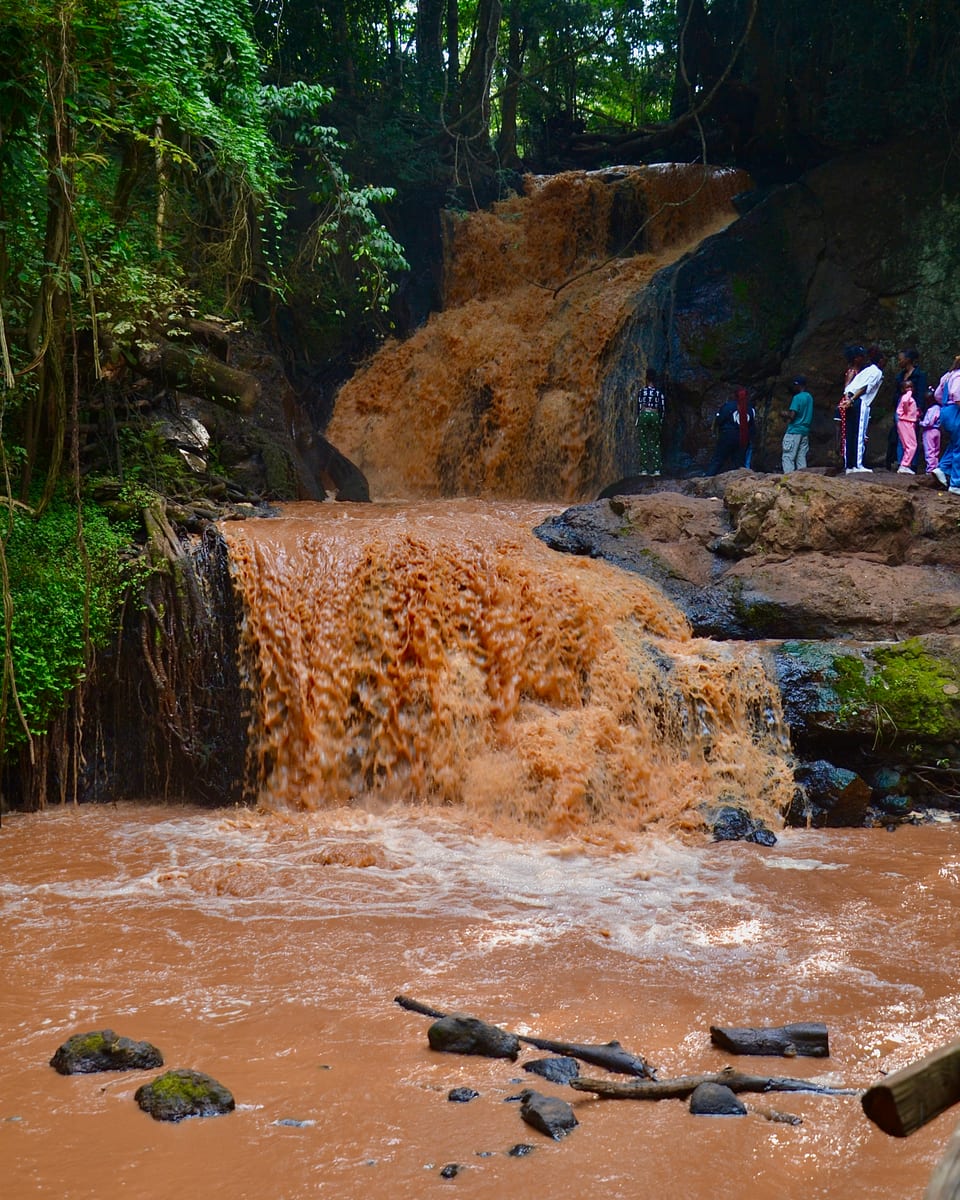
Image context: the lead image is a real Wikimedia Commons photograph of the Karura Forest waterfall, shot in August 2025 by Brihaspati. It is a photographic source for the actual place discussed here, not a generated travel mood image, map, or diagram.[8]
Start at the gate, not at the waterfall
Limuru Road gate is the cleanest first entrance because it makes Karura feel like a city habit rather than an expedition. Friends of Karura says vehicles can be parked at the two main gates, including the Limuru Road gate, and that driving inside is limited to the route between Limuru Road gate and the KFEET Centre, with a strict 20 kph speed limit.[1] The 2026 Nairobi guide also treats Limuru Road gate as the most legible main entrance, with parking, bike-rental, and security-checkpoint infrastructure, while local/community search surfaces are useful for same-day route friction.[5][7] In practice, that means you should not overbuild the logistics. Ride-hail, matatu plus a short approach, or a private car all work; the important part is arriving with time to walk.
Payment is now part of the local knowledge. In a December 2025 update, Friends of Karura said daily entry fees are paid at the gates by phone through the eCitizen system, not in advance, and gave the example of a single adult citizen entry totaling KSh121 after VAT and the reduced convenience fee.[4] A 2026 local guide reports cashless payment as the norm and gives early-2026 visitor price examples, including KES174 for Kenyan citizens and East African residents and KES850 for non-residents, while warning not to count on cash backup at the gate.[5] Treat those numbers as a planning floor, not a permanent tariff table: the reliable move is to bring a phone with mobile money or card, plus enough margin to handle a gate-system hiccup.[4][5]
Recent local discussion keeps pointing to the same practical layer: visitors are not only asking what is beautiful, but how to arrange a guide, payment, and a few safe hours inside the forest.[6] That is a useful correction for outsiders. Karura is easy, but it is still a managed urban forest with gate systems, route choices, and closing-time consequences.[1][4][6]
Once you enter, resist the urge to sprint toward the waterfall as if it were the only proof you came. Friends of Karura lists walking, jogging, running, trail biking, bird-watching, dog-walking, picnics, and education as ordinary uses, and it specifically marks 5 km, 10 km, and 15 km running trails.[1] That tells you how to read the place. Karura is a loop culture before it is an attraction culture. The waterfall is the anchor; the shaded approach is the payload.
The waterfall is modest. That is why the route works.
Friends of Karura lists a 15-metre waterfall among the reserve's historical sites and areas of special interest, along with the caves, old Central Bank incinerator chimney, Lily Lake, bamboo patches, marshlands, and indigenous groves.[2] The 2026 Nairobi guide calls the popular waterfall route about 5 km return from Limuru gate and says a casual walk with photo stops takes roughly 1.5 hours.[5] It also makes the useful correction: the waterfall is not a destination that overwhelms the forest. During dry months it may be modest; during rainy periods it is livelier. Either way, the walk there is the reason to go.[5]
That calibration saves the visit from a common non-local mistake. If you arrive expecting big-game drama or a world-class cascade, Karura will feel underpowered. If you arrive expecting an urban forest to show you how Nairobi residents claim shade, soft ground, and quiet without leaving the city, it becomes much sharper. The waterfall works because it gives the route a destination without making the destination consume the forest.
Add the Mau Mau caves only if your pace still feels easy. Friends of Karura says the caves are steeped in Kenyan history and were used as hideouts by Mau Mau freedom fighters during the struggle for independence.[2] The local guide describes them as a short, clearly signposted spur off the waterfall trail, more historically meaningful than visually spectacular, and worth 15 to 20 minutes if you are already nearby.[5] That is the right expectation. Do not make the caves into a quick selfie stop. Give them a quiet pause or skip them and keep the forest walk coherent.
Local moves that change the outcome
First, go in the morning. Weekday 7:00-10:00 is the calm version; Saturday morning is the social version with runners and families already moving.[5]
Second, pay at the gate with the right tools. The current system is phone-led and eCitizen-linked, so do not arrive depending on loose cash alone.[4][5]
Third, use Limuru Road gate for a first visit. It is the most legible entrance for the waterfall walk and has the practical gate-and-parking infrastructure first-timers need.[1][3][5]
Fourth, keep the first loop to about two hours. A 5 km waterfall route plus a slow return gives you the forest without turning a city morning into a forced hike.[1][5]
Fifth, wear shoes for dirt, roots, and damp steps, not city sandals. The route is gentle, but the surface is still natural dirt and gravel, with roots, rocks, damp sections, and uneven steps near the waterfall.[5]
Sixth, bring water even though the forest feels close to the city. Shade lowers the stress, but Nairobi's altitude and dry stretches still punish casual walkers who treat the route like a mall errand.[5]
Seventh, keep to marked paths and stay quiet near wildlife. Friends of Karura's guiding principle is simple - leave only footprints and take only memories - and the local guide repeats the practical rule: stay on marked trails, do not feed monkeys, and carry trash out.[1][5]
Eighth, do not make the waterfall the only stop. Pause once under the canopy before the falls and once on the return. Karura's strength is how quickly the city noise drops away, not how many features you tick off.[1][2][5]
Non-local trapline
Mistake 1: treating Karura as a backup safari. The better alternative is to treat it as Nairobi's everyday forest room. Kenya Biodiversity lists birds, small mammals, reptiles, butterflies, and more than 50 km of trails, while the local guide is clear that wildlife is background to the walk rather than the reason to come.[3][5]
Mistake 2: arriving at midday because it is "just a park." The better alternative is a morning slot. Locals use the cool hours for a reason, and the forest starts emptying as the 17:45 last-entry and 19:00 gate-lock reality approaches.[1][5]
Mistake 3: assuming you can improvise payment like an old cash gate. The better alternative is to come with phone payment ready and enough battery. Friends of Karura's update makes the eCitizen gate process part of the current visit mechanics.[4]
Mistake 4: leaving the trail for a better photo or shortcut. The better alternative is to accept the marked system. Karura works because its trails are maintained, signed, and shared; cutting corners damages exactly the everyday forest room you came to use.[1][5]
Concrete go details
Best time window: 7:00-10:00 on a weekday for quiet, or early Saturday if you want the local running-and-family rhythm.[5]
Expected spend: plan from the current gate examples rather than a fixed universal number. Friends of Karura's December 2025 update gives a KSh121 adult citizen example under eCitizen; the 2026 Nairobi guide lists KES174 citizen/East African resident entry and KES850 non-resident entry, plus optional parking or bike rental.[4][5]
Queue and reservation reality: no advance booking is needed for a normal walk, but the gate payment system and weekend family/running traffic are the real friction points.[4][5][7]
What to do: from Limuru Road gate, take the waterfall route at walking pace, decide at the junction whether the Mau Mau caves spur still fits, then return before your energy starts turning the forest into a commute.[1][2][5]
Where to stand or sit: pause once before the falls where the canopy thickens, again at the waterfall viewing area if it is not crowded, and once on the return before the gate noise comes back.
Navigation cue: Limuru Road gate -> marked forest path -> waterfall route -> optional Mau Mau caves spur -> return by the same broad trail logic -> gate exit before late afternoon.[1][2][5][7]
Numeric anchors worth keeping: 06:00, 17:45, 19:00, 1,000-1,041 hectares, 5 km, 10 km, 15 km, 15 metres, 1.5 hours, 7:00-10:00, 20 kph, and a practical two-hour first visit.[1][2][3][5]
Karura's gift is that it lowers the volume without pretending Nairobi has disappeared. You still pay at a gate, watch the time, follow signs, and share the path with people who are exercising, talking, walking children, or protecting a routine. That is the point. The forest is not an escape from the city so much as one of the city's better civic habits: enter early, walk lightly, leave before the gates become the story.
Sources
- Friends of Karura Forest, "Forest Activities" (official community forest page used for hours, last entry, gate-lock timing, activities, marked 5/10/15 km running trails, parking notes, driving limits, and quiet-use rules).
- Friends of Karura Forest, "Karura Forest Reserve" (official community forest page used for reserve scale, urban-forest framing, KFS/FKF management context, waterfall, caves, Lily Lake, bamboo, marshland, and indigenous-grove details).
- Kenya Biodiversity, "Karura Forest" (national clearing-house page used for the 1,041-hectare figure, urban-forest designation, 1932 status year, KFS/FKF management context, biodiversity notes, and 50+ km trail context).
- Friends of Karura Forest, "Update from Karura Forest" (2025-12-10; current operations update used for eCitizen gate-payment mechanics and the KSh121 adult citizen example).
- BestKenya, "Karura Forest: Nairobi's Best-Kept Outdoor Secret" (2026-02-14; recent Nairobi guide used for local timing, gate examples, early-2026 fee examples, waterfall-loop distance, waterfall expectations, running culture, and practical visitor traps).
- Reddit / r/nairobi, "Karura Forest Guide" (recent local/community thread used as a current community-signal surface for guide and visit-planning questions).
- Google Maps search, "Karura Forest Limuru Gate Waterfall" (current navigation and community-review surface for live checks around the Limuru Road gate and waterfall route).
- Wikimedia Commons, "File:Waterfall at Karura Forest, Nairobi, Kenya.jpg" (documentary photographic source for the cover image by Brihaspati, photographed August 4, 2025).