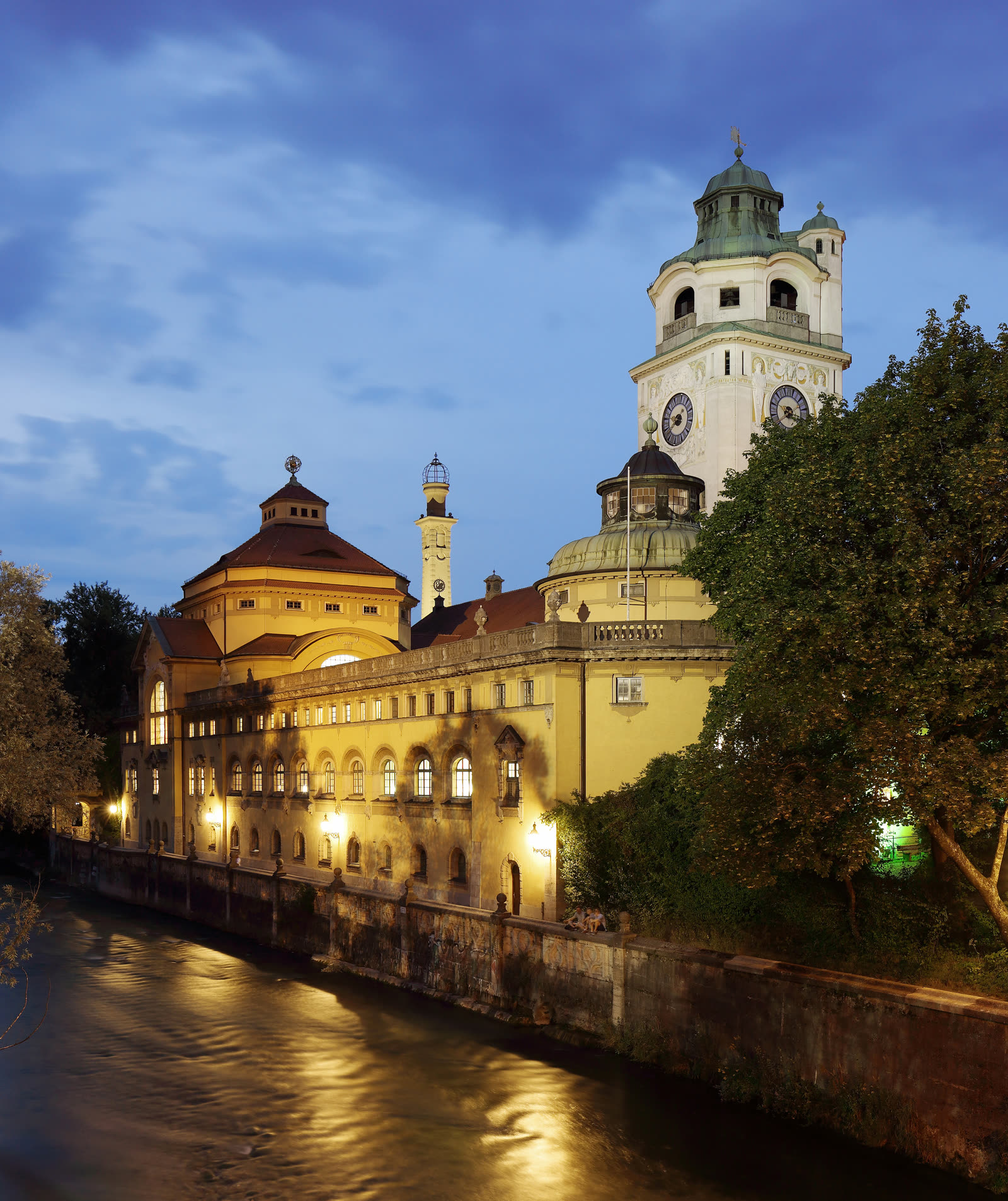
Munich has bigger evening scenes than this, but not many that explain the city so quickly. The useful sequence is exact: go into Müller'sches Volksbad first, then let the night finish at Reichenbachbrücke and the Isar edge below it.[1][3][4] One anchor is a 1901 Jugendstil public bath built for ordinary city use. The other is the bridge where Glockenbachviertel and the Au keep handing people toward the river for lunch breaks, after-work beers, short pauses, and low-stakes drifting.[1][3][5] The route works because the two halves are not opposites. They are consecutive rooms.
The bath gives the evening its first discipline. SWM's current page still frames Müller'sches Volksbad as the city's historic indoor jewel: the building opened in 1901 as Munich's first indoor swimming pool, preserves its ornamental halls, and adds a sauna with a large warm-water pool.[1] Just as useful are the operating facts. The bath currently runs Monday to Sunday from 7:30 a.m. to 11:00 p.m., with ticket office close 30 minutes before the end and bathing and sauna close 15 minutes before the end.[1] Current entry pricing keeps the place local rather than ceremonial: standard indoor-pool admission for Müller'sches Volksbad is EUR 5.80, the 1.5-hour short-swim ticket is EUR 4.30, and the sauna rate is EUR 23.00 for four hours or EUR 17.50 from 7:45 p.m. onward.[2] That is enough structure to turn the bath into a timing gate rather than a whole evening.
The bridge and riverbank give the second half its social grammar. Munich's own Reichenbachbrücke page calls the bridge a popular meeting point because it joins Glockenbachviertel and the Au, names it as a place for lunch breaks and after-work beer, and notes the view toward St. Maximilian and the kiosk at the west end that serves drinks and snacks 23 hours a day.[3] The city's Isar page then makes the river logic concrete: bathing is permitted a few meters downstream from Wittelsbacherbrücke to Reichenbachbrücke, and the practical transit exit is Fraunhofer Straße on U1, U2, U7, tram 18, night tram N27, and bus 132.[4] A recent 21 March 2026 local guide from IN München sharpens the atmosphere further, describing the stretch between Reichenbach- and Wittelsbacherbrücke as one of the city's most closely packed Isar social zones, good for sun, a Feierabendbier, or a pause by the water, but also warning that the current shifts and that Weideninsel is only reachable by swimming and is not a novice move.[5] That is the night room: heat inside first, then river air, kiosk light, and one of Munich's most legible neighborhood seams.
Image context: the cover uses a real Wikimedia Commons photograph of Müller'sches Volksbad at dusk. It is the right image for this piece because the route begins with exterior recognition before it becomes a bodily routine.[8]
Why bath-first works better than bridge-first
If you go to Reichenbachbrücke cold, the evening tends to flatten into generic Isar behavior: buy a drink, stand by the rail, sit for a while, maybe wander south. That can be pleasant, but it does not explain Munich. Starting in the bath changes the scale. Müller'sches Volksbad still carries the memory of the city before private bathrooms became ordinary, and SWM's own framing makes the civic intention explicit: Karl Müller gave the bath to Munich on condition that it serve people who otherwise had little access to bathing infrastructure.[1] The route becomes clearer once you let that older public-utility logic lead.
The second reason is bodily rather than historical. A pool or sauna gives the city an internal start. Once you come out through Rosenheimer Straße after a swim, Munich feels temporarily edited down to essentials: cool air, damp skin, the river a few minutes away, one bridge, one bank, one church silhouette.[1][3] Reichenbachbrücke works because it is not trying to out-spectacle the city. It is an urban hinge where the temperature changes and the evening loosens.
The third reason is neighborhood texture. Munich's Au page describes Reichenbachbrücke as perhaps the city's busiest bridge, names Fraunhoferstraße as the meeting point, and ties the bridge's pull to sunset views over St. Maximilian and the Isar flicker below.[6] That is a very Munich kind of glamour: civic, low-rise, river-adjacent, never fully separating scenery from everyday use. The bridge is not a detached landmark. It is the seam that lets the bath, the kiosk, the riverbank, and the walk home stay in one sentence.
Use the bath as the evening's timing gate
The cleanest pool version starts with the short-swim ticket on a weekday evening. At EUR 4.30 for 1.5 hours, it is almost perfectly calibrated for this route because it keeps the first half compact and stops the outing from turning into a full spa session.[2] If you want the sauna instead, the logic changes but the route stays intact: the evening rate starts at 7:45 p.m., which makes the river segment less about twilight and more about post-sauna cooling and neighborhood drift.[2]
One operational detail matters more than visitors usually think. The bath ends in layers: 30 minutes before closing, the cash desk shuts; 15 minutes before closing, the water and sauna use end.[1] If you treat 11:00 p.m. as the moment you can still decide whether to go in, you are already too late. The better move is to treat the cutoffs as part of the ritual. Munich runs well when you respect the infrastructure's real clock rather than the ideal clock in your head.
From the bath, do not overcomplicate the walk. The route does not need museum detours or old-town stitching. It gets stronger the more directly you move toward Reichenbachbrücke and then the east-bank stretch between Reichenbach- and Wittelsbacherbrücke.[3][4][5] That segment is where the city is most honest about what the Isar is for: not a wilderness fantasy, not a sightseeing platform, but a repeat-use civic release valve.
Let Reichenbachbrücke and the east bank hold the long pause
Once you reach the bridge, pause only long enough to read the frame: St. Maximilian, river surface, cyclists and walkers crossing between Glockenbach and the Au, kiosk traffic at one end.[3][6] The longer stop belongs below, not above. The river edge south of the bridge is where Munich's evening social behavior stops looking like a viewpoint and starts looking like a lived system.
That is why the official bathing zone matters even if you never plan to swim in the river. The Isar page places this segment inside the city's permitted swimming stretch, which tells you the bank is designed to be used physically, not only looked at.[4] The local guide adds the crucial boundary: currents and depths shift, warm days get crowded, and Weideninsel is for people who actually know what they are doing in moving water.[5] In practice, the best version of the route is modest. Sit, cool down, watch the bridge, maybe let your feet near the edge if conditions are calm, but do not convert a refined after-work sequence into a macho river test.
The reward is proportion. Munich can overperform its own prettiness if you approach it through the standard park-and-beer-garden script. This route is smaller and better. The bath gives you enclosure, tile, steam, and clock discipline. The river gives you movement, voices, and night air. Reichenbachbrücke is the hinge that lets one become the other.
8 local moves that make this Munich night room actually land
- Choose the pool or sauna before you arrive. The route behaves differently at EUR 4.30 for a short swim than at EUR 17.50 for the late sauna window.[2]
- Use the short-swim ticket to keep the first half tight. The point is not to do a maximal pool session; it is to arrive at the river still carrying the bath's tempo.[2]
- Respect the real end-time mechanics. Cash desk at T minus 30 minutes, water and sauna at T minus 15.[1]
- Exit toward Reichenbachbrücke, not back toward generic old-town wandering. The route sharpens when you hold the bath-to-river line.[3][4]
- Treat the bridge as the opening glance, not the main stop. The longer pause belongs on the east bank between Reichenbach- and Wittelsbacherbrücke.[4][5]
- Use the kiosk as a support point, not as the headline. The west-end kiosk is useful because it extends the bridge's civic life, not because it replaces the river.[3]
- Read St. Maximilian as the visual anchor. The bridge's best function is to hold church towers, river surface, and bank movement in one frame.[3][6]
- Keep river ambition low unless you know local conditions. This stretch is lively, but the current is real, and Weideninsel is explicitly not a beginner move.[4][5]
Non-local trapline: 4 common mistakes and the better move
Mistake 1: treating Müller'sches Volksbad as a standalone heritage stop
Better move: let the bath be the first room, not the entire evening. The whole point is the temperature change and neighborhood handoff afterward.[1][3]
Mistake 2: going to the bridge first because it looks more obviously "nightlife"
Better move: start indoors. Reichenbachbrücke gets more precise after the swim because the city has already been compressed into one bodily register.[1][3]
Mistake 3: arriving too late and assuming the published closing time is the only one that matters
Better move: remember the 30-minute ticket-office cutoff and the 15-minute bathing cutoff.[1]
Mistake 4: reading the Reichenbach stretch as a calm urban beach
Better move: treat it as an evening sit-and-watch zone unless you are confident with changing current and river conditions. The official bathing allowance is not a promise of gentle water, and the local guide's warning on Weideninsel is there for a reason.[4][5]
Concrete go details
- Best window: for the pool version, enter around 6:45 p.m.-8:00 p.m. and reach the river before the city turns fully late; for the sauna version, use the 7:45 p.m. evening-price threshold and let the bridge/river segment become the cool-down.[2]
- Expected spend: EUR 4.30-5.80 for the swim half, or EUR 17.50-23.00 for the sauna half, plus whatever you actually want from the kiosk.[2][3]
- Queue and reservation reality: no reservation layer, but the bath's real operating gates are the 30-minute ticket-office cutoff and 15-minute bathing cutoff.[1]
- Where to stand or sit: first glance on Reichenbachbrücke for the St. Maximilian line; longer pause on the east-bank stretch between Reichenbach- and Wittelsbacherbrücke.[3][4][6]
- Navigation cue:
Müller'sches Volksbad -> Reichenbachbrücke -> east-bank Isar stretch toward Wittelsbacherbrücke. - Numeric anchors worth keeping: 1901, 7:30, 23:00, 30 minutes, 15 minutes, EUR 5.80, EUR 4.30, EUR 23.00, EUR 17.50, 7:45 p.m., 23 hours.[1][2][3]
Munich has grander evenings and rougher ones. This one is better because it stays exact. Start with tile, steam, and one old public room. End with the bridge, the river, and the part of the city that still knows how to cool itself down in public.
Sources
- SWM, "Müller'sches Volksbad" (official bath page with the 1901 opening, Jugendstil description, current opening hours, and 30-minute / 15-minute cutoff rules).
- SWM, "M-Bäder: entrance fees" (official current pricing page for Müller'sches Volksbad pool entry, short swim, and sauna evening pricing).
- muenchen.de, "Reichenbach Bridge in Munich: Popular meeting place at the Isar river" (official city page on the bridge's after-work role, kiosk, and St. Maximilian view).
- muenchen.de, "The Isar in Munich: Bathing, barbecuing and relaxing" (official city page with the permitted bathing section between Wittelsbacherbrücke and Reichenbachbrücke plus current transit cues).
- IN München, "Baden an der Isar - alle Badeplätze an der Isar in München" (published 2026-03-21; local guide describing the Reichenbach-to-Wittelsbacher stretch, current conditions, kiosks, and the Weideninsel warning).
- muenchen.de, "Freizeit-Tipps für die Münchner Au" (official district guide calling Reichenbachbrücke perhaps Munich's busiest bridge and tying it to Fraunhoferstraße and sunset views).
- Google Maps community listing, "Müller'sches Volksbad, Munich" (current community/location surface used for live navigation and visitor context).
- Wikimedia Commons, "File:Müllersches Volksbad Munich at Dusk, July 2018.jpg" (documentary photographic source for the cover image).