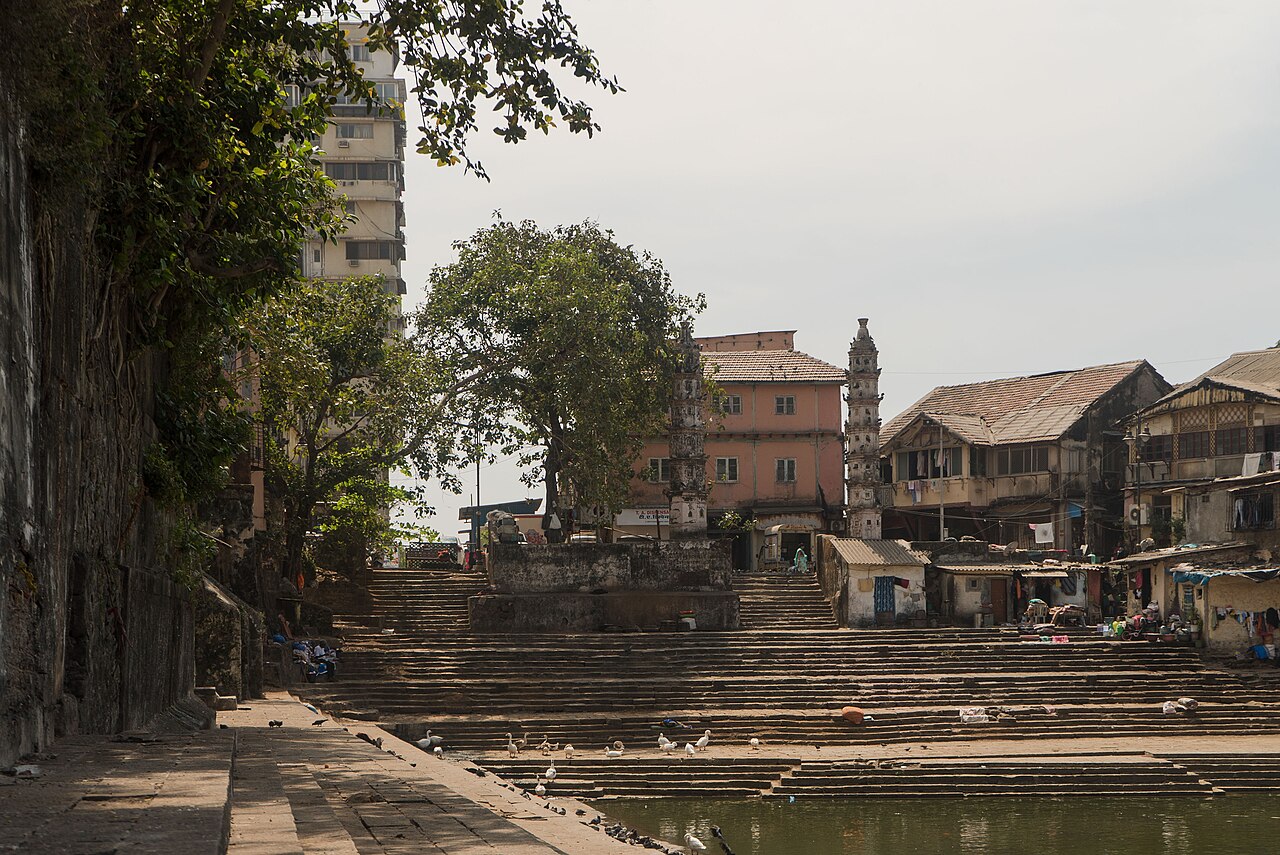
Banganga Tank is most legible before Mumbai's day has fully hardened. Go between 6:30 and 8:00 a.m., when Walkeshwar still feels residential, the stone steps are not yet hot, and the water can hold a reflection instead of a crowd. The mistake is to treat it as a hidden photo stop near Malabar Hill. The better move is slower: arrive, stand back, read the ring of temples and houses, and let the tank explain how old Bombay survived inside present-day Mumbai.
The official municipal heritage note gives the hard frame. Banganga is a 33-foot-deep ancient water tank within the Walkeshwar Temple complex, built with cut stone, associated with Silhara-period steps dated to 1127, and fed by an underground freshwater spring.[1] That last detail is why the place feels improbable. You are close to the Arabian Sea and inside one of Mumbai's most expensive neighborhoods, yet the civic object in front of you is a sacred freshwater tank with ghats, small shrines, dharamshalas, and ordinary apartment balconies all sharing the same bowl.
The name carries the local micro-fact that makes the place stick. In the Ramayana-linked tradition recorded by the municipal legacy project, Rama was searching for Sita, needed fresh water near the coast, and shot an arrow into the earth; the spring that rose was understood as a Ganga-like water source, hence Baan-Ganga, or Banganga.[1] Whether you read that as belief, story, or urban memory, it changes the visit. This is not a decorative pond. It is a ritual water body that still hosts prayer, mourning, washing, festival use, photography, arguments about cleanliness, and neighborhood attachment.
The Approach
Do not make the approach heroic. Use Grant Road or Charni Road as the rail-side mental anchor, then take a taxi or ride-hail up to Walkeshwar. A local transit guide places Grant Road local station around 1.2 km from the tank and the newer Grant Road metro stop around 1.7 km away, which is close on a map but not always pleasant as a first-time walk in heat, traffic, or formal clothes.[5] If you want to walk, make it a downhill exit afterward, not the arrival ritual.
Set your destination as Banganga Tank or Walkeshwar Temple, then get dropped at the street above the steps rather than asking the driver to improvise through the tightest lane. Carry small cash for a taxi fallback, keep footwear simple, and dress as if you may pass through temple space. The precinct is listed by LikeALocal as open 24 hours, and other travel listings mark entry as free, but "always open" is not the same as "always equally appropriate."[2][5] Early morning and early evening are the windows that make sense for a respectful first visit.
The useful first move is to pause above the tank before descending. Look for the rectangular geometry, the steps on all four sides, the small temple forms, and the narrow domestic edges. That overview helps you avoid drifting into private-feeling corners or blocking people who are there for worship. Then descend only partway, not straight to the waterline. Sit where you can watch without occupying the most active ritual edge.
How To Behave Once You Are There
Local and traveler-facing sources agree on the atmosphere: peaceful, old, religious, and unusually quiet for Mumbai.[2][3] The part that matters is what those adjectives require from you. Keep your voice low. Do not fly a drone. Do not stage a fashion shoot on the steps. Do not feed animals for a photograph. Do not touch the water unless you understand the context and someone local has made it clear that it is appropriate. If a ritual is happening, move farther back rather than trying to angle around it.
Plan 35 to 50 minutes. Ten minutes is too short because the tank initially reads as a single image. After 20 minutes, the place separates into layers: temple bells, laundry, pigeons, passing residents, photographers, ritual visitors, and the odd shock of high-rise Mumbai peering over a much older water grammar. If you have another Malabar Hill stop in mind, keep the pairing simple: Banganga first, then Hanging Gardens or Kamala Nehru Park. Do not try to stack this with a long South Mumbai checklist unless you enjoy turning places into errands.
There are 8 local moves that make the visit better. Arrive before 8:00 a.m.; use a taxi for the uphill approach; step down slowly and stop at mid-level; keep shoes and clothing temple-appropriate; ask before photographing people; leave the water and animals alone; carry out every wrapper; and exit before you become impatient. None is complicated. Together they keep the place from becoming the thing locals complain about.
The Trapline
The first visitor mistake is calling it "Mumbai's Varanasi" and acting as if the comparison gives you permission to consume it. A 2026 Mumbai travel guide uses the "Kashi of Mumbai" shorthand because the spiritual comparison is locally recognizable, but the same guide is careful to describe Banganga as a living religious site, not just a scenic substitute for somewhere else.[4] Use the comparison only as a visual shorthand, then drop it.
The second mistake is assuming that a pretty frame means a pristine site. Wanderlog's current listing carries high-volume review signals and recent Google-sourced comments from late 2025 and early 2026, but it also flags practical etiquette: dress modestly, respect the religious setting, and be mindful about cleanliness.[3] TrekGo's January 2026 guide makes similar practical points, including asking before photographing people, not interrupting rituals, and not entering the water recreationally.[4] The better alternative is simple: look carefully, enjoy the beauty, but do not romanticize neglect.
The third mistake is descending to the lowest step immediately. At a ritual water body, the waterline is often the working zone. Families may be performing rites; residents may be using the edge; priests or caretakers may be moving through. The better alternative is the half-step posture: stay one or two tiers above the most active edge, watch first, and move only when you can do so without crossing someone's line of use.
The fourth mistake is arriving at noon because the map says the site is open. Midday flattens the reflections, heats the stone, and makes the precinct feel more exposed than contemplative. Go early, or come in the last hour before dusk if your schedule refuses morning. If you choose evening, be extra careful with photography. Bells, prayer, and low light can make the place feel cinematic, which is exactly when visitors start behaving badly.
Why It Is Worth The Detour
Banganga is not hard to visit, but it is easy to misunderstand. The official history ties it to Walkeshwar, Silhara patronage, later restoration, Malabar Hill's older name Shrigundi, and pilgrimage routes that existed before the modern road network made the hill feel like elite real estate.[1] That layering is the reason the tank changes the way you read Mumbai. The city is usually narrated through trade, trains, mills, film, finance, reclamation, and real-estate pressure. Here, the story runs through water and ritual.
It is also a place under pressure. Mid-Day's March 2025 photo report described low water during desilting and restoration work, BMC's multi-phase restoration, earlier step damage during work, and the larger problem of worn stones, lampstands, and unauthorized construction around the tank.[6] That does not mean a visitor should avoid it. It means the visit should be lighter. If barriers are up, respect them. If work is happening, do not squeeze past for a better angle. If the water level looks strange, remember that this is not a theme-park set built for your itinerary.
The best exit is quiet. Climb back to the lane, look once more from above, and then decide whether you are still in a slow enough mood for Malabar Hill. If yes, walk or ride toward Hanging Gardens. If not, drop back down by taxi toward Chowpatty, where the city returns to surf, traffic, vendors, and open horizon. Banganga works because it does not try to compete with that Mumbai. It holds a smaller, older room inside it.
Image context: the cover image is a real Wikimedia Commons photograph of Banganga Tank taken on February 22, 2023. It was selected because it clearly shows the stepped tank, water surface, surrounding homes, and temple-edge scale that a first-time visitor needs to recognize on arrival.[7]
Sources
- Brihanmumbai Municipal Corporation, Mumbai Legacy Project, "D Ward: Banganga Tank" heritage note.
- LikeALocal Guide, "Banganga" in Mumbai, local visitor note and opening-hours listing.
- Wanderlog, "Banganga Tank, Mumbai, India," review signals, recent visitor comments, and etiquette notes.
- TrekGo, "Banganga Tank: Mumbai's Hidden Ancient Heritage," published January 10, 2026.
- Mumbai Metro Route, "Banganga Tank Mumbai: Nearest Metro Station, Things to Do & Travel Info," access distances and basic visitor information.
- Mid-Day, "IN PHOTOS: Low water level at Banganga Tank in Mumbai as desilting work continues," updated March 12, 2025.
- Wikimedia Commons, "File:Banganga Tank, Mumbai 2023-02-22.jpg," photograph by Alexey Komarov.