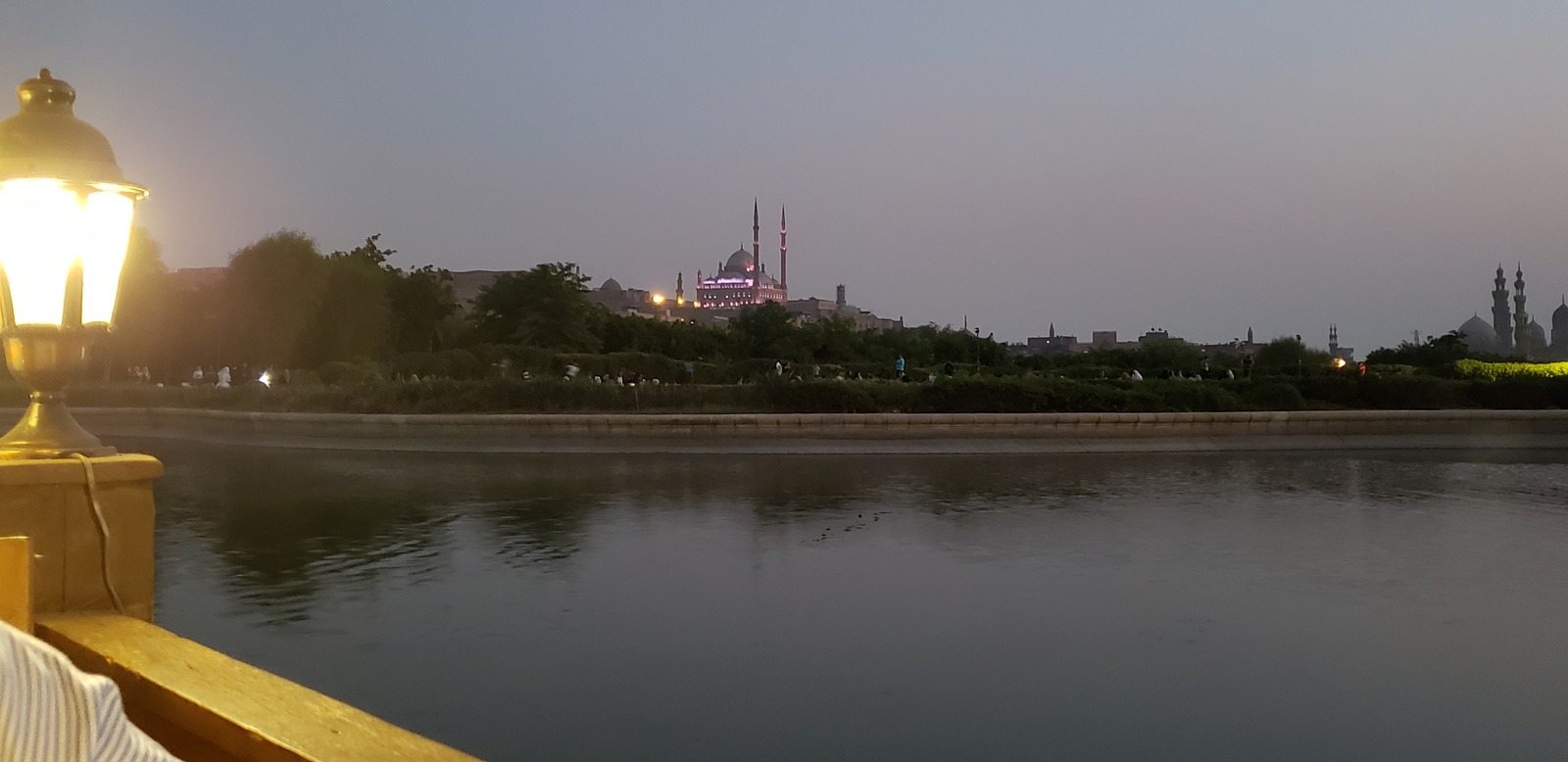
Al-Azhar Park is easy to undersell if you call it an escape from Cairo. That is only half right. The smarter visit treats it as a street microcosm: a 30-hectare civic balcony above Darb al-Ahmar, with families on the grass, wedding shoots near the water, restaurant lights coming on, the Citadel on the horizon, and one possible descent toward Bab Zuwayla if your attention is still working.[1][2] Go for the park, but use the park to learn how the city changes height.
The timing is the whole trick. Aim to enter between 5:15 and 6:00 p.m. in warm months, earlier in winter, then give yourself 45 to 70 minutes before deciding whether to continue toward the old walls. The official park page lists opening hours as 9:00 a.m. to 10:00 p.m.; current ticketing puts non-Egyptian adults at 150 LE Sunday through Thursday and 200 LE Friday and Saturday, while Egyptian and foreign-resident adult tickets are listed at 50 LE and 60 LE for the same weekday/weekend split.[1] That price structure matters because weekends are not just more expensive. They are also when the park is most likely to become a family outing, date-night promenade, children's running ground, and photo studio all at once.
The local move is to arrive by ride-hail or taxi at the Salah Salem entrance, not by trying to make the last approach heroic on foot. Al-Azhar Park's own FAQ points to Attaba as the nearest metro station and Sayeda Aisha as the nearest bus station, but "nearest" in Cairo does not always mean pleasant for a first-time visitor at dusk.[8] Save your walking for inside the park and, if you choose it, for the lower Darb al-Ahmar edge afterward. Bring small cash, keep a phone battery reserve for the ride out, and do not build this after a full museum day. Cairo punishes exhausted curiosity.
The Hill First
The park's backstory is why the view feels loaded rather than merely pretty. AKDN describes Al-Azhar Park as a 30-hectare project by the Aga Khan Trust for Culture in historic Cairo, designed as green space and as a catalyst for renewal in one of the city's densest quarters.[2] In its inauguration note, AKDN framed the park as a transformation of a 500-year accumulation of fill and debris into a public green lung for a city then described as having 17 million people and an extremely low ratio of green space per inhabitant.[2] That origin is not trivia. It explains why the place feels engineered, social, and historical at the same time.
Start with the broad path and resist the urge to head straight for the restaurant terrace. Walk until the Citadel view opens, then stop before you take photos. Look for three layers: the near layer of grass, palms, paths, and lake; the middle layer of Darb al-Ahmar's dense roofs and minarets; the far layer of the Citadel and Muhammad Ali Mosque. Cairo 360's local review of the Lakeside Cafe is old, but its sense of the park still holds: the restaurants use the elevation, water, palm forest, and Citadel view as the park's evening theater.[3] The useful visitor move is to enjoy that theater without letting dinner become the only reason you came.
There are 8 practical moves that make the park work. Enter before sunset, not after dark. Walk uphill first, then sit. Use the lake and Citadel view as orientation points. Keep balls, bikes, pets, alcohol, cookware, and fireworks out of the plan because the official park rules prohibit them.[1] If you are there on Friday or Saturday, expect more noise and less empty lawn. If wind picks up on the high edge, shift behind trees or lower toward the lake. If you want food, treat it as a pause, not the itinerary. If you plan to descend toward Bab Zuwayla, leave while you still have 45 minutes of focus.
Then Decide Whether To Descend
The non-local mistake is assuming every good Cairo view should be followed by Khan el-Khalili. That can work, but it turns Al-Azhar Park into a prelude to shopping. The better pairing is smaller: Al-Azhar Park, then Bab Zuwayla. The gate is close enough in concept to make the route coherent, but different enough in mood to keep the evening from becoming one long panorama.
Bab Zuwayla is not a decorative endpoint. Egypt's Ministry of Tourism and Antiquities identifies it as one of the gates of Fatimid Cairo's walls on the southern side, named for the Zuwayla tribe and also known as Bawabat al-Mitwalli. The ministry's account ties it to the public hanging of the last Mamluk sultan, Tumanbay, in 923 AH / 1517 AD, and notes restoration work involving the Supreme Council of Antiquities and the American Research Center in Egypt from 1998 to 2003.[5] ARCE adds a physical detail worth carrying into the visit: during restoration, the two massive wooden doors, each almost 4 tons, were found to move on ball bearings.[6] That is the kind of fact that changes how you look at a gate. It stops being a photo arch and becomes a machine.
Do the descent only if you are still patient. By the time you leave the park, traffic may be loud, pavements uneven, and your phone's blue line less useful than your ability to stop, look, and recalibrate. If you are tired, take a car out and make Bab Zuwayla a separate morning. If you continue, keep the goal simple: reach the gate, read the wall and minarets, then decide whether to keep walking north into al-Muizz Street or leave cleanly. Do not add three mosques, two markets, and dinner unless you know Cairo well.
The Trapline
The first visitor trap is arriving at noon because the official hours allow it. Technically, 9:00 a.m. to 10:00 p.m. gives you a large window.[1] In practice, midday makes the lawns hotter, the skyline flatter, and the park feel more like an exposed attraction than a neighborhood balcony. The better alternative is late afternoon: enter around 5:30 p.m., walk for 20 minutes, sit for 15, then let the light decide whether you are staying for food or moving on.
The second trap is treating local crowds as a flaw. Recent review signals collected by Wanderlog include late-2025 and early-2026 Google-sourced visitor notes about the park as a calm green break, with the Citadel view, lake, and space to walk doing much of the work.[4] The same review flow also makes the practical pattern clear: sunset, families, couples, restaurant pauses, and weekend crowding are part of the ordinary use.[4] If you want a silent garden, choose a weekday. If you come on a weekend, read the social life as the point.
The third trap is over-walking the exit. On a map, historic Cairo looks temptingly compact. On the ground, attention is the scarce resource. The better alternative is a one-gate rule: if you leave the park on foot, make Bab Zuwayla your only required target. If you are still fresh when you arrive, continue. If not, stop there. The gate has enough history, mass, and street life to close the loop.
The fourth trap is letting the restaurants flatten the park into a view-with-dinner product. Cairo 360's local review is useful because it praises the evening atmosphere while also noting the altitude and wind.[3] That is the operating clue. Dress for a breeze, do not reserve so late that you miss the grounds, and remember that the best table may be a bench where the old city is still visible through palms.
A Clean 90-Minute Version
Start at the Salah Salem entrance. Buy the ticket, walk toward the lake, then climb until the Citadel and old-city roofline line up. Spend the first 20 minutes moving slowly, not photographing everything. Sit for 15 minutes where you can see both the lawn life and the skyline. Use the next 10 minutes to decide: dinner inside, a short loop back to the entrance, or the Bab Zuwayla descent. If you choose the gate, keep 45 minutes for the move and do not be embarrassed to bail by car if the street energy feels wrong.
Expected spend is straightforward: 150 to 200 LE for a non-Egyptian adult park ticket before food or transport, more if you sit down at a restaurant; residents pay less under the current ticket table.[1] Queue reality is also simple: the park is usually easier than Cairo's marquee antiquities sites, but weekends and holidays can slow entry and thin out calm seating. The navigation cue is the Citadel view. If you cannot see it, keep moving until the park gives you the city back.
What makes this route worthwhile is not that it reveals a secret Cairo. It does the opposite. Al-Azhar Park is visible, popular, planned, and reviewed. Bab Zuwayla is monumental, restored, and historically named. The value is in refusing to rush between them. For one evening, the city becomes a vertical street: hill, lawn, lake, skyline, wall, gate. That is enough.
Image context: the cover image is a real Wikimedia Commons photograph taken from Al-Azhar Park in 2018. It was selected because it shows the park's practical recognition cues: the elevated lawn-and-lake foreground, the historic skyline, and the Citadel view that governs the recommended dusk route.[7]
Sources
- Al-Azhar Park, "Tickets" and "FAQs," current opening hours, ticket table, visitor rules, and access notes.
- Aga Khan Development Network, "Aga Khan creates new 30-hectare park in Historic Cairo" and "Inauguration of Cairo's Al-Azhar Park," project context and Darb al-Ahmar renewal frame.
- Cairo 360, "Lakeside Cafe: Dinner with a Citadel View," local review of the park's evening restaurant/view atmosphere.
- Wanderlog, "Al-Azhar Park, Cairo, Egypt," Google-sourced review signals, address, hours, and recent visitor confirmation.
- Egypt Ministry of Tourism and Antiquities, "Bab Zuwayla," official monument history and restoration note.
- American Research Center in Egypt, "Bab Zuwayla," restoration and architectural details.
- Wikimedia Commons, "File:Al azhar park.jpg," photograph by Rawan zy.
- Al-Azhar Park, "FAQs," access notes including nearest metro and bus stations.