Lyon is easy to do badly. Visitors reach Vieux Lyon, start eating too early, and then treat the hill above it as an optional climb if their legs still feel generous. The cleaner move is the opposite: take F2 from Vieux-Lyon to Fourvière, read the city from the esplanade, step into the basilica, then descend through the Jardin du Rosaire back toward the old town.[1][2][3] One anchor gives you altitude and city plan. The second gives you pace, shade, and a properly staged return to street level.[4][5][6]
That pairing matters because Fourvière is not just a viewpoint platform and the Rosaire is not just a shortcut path. The official Fourvière visit page says the site is designed to be reached either by F2 from Vieux-Lyon or on foot through the Rosaire gardens in about 25 minutes.[2] The practical-times page makes the upper and lower clocks explicit: the gardens run from 6:30 a.m. to 10:30 p.m., the esplanade gates to 11:00 p.m., and the basilica itself from 7:00 a.m. to 8:00 p.m., or 9:00 p.m. on Sundays.[3] Lyon Secret adds the missing texture from below: the Jardin du Rosaire is a 19th-century garden, a protected historic site, spread across more than two hectares, and under restoration since January 2026.[4] The route works because the hill is not one monument. It is a vertical civic seam.
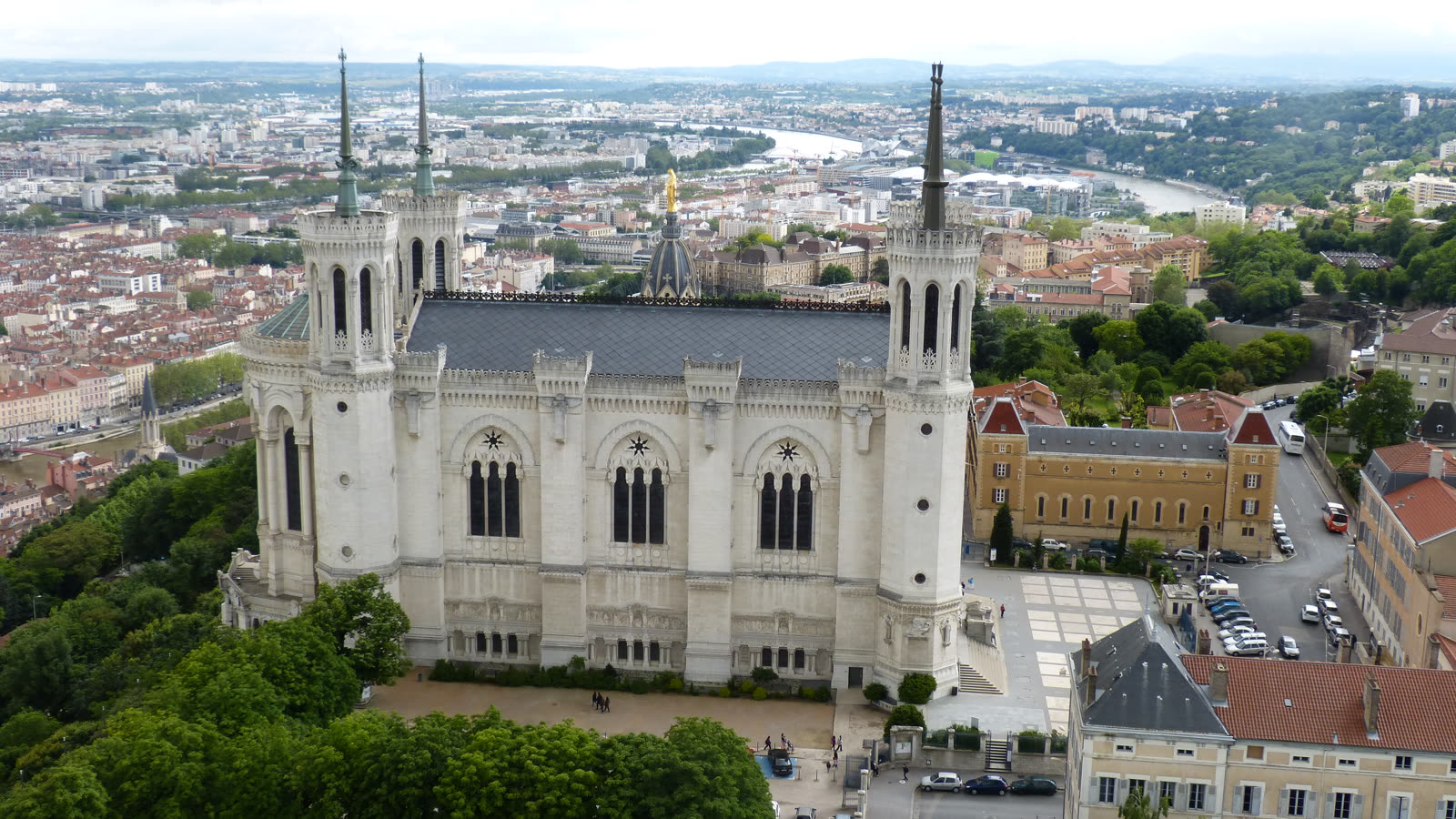
Image context: the cover uses a real documentary photograph from Wikimedia Commons showing Fourvière above the city. That is the right recognition cue here because this article is about the upper threshold first: before the descent, before dinner, before old-town drift, the hill has to register as a single clear mass above Lyon.[9]
Use the hill as an upper clock
The first practical improvement is to spend your effort on the descent instead of the ascent. TCL's fare page is unusually straightforward about the scale of the move: a same-day round-trip funicular ticket costs EUR 3.60 instead of EUR 4.20 for two single rides, and it loads onto a rechargeable ticket that costs EUR 0.20 on first purchase.[1] That is not a huge saving, but it explains the right mentality. F2 is not a novelty ride. It is a precise tool for solving the hill cleanly.
The second improvement is timing. Fourvière's official pages make this easy to plan: the basilica opens from 7:00 a.m., the gardens stay open well into the evening, and Sunday gives the basilica an extra hour to 9:00 p.m..[2][3] In practice, the strongest window is the late-afternoon shoulder, roughly 45 to 60 minutes before sunset. You still have light on the facades and the rivers, the esplanade has not yet gone fully night-view, and the descent keeps enough definition that the garden feels like part of the route rather than a black tunnel.
This is also the moment to keep the stop disciplined. The site has a café, but the official page is clear about what it is: a terrace coffee-and-snack operation, not a dinner destination.[7] If you buy anything on top, make it a coffee or pastry and keep moving. The upper level is for orientation, not for consuming the whole evening.
The descent is where Lyon starts to feel local
The local value of Fourvière is not only the panorama. It is the change of speed between the esplanade and Vieux Lyon. That is why local Lyon threads keep recommending the hill as a route rather than as a static attraction. In a recent r/Lyon thread, one local answer tells a newcomer that if they pass Fourvière they should make the detour downhill for one of the city's best views.[5] Another thread about what to see and avoid frames the path from Fourvière back down to Vieux Lyon as part of the charm, not as dead transfer space.[6]
That is the right read. If you ride up and ride down, the hill stays ornamental. If you ride up and walk down, Lyon starts to separate itself into layers: basilica forecourt, trees and retaining walls, glimpses of rooftops, then stone lanes and the old town below. Lyon Secret's recent Rosaire piece is useful here not because it writes like a guidebook, but because it confirms the garden is still being actively worked on in 2026.[4] In other words, this is a living path with real detours and maintenance, not a frozen postcard stair.
The descent also fixes a common visitor error in Vieux Lyon itself. The district is best entered as a second act, not as the first thing you do on arrival. If you reach it from above, the lanes feel earned and proportionate. If you begin with them, they can shrink quickly into restaurant comparison and souvenir drag. The hill solves that by delaying the old town until after the city has already explained itself.
8 local moves that make this vertical sequence land
- Spend the rail on the uphill and your legs on the downhill. If you only do one direction by funicular, it should be the ascent.[1][2]
- Use the esplanade before the basilica interior. Let the rivers and street grid settle in your head first, then go inside.[2][3]
- Start the route late rather than early if you only have one hour. The hill reads best when the light is soft and the old town is still ahead of you, not behind you.[2][3]
- Keep the top stop short. Coffee or pastry at the Fourvière café is enough; the café does not serve dinner, which is a feature, not a problem.[7]
- Treat the Rosaire as the main downward line, not as a backup. The route becomes generic if you descend by road instead.[2][4][6]
- Respect current works and detours. The garden entered a restoration phase in January 2026, so follow the path that is actually open instead of forcing the prettiest stair on your screenshot.[4]
- Sit only once. The best pause is either the esplanade edge at the top or a bench partway down; too many stops flatten the sequence.
- Push the meal to Vieux Lyon after the descent. The route improves when food comes after the city has already been read, not before.[6]
Non-local trapline: 4 mistakes and the better alternative
Mistake 1: climbing up from Vieux Lyon just because the official walk says 25 minutes
Better alternative: use the 25-minute figure as a downhill budget, not an uphill challenge. Rail up, walk down.[1][2]
Mistake 2: stopping at the esplanade and then taking the same line straight back down
Better alternative: make the Rosaire descent non-negotiable. That is the part that turns the view into an actual city sequence.[4][5][6]
Mistake 3: turning Fourvière into a full aperitif stop
Better alternative: keep the upper stop to coffee, pastry, and orientation. The official café page is explicit: it is not a dinner room.[7]
Mistake 4: ignoring current access conditions because the hill looks timeless
Better alternative: remember that the garden is a live historic site under restoration and the basilica, gardens, and esplanade each keep different hours.[3][4]
Concrete go details
- Best window: arrive at Fourvière roughly 45-60 minutes before sunset, or use the late-afternoon shoulder when the basilica is still open and the Rosaire still has shape.[2][3]
- Expected spend: EUR 3.80-4.20 for the core route, depending on whether you buy the EUR 3.60 round-trip funicular ticket plus the EUR 0.20 rechargeable card, or simply use two single trips at EUR 4.20.[1]
- Queue and reservation reality: no reservation for the esplanade, basilica, or gardens; the real variable is sunset crowding, not ticketing.[2][3]
- What to order and where to stand: if you buy one thing on top, make it coffee or a pastry from the Fourvière café, then take your first real pause at the esplanade edge before you start down.[7]
- Live-status check: if weather is unstable or you are arriving close to dusk, check the current place surface before you go up the hill so you do not discover a closure or crowd spike too late.[8]
- Navigation cue:
Metro D / Vieux-Lyon -> F2 funicular -> Fourviere -> basilica forecourt -> Jardin du Rosaire -> Vieux Lyon.[2][3] - Numeric anchors worth remembering: 25 minutes, 6:30, 10:30, 11:00, 7:00-20:00, 21:00 on Sunday, EUR 3.60, EUR 4.20, EUR 0.20, 2+ hectares.[1][2][3][4]
Lyon often feels best when it is arranged vertically instead of horizontally. One short rail climb, one slow garden descent, one delayed entry into Vieux Lyon: that is enough to make the city feel composed rather than consumed.
Sources
- TCL, "Round trip Funicular" (official fare page covering the EUR 3.60 same-day return, EUR 4.20 two-single comparison, EUR 0.20 rechargeable ticket, and Fourviere/Vieux-Lyon vending machines).
- Notre-Dame de Fourviere, "Visit" (official access page covering F2 from Vieux-Lyon, the 25-minute walk through the Rosaire gardens, and the main visitor information).
- Notre-Dame de Fourviere, "Times" (official site-hours page covering garden hours, esplanade-gate hours, and basilica opening hours).
- Lyon Secret, "Nestled in the hills of Lyon, this 19th-century garden, classified as a historic monument, is getting a makeover..." (local Lyon source covering the Rosaire garden's 19th-century status, more-than-two-hectare scale, and January 2026 restoration works).
- Reddit r/Lyon, "Besoin de conseils" (April 2026 local community thread noting that the downhill detour after Fourviere is one of the city's strongest views).
- Reddit r/Lyon, "Lyon in 48 Hours What Should We See and Avoid?" (local community thread highlighting the charming path from Fourviere back down to Vieux Lyon).
- Notre-Dame de Fourviere, "Cafes" (official café page covering terrace coffee/snack service and the fact that the site café does not serve dinner).
- Google Maps search, "Basilica of Notre-Dame de Fourviere Lyon" (current place-status and community-review surface, accessed April 25, 2026).
- Wikimedia Commons, "File:Lyon Fourviere.jpg" (documentary photograph used for the cover image).