Liverpool gets sold from the wrong side of itself. Visitors are told to stand on the waterfront, admire the Three Graces, maybe continue toward Albert Dock, and call the river view complete. The more useful local correction is shorter and slightly counterintuitive: board the Mersey Ferry at Pier Head, cross to Seacombe, step off only briefly if you want, then let Liverpool arrive on the return instead of trying to consume it from the same bank.[1][2][3][8] This is not a grand cruise plan. It is one repeatable city-reading move.
As of 2026-05-05 UTC, the operating facts make the move unusually clean. Mersey Ferries' current direct cross-river service takes 10 minutes and runs every 20 minutes from 07:20-09:40 and again from 17:00-18:40 on weekdays between Seacombe and Liverpool Gerry Marsden (Pier Head).[1] If you miss that weekday rhythm or you are doing this on a weekend, the 50-minute River Explorer Cruise gives you the fallback version: weekdays from 10:00-16:00, and during the current 3 April-4 October 2026 seasonal window, weekends and bank holidays from 10:00-18:00, with the option to hop off at either Liverpool or Seacombe and rejoin later.[2] Either way, the basic insight is the same. Liverpool is one of those cities that becomes easier to understand once a little water gets put between you and the buildings.
That is why the local texture matters. VisitLiverpool's waterfront page describes Pier Head as the home of the Three Graces and the place where visitors catch the iconic Ferry Cross the Mersey.[3] The Guide Liverpool pushes the point further and says there is no better way to see the city's famous skyline than from the deck itself.[4] That is not brochure inflation. It is the right spatial diagnosis. On land, the Pier Head buildings are too close to one another and too close to you. On the water, they begin to cohere.
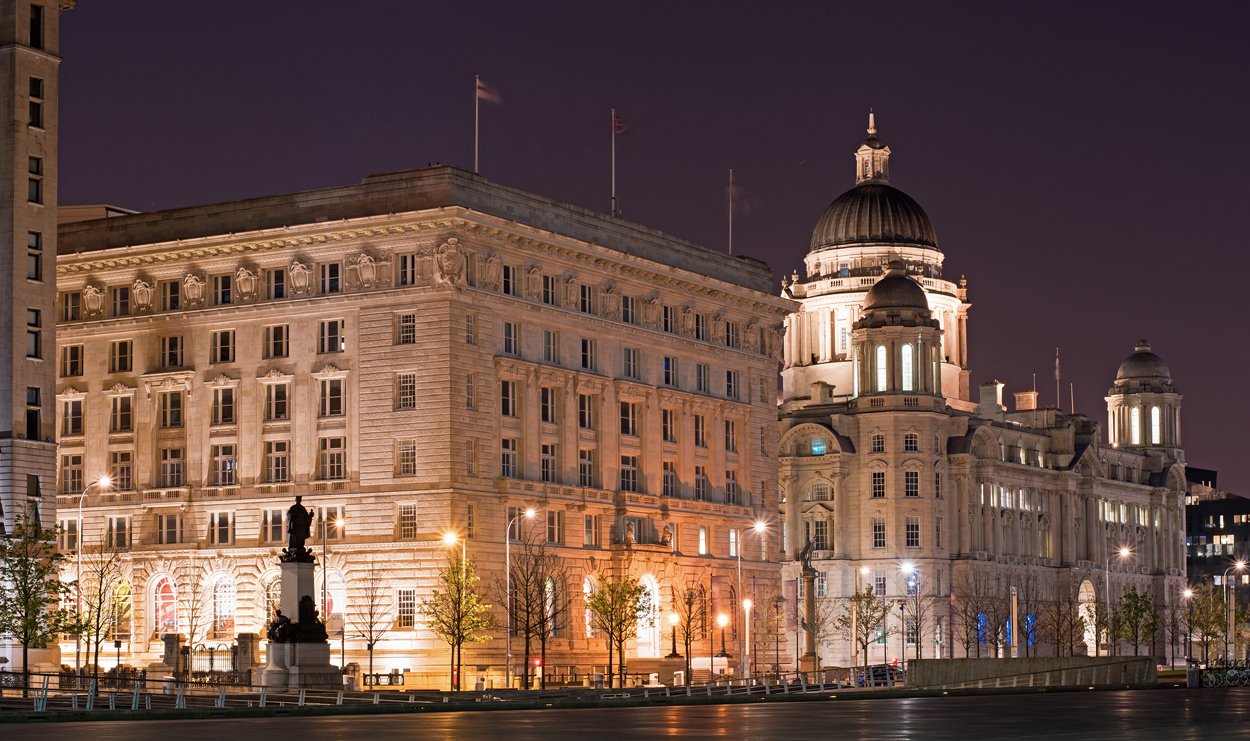
Image context: the cover uses a real documentary night photograph of Pier Head from Wikimedia Commons rather than an abstract skyline graphic or a daytime postcard. That is the right recognition cue because this article is about distance, not monument worship. The ferry creates exactly enough separation for Liverpool's waterfront to stop feeling like frontage and start feeling like form.[9]
Why the crossing matters more than the waterfront stroll
The first useful thing the ferry does is correct scale. The direct service page makes clear that this is still a working crossing, not only a sightseeing prop: commuters use it, cyclists can bring bikes, and passengers can choose the top deck in the open air or the lower deck by the windows.[1] That matters because it keeps the ride from feeling staged. You are not entering an attraction disguised as transit. You are entering a piece of ordinary regional movement that happens to produce the city's best self-explanation.
Local/community patterns reinforce that reading. In a recent r/Liverpool thread, locals say the ferry is not just a tourist/weekend novelty and note that people still use it for practical travel from the Wirral side when the route fits their day.[6] In another thread from March 2026, locals describe riding it simply for the pleasure of it, pairing the crossing with a promenade walk and treating it as a cheap, familiar outing rather than a ceremonial event.[7] This is the clue non-locals usually miss. The ferry is worth doing precisely because it has not been evacuated of ordinary use.
The second useful thing the crossing does is make Liverpool readable as a skyline rather than a list. BookLiverpool's local guide is blunt about the payoff: the ferry gives the most iconic view of the waterfront and works especially well around sunset.[5] Community advice points in the same direction. In an r/Liverpool thread from August 2024, a local recommendation for visitors is to take the Mersey Ferry and view the skyline from the water or from the Wirral side instead of trying to force the whole picture from within the city itself.[8] That is the exact ritual this article is after.
Why Seacombe is the right short turn
This route needs a turn point, and under the current service pattern that turn point is Seacombe. Mersey Ferries' own timetable makes it operationally clear: the direct cross-river weekday service currently runs between Pier Head and Seacombe, while the River Explorer also uses Seacombe as the practical hop-off point on the Wirral side.[1][2] Seacombe is therefore not a random second stop. It is the right amount of opposite bank: far enough for Liverpool to settle, near enough that the ritual stays compact.
The clean version is not to overbuild the Wirral side. Get off, take 5-15 minutes by the terminal or seawall if the weather is decent, then board back. If you want the longer local version, the community thread about taking the ferry "just for fun" makes the logic clear: the crossing can open into a promenade walk, not a museum march or a second city's itinerary.[7] But the essential move is still the return. Liverpool arrives best when you are coming back toward it.
This is where the title's claim becomes literal. On the outward run, the city falls apart into towers, rooflines, ventilation stacks, cranes, and river edge. On the return, the same elements start aligning. The Royal Liver Building stops being a single building. The waterfront stops being a row. The city becomes a face.
8 local moves that make the ferry ritual land
- Use the weekday direct service if you want the most local-feeling version. The official page frames it as a commuter crossing first, and that gives the ride a more natural rhythm than the longer sightseeing loop.[1]
- Aim for the late-day bank instead of the morning bank. The current 17:00-18:40 weekday window fits the route better because the skyline gains definition as the light lowers.[1][5]
- If you are traveling on a weekend, switch cleanly to the River Explorer instead of improvising. The official seasonal timetable gives you a straightforward 10:00-18:00 window in the current spring-summer period.[2]
- Stand outside on the top deck for at least one leg unless the weather turns nasty. Mersey Ferries explicitly presents the top deck as the fresh-air skyline view.[1]
- Keep Seacombe brief on the first pass. The point is not to replace Liverpool with a long Wirral plan; it is to create enough water distance for the return view to work.
- Treat the return leg as the real climax. The outward trip loosens the buildings. The inward trip composes them.[4][5][8]
- Use the ferry if you missed the longer sightseeing sailings rather than giving up on the river entirely. The direct service page says this short crossing is exactly the fallback for people who still want the skyline and the river without the full 50-minute cruise.[1]
- If you want to extend, extend along the promenade rather than by stacking unrelated central-city stops back on top. Community advice around the "just for fun" ride treats the walk after landing as the natural add-on, not another queue-heavy attraction.[7]
Non-local trapline
Mistake 1: treating Pier Head itself as the finished skyline view
Better move: use Pier Head as the departure room, not the conclusion. Liverpool's skyline needs river distance to lock into place.[3][4][8]
Mistake 2: defaulting to the longest cruise when the shorter crossing is the cleaner route
Better move: match the service to the point of the outing. If you want a quick, non-food city read, the 10-minute direct sailing is often stronger than padding the ritual into a full loop.[1][2]
Mistake 3: lingering too long on the Wirral side and flattening the return
Better move: keep the Seacombe stop short unless you consciously want the promenade extension. The skyline payoff belongs to the ride back.
Mistake 4: assuming the ferry is a tourist-only relic
Better move: read it the way locals still do, as both a practical crossing and a low-friction pleasure ride.[1][6][7]
Concrete go details
- Best window: on weekdays, target the 17:20, 17:40, or 18:00 departures from Pier Head; on weekends in the current warm-season timetable, use the later River Explorer hours to hold more evening light.[1][2]
- Expected spend: check the current Mersey Ferries fare page when you travel, but the route itself requires no reservation and no add-on ticketing beyond the crossing you choose.[1][2]
- Queue and reservation reality: no reservation for the direct service; River Explorer tickets can be bought online or by card at the terminal, subject to availability.[2]
- Where to stand: outside on the top deck for one leg if weather allows, then stay facing the city on the return so the skyline builds rather than slips past.[1][4][5]
- Time budget: 25-40 minutes for the compact weekday out-and-back; longer if you choose the 50-minute River Explorer or add a promenade pause at Seacombe.[1][2][7]
- Navigation cue:
Pier Head -> direct or River Explorer sailing -> Seacombe brief landing -> immediate or next return sailing -> Pier Head skyline arrival. - Numeric anchors worth keeping: 10 minutes, every 20 minutes, 07:20-09:40, 17:00-18:40, 50 minutes, 10:00-16:00, 10:00-18:00, 5-15 minutes, 25-40 minutes.[1][2]
Liverpool has grander museum days and noisier waterfront nights than this. It has very few moves that explain the city so efficiently. One terminal, one short crossing, one brief turn on the far bank, and one return approach are enough to make the whole riverfront snap into focus.
Sources
- Mersey Ferries, "Direct Cross-river Service" (official current page covering the 10-minute weekday crossing, every-20-minute service windows, top-deck/open-air viewing, and Pier Head-Seacombe operation).
- Mersey Ferries, "River Explorer Cruise" (official current page covering the 50-minute round trip, weekday and seasonal weekend timetables, and the hop-off/rejoin option at Liverpool or Seacombe).
- VisitLiverpool, "Waterfront" (official city guide page noting Pier Head, the Three Graces, and Ferry Cross the Mersey as the riverfront's central public anchor).
- The Guide Liverpool, "Mersey Ferries" (local guide page describing the ferry as an essential local institution and arguing that the skyline reads best from the deck).
- BookLiverpool, "Take the Mersey Ferry: The Best View of Liverpool's Skyline" (local city-guide post recommending the crossing specifically for skyline reading and sunset light).
- Reddit
r/Liverpool, "Do locals use the Mersey ferries day to day or is it literally just a tourist/weekend day out thing to do?" (community thread from April 2026 discussing current practical use of the ferry by locals). - Reddit
r/Liverpool, "Anyone else take the Mersey Ferry just for fun?" (community thread from March 2026 framing the ferry as a low-friction local outing and pairing it with promenade walking on the far bank). - Reddit
r/Liverpool, "Visiting from the US" (community thread from August 2024 recommending the ferry or the Wirral side as the right place to read Liverpool's skyline from water distance). - Wikimedia Commons, "File:Liverpool Pier Head at night - May 2017 (10) - geograph.org.uk - 5377917.jpg" (documentary source page for the cover image used in this article).