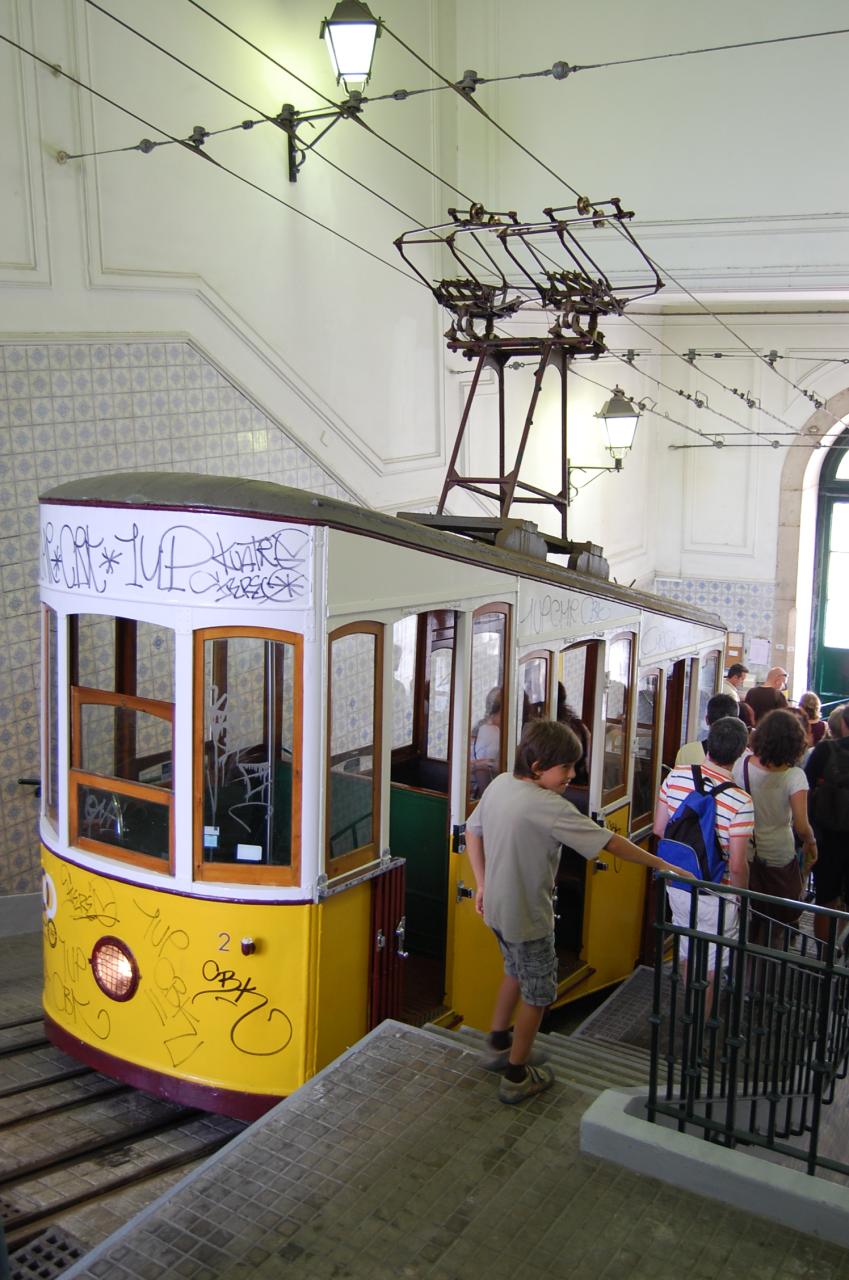
Lisbon usually punishes visitors who confuse an icon with a plan. Rua da Bica de Duarte Belo is a perfect example. The postcard image is the little yellow funicular, but the operational fact on 2026-05-02 is simpler: Carris currently says Ascensor da Bica is closed and recommends 22B Cais do Sodre / circulacao Principe Real as the alternative between Rua de Sao Paulo and Largo do Calhariz.[1] The useful move, then, is to stop treating Bica as a ride queue and read it as a short uphill street system that still works on foot.
That makes this a strong street-microcosm route rather than a transport novelty. Keep the scope tight to two anchors: the lower mouth of Rua da Bica de Duarte Belo above Cais do Sodre, then the upper release at Miradouro de Santa Catarina / Adamastor.[1][4][9] The line between them is short, steep, scenic, and unusually legible. Even community reviews that love the funicular keep drifting back to the same point: the street itself is the real thing to see, especially when the car is not running or when the queue at the lower end gets silly.[9]
Bica can carry that weight because the infrastructure and the hillside belong to Lisbon's longer city logic. Carris' own history page says the Bica funicular opened on 28 June 1892 and climbs Santa Catarina hill between Rua de Sao Paulo and Largo do Calhariz.[2] Time Out Lisboa adds the useful technical detail that it began under steam and was electrified in 1914.[5] Lisboa Secreta's local coverage keeps emphasizing what every visitor notices in the first minute: this is one of the city's most photographed street corridors, especially from the top near Calhariz and from the stairs that flank the track.[6]
The upper anchor matters just as much. Visit Lisboa describes Miradouro de Santa Catarina less as a monument stop than as an atmosphere platform: evening music, conversation, beer, broad Tagus views, and the Adamastor figure from Camões watching the river.[4] That mood is why the route improves once you stop below the worst nightlife compression. In a recent r/Lisbon thread, one local explicitly advised visitors that if they want fewer stag groups and a better evening around Cais do Sodre, they should walk five to ten minutes toward Santos or Santa Catarina rather than staying in the middle of Pink Street.[7]
Image context: the cover uses a real documentary Wikimedia Commons photograph of the Bica funicular on Rua da Bica de Duarte Belo with the river opening behind it. That image fits the article because this route depends on one specific Lisbon compression: transport track, steep housing wall, and Tagus background all visible in the same narrow urban seam.[10]
Why this route works better during the closure than after a reopening queue
The first reason is psychological. Once the car is closed, the temptation to stand around "waiting for the real experience" should disappear. You are free to use the street for what locals and regular passersby already use it for: a connector, a view corridor, and a short climb that tells you how Bica, Chiado, Santa Catarina, and Cais do Sodre fit together.[1][8][9]
The second reason is spatial. Tripadvisor's place page lists the lower end as a 6-minute walk from Cais do Sodre, which means the route begins almost immediately once you step out of one of Lisbon's busiest interchange zones.[9] The problem with staying low is not access difficulty; it is behavior drift. The riverfront and Pink Street pull people into a flat, noisy strip, while Bica gets better the moment you accept the hill and move above it.[7][8]
The third reason is economic. Carris' 2026 fares page says a standard CARRIS/METRO ticket costs EUR1.90 and stays valid for 60 minutes across the network, while a 24h CARRIS/METRO ticket costs EUR7.25. The funicular onboard fare remains EUR4.30 for up to 2 journeys when service is running.[3] During the closure, the neighborhood becomes cheaper to do well because the best version is largely free: walk the street, use 22B only if your legs or schedule need the assist, and spend the saved queue time on the miradouro instead.[1][3]
8 local moves that materially improve outcomes
- Start from the bottom, even though the top photographs more cleanly. The lower mouth above Rua de Sao Paulo gives you the most useful transition from transport hub to hill street, and it is only a 6-minute walk from Cais do Sodre.[9]
- Use the side stairs and pavement as the route itself. With Bica currently closed, the track is a visual spine, not a boarding problem. Walking beside it lets you keep stopping without blocking anyone's commute.[1][9]
- Do this either early or late, not in the anonymous middle. Community reviews describe the street as calm in the morning, livelier in the afternoon, and atmospheric by evening, while Visit Lisboa frames Santa Catarina as a sunset room.[4][9]
- Let Pink Street fall behind you quickly. The useful local advice is direct: if you want a better evening with fewer stag groups, move 5 to 10 minutes uphill toward Santa Catarina instead of lingering in the lower strip.[7]
- If the climb is the problem, flatten only the climb, not the whole neighborhood. Carris currently recommends 22B between Rua de Sao Paulo and Largo do Calhariz while Bica is closed; that is the practical substitute when mobility matters more than the walk.[1]
- Wear shoes that can tolerate polished cobbles. A Lisbon resident in a recent travel-advice thread told newcomers to bring rubber-soled shoes because the city is hilly and heavily cobbled; Bica is exactly the kind of street where that advice stops being abstract.[8]
- Save your longer pause for Santa Catarina, not the lower station area. The miradouro gives you the broad Tagus release, the Adamastor statue, and the social atmosphere that makes the climb feel finished.[4]
- Use transit pricing intentionally if you are linking other hills in the same day. EUR1.90 for a 60-minute Carris/Metro ticket and EUR7.25 for a 24-hour ticket are the numbers that matter; the published EUR4.30 funicular fare only becomes the right choice once Bica is actually running again.[3]
Non-local trapline: 4 common mistakes and the better alternative
Mistake 1: standing at Bica as if the funicular were the route
Better move: accept the current closure immediately and either walk the seam or take 22B for the hill portion. Carris already tells you the machine is shut and where the alternative runs.[1]
Mistake 2: treating Pink Street as the evening destination instead of the lower access zone
Better move: keep climbing. The neighborhood gets more breathable once you move five to ten minutes toward Santa Catarina.[7]
Mistake 3: rushing to the top only for one photo, then leaving
Better move: read the street in sequence. Lisboa Secreta is right that the top near Calhariz is photogenic, but the stairs and mid-slope frames are part of the point too.[6]
Mistake 4: wearing slick shoes because the route looks short on a map
Better move: treat the surface seriously. The climb is not long, but cobbles plus slope change the whole feel of the walk.[8]
Concrete go details
- Best window: 09:00-11:00 for cleaner street texture or roughly 18:30 to sunset for the Santa Catarina atmosphere and river light.[4][7][9]
- Expected spend: EUR0 if you walk it; EUR1.90 for a 60-minute Carris/Metro ticket; EUR7.25 for a 24-hour Carris/Metro ticket; EUR4.30 remains the published onboard Bica fare for up to 2 journeys once service returns.[1][3]
- Queue reality: right now the correct assumption is no queue worth joining because the funicular is closed; the live bottleneck is nightlife crowding lower down, not ticket access.[1][7]
- Where to stand: lower Rua de Sao Paulo mouth for the rails-to-river frame, the side stairs for the compressed mid-slope view, then Santa Catarina for the wide release over the Tagus.[4][6][10]
- Navigation cue:
Cais do Sodre -> 6-minute walk to Rua da Bica de Duarte Belo -> side stairs and track corridor uphill -> Largo do Calhariz -> Miradouro de Santa Catarina / Adamastor -> continue toward Chiado or drop west toward Santos.[1][4][9] - Numeric anchors worth keeping: 6 minutes, 5-10 minutes, 28 June 1892, 1914, EUR1.90, 60 minutes, EUR4.30, 2 journeys, EUR7.25.[1][2][3][5][7][9]
Lisbon does not always reward the most famous machine. Sometimes it rewards the slope next to it. Bica, read this way, stops being a souvenir transport fantasy and becomes a precise little city lesson: leave the flat noise quickly, let the hill do the editing, and finish where the river opens again.
Sources
- Carris, homepage service notices (as of 2026-05-02, noting that Ascensor da Bica is closed and recommending 22B Cais do Sodre / circulacao Principe Real between Rua de Sao Paulo and Largo do Calhariz).
- Carris, "History" (official company history noting that the Bica Funicular opened on 28 June 1892 and climbs Santa Catarina hill between Rua de Sao Paulo and Largo do Calhariz).
- Carris, "Occasional journeys" (official 2026 fares and ticket rules covering EUR1.90 Carris/Metro tickets, EUR7.25 24-hour tickets, EUR4.30 onboard funicular fares for up to 2 journeys, and 60-minute validity).
- Visit Lisboa, "Miradouro de Santa Catarina" (official city tourism page on the Adamastor terrace, Tagus view, and sunset atmosphere).
- Time Out Lisboa, "Cinco coisas que nao sabe sobre... o Ascensor da Bica" (local reporting from 2025 covering the 1892 opening and 1914 electrification).
- Lisboa Secreta, "Elevadores e ascensores de Lisboa: do mais antigo ao mais fotografado" (local guide describing Bica as probably the most photographed funicular in Lisbon and highlighting the Calhariz/top-side photo logic).
- Reddit / r/Lisbon, "Visiting or moving to Lisbon? Ask your questions here (Week 9, 2026)" (local/community advice recommending a 5 to 10 minute move toward Santos or Santa Catarina for a better evening than staying in the Pink Street core).
- Reddit / r/Lisbon, "Anxious about Lisbon and feeling unprepared - would appreciate any thoughts or advice" (recent local/community advice on walking between miradouros, rubber-soled shoes on cobbles, and favoring the upper neighborhoods over the riverfront strip for eating and lingering).
- Tripadvisor, "Bica Funicular (2026) - All You Need to Know BEFORE You Go" (community review page covering the 6-minute walk from Cais do Sodre, recurring queue behavior, and the street's appeal even when the funicular is closed).
- Wikimedia Commons, "File:Lisbon Bica Funicular-Rua da Bica de Duarte Belo.jpg" (documentary cover photograph source).