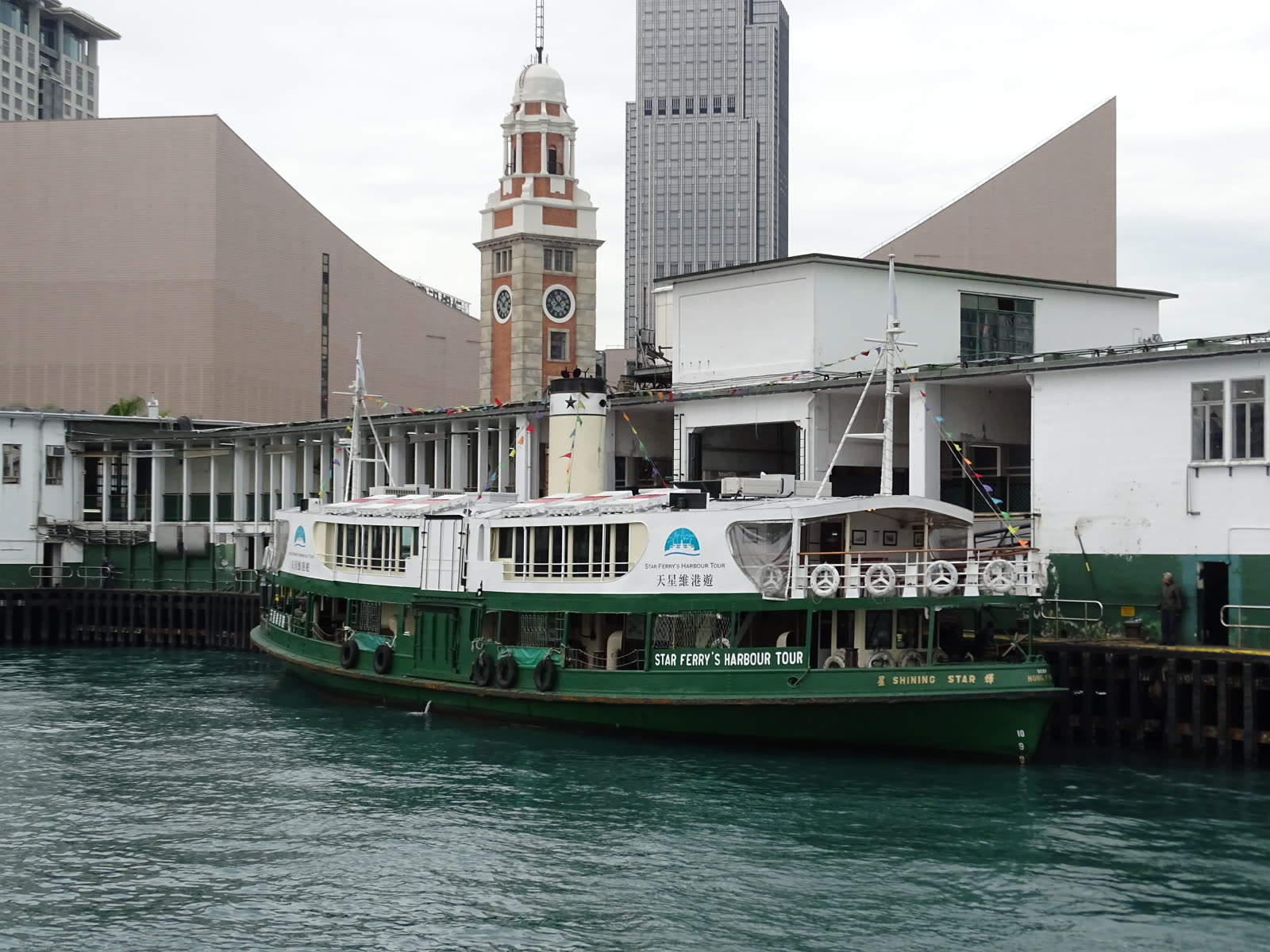
Hong Kong has bigger night moves than this one, but very few cleaner ones. The useful ritual is short, specific, and old enough to feel settled: walk to Central Pier 7 after 6 p.m., take the Star Ferry across Victoria Harbour, and do not rush past the Clock Tower when you land at Tsim Sha Tsui.[1][3][4][5] The city opens in the right order that way. First the water, then the skyline, then the promenade. If you reverse that sequence, the evening gets noisier and less legible.
This works because the ferry is still real transport before it is a postcard. Star Ferry's current service table keeps the Central to Tsim Sha Tsui route on a 6/8-minute rhythm from 7:25 a.m. to 8:40 p.m. on weekdays and from 7:25 a.m. to 10:40 p.m. on weekends and public holidays, with looser 10/12-minute spacing outside those bands.[1] Hong Kong's Transport Department mirrors the same fare table and departure structure, while the public data record behind it was updated on 24 February 2026.[2] The result is a crossing that rewards timing, but not nervous over-planning. Before the late-evening slowdown, you can aim for a window instead of one exact minute.
The other half of the ritual sits on the Kowloon side. Hong Kong Tourism Board's Star Ferry page still frames the ride as an 11-minute harbor line and explicitly calls sunset and the 8 p.m. Symphony of Lights window special.[3] Its Tsim Sha Tsui Promenade page then gives away the key navigational fact: the promenade starts at the Clock Tower next to the Star Ferry Pier and only then winds east along the waterfront.[5] That matters more than it sounds. Many visitors land and immediately drift down the whole promenade as if the point were to accumulate distance. The cleaner move is to let the first pause happen at the landing itself.
The Clock Tower can carry that pause. HKTB's own landmark page notes the tower's 44-metre height, its 1915 construction as part of the Kowloon-Canton Railway terminus, and the fact that its bell chimes every hour from 8 a.m. to midnight.[4] That is the place-specific texture this short route needs. The landing is not just scenic. It is a former rail-and-harbor threshold through which millions once passed into the city and beyond. If Central gives you the financial-front skyline, the Clock Tower gives you the older migration-facing edge of Hong Kong in return.[4][6]
Image context: the cover uses a real documentary Wikimedia Commons photograph showing the Star Ferry pier with the Clock Tower directly behind it. That fit matters because the whole article depends on one exact relationship: a harbor crossing that lands straight into Hong Kong's old rail marker rather than into an anonymous waterfront strip.[9]
Why this ritual works best after 6 p.m.
The first reason is crowd shape. A lot of Hong Kong advice is technically correct but rhythmically wrong. "Take the Star Ferry" is fine; it just does not tell you when the ride feels like transport and when it feels like a clogged attraction. The sweet spot starts once the office light has softened but before the service cadence loosens. On weekdays, that usually means roughly 6:15-7:30 p.m. for the outward run. You still get the stronger 6/8-minute frequency from Central, the harbor lights are starting to switch on, and Tsim Sha Tsui has not yet forced the whole waterfront into one undifferentiated nighttime mass.[1][2][3]
The second reason is spatial. The promenade is long enough to dilute you if you enter it too fast. HKTB's page describes it as a waterfront stretch that begins at the Clock Tower, runs past the Cultural Centre and Avenue of Stars, and becomes prime territory for the nightly light show and special-event viewing.[5] In other words, the place is already telling you where to start. If you take the ferry and then immediately march east without a first harbor pause, you flatten the best moment into transit between "landed" and "somewhere else."
The third reason is economic. Star Ferry's current fares are still modest enough that you can optimize for feel rather than bargain panic: weekday adult fares are HK$5.0 on the upper deck and HK$4.0 on the lower deck; weekends and public holidays move to HK$6.5 and HK$5.6.[1][2] That difference is too small to waste thought on if the goal is an evening harbor read. A local-community reply from 2025, responding to cruise hawkers near the Clock Tower and Avenue of Stars, put it bluntly: the upper deck of the Star Ferry and a walk along the Avenue of Stars will do a far better and cheaper job than the upsold nighttime harbor boats.[8] That is the right scale of decision. Spend the extra dollar-equivalent where it improves the ride, then keep moving.
8 local moves that make the harbor line work
- Use Central Pier 7, not Wan Chai, for this version of the ritual. HKTB's Star Ferry page names Central Pier 7 explicitly, and the Kowloon landing at Salisbury Road puts you straight onto the promenade's western start instead of into a second transfer problem.[3][5]
- Aim for a window, not an exact sailing, while the route is still on 6/8-minute frequency. The timetable is tight enough that missing one boat before 8:40 p.m. from Central usually does not break the evening.[1][2]
- Pay for the upper deck if skyline sightlines matter more than shaving one Hong Kong dollar. The fare gap is small, and the upper-deck harbor experience is exactly what locals in the cruise-thread discussion were defending as the better cheap night ride.[1][8]
- Treat the landing as your first destination. The promenade literally begins at the Clock Tower next to the pier, so let the first stop happen there rather than turning the whole route into a speed walk toward the eastern end.[4][5]
- If you want the 8 p.m. light-show band, stand between the Clock Tower and the western Avenue of Stars stretch. A local-community answer pointed to that exact section of waterfront as the best place to watch the harbor show.[7]
- If you do not care about the 8 p.m. show, go slightly later instead of slightly earlier. After the show starts to empty, the promenade breathes again, and the ferry is still running until 11:30 p.m. in both directions.[1][2]
- Decide your return before you get absorbed by malls and side streets. Tsim Sha Tsui to Central keeps its 6/8-minute frequency only until 8:30 p.m. on weekdays, then relaxes to 10/12 minutes.[1][2]
- Use the ferry as the night view, not as the prelude to a paid harbor cruise. The local comparison is already out there, and it is right: for this stretch of shoreline, the regular ferry plus the promenade is the cleaner move.[8]
Non-local trapline: 4 common mistakes and the better alternative
Mistake 1: taking the ferry at midday because it seems easier to fit in
Better move: put the crossing after 6 p.m. so the harbor earns its lighting transition and the Clock Tower landing has an evening role rather than a daytime placeholder role.[1][3][4]
Mistake 2: landing in Tsim Sha Tsui and walking straight past the Clock Tower
Better move: stop at the western edge first. The promenade starts there for a reason, and the skyline read is immediate.[4][5]
Mistake 3: letting harbor-cruise sellers turn a short city move into a ticketing decision
Better move: keep the route public and simple. The upper deck plus the waterfront walk is the stronger value and the cleaner experience.[1][8]
Mistake 4: forgetting that the service pattern loosens later in the evening
Better move: know the thresholds. Central's stronger daytime-evening band holds until 8:40 p.m. on weekdays; Tsim Sha Tsui's holds until 8:30 p.m. If you want flexibility, use it before those points.[1][2]
Concrete go details
- Best window: roughly 6:15-7:30 p.m. for the cleanest dusk crossing, or 8:15-9:15 p.m. if you want post-show breathing room while service is still frequent enough to stay flexible.[1][2][3][5]
- Expected spend: weekday adult HK$5.0 upper / HK$4.0 lower; weekend or public-holiday adult HK$6.5 upper / HK$5.6 lower; HK$50 buys the 4-day tourist ticket if you know you will reuse the regular Central/Tsim Sha Tsui and Wan Chai/Tsim Sha Tsui routes.[1][2]
- Queue / reservation reality: no reservation; the live variable is frequency band, not ticket scarcity. From Central the line stays on 6/8-minute departures until 8:40 p.m. on weekdays; from Tsim Sha Tsui it stays there until 8:30 p.m..[1][2]
- Where to stand: on the outward run, use the upper deck rail if it is available and you care about the harbor more than the fare delta; after landing, let your first longer pause happen at the Clock Tower edge before continuing east.[4][5][8]
- Navigation cue:
Central -> Pier 7 -> Central/Tsim Sha Tsui Star Ferry -> Salisbury Road landing -> Clock Tower -> short west-to-east promenade drift toward Avenue of Stars.[3][4][5] - Numeric anchors worth keeping: 6:30, 7:25, 8:30, 8:40, 11:30, HK$5.0, HK$4.0, HK$6.5, HK$5.6, HK$50, 11 minutes, 44 metres, 1915, 8 p.m., 8 a.m.-midnight.[1][2][3][4]
Hong Kong has many bigger evening set pieces. This one wins because it asks for so little and gives back so fast: a pier, a short crossing, one old clock, one band of water, and a skyline that knows exactly when to enter.
Sources
- Star Ferry, "Service" (current Central / Tsim Sha Tsui timetable and fare table, including upper/lower deck fares, tourist ticket, and weekday/weekend frequency bands).
- DATA.GOV.HK, "Ferry Service Details - Central / Tsim Sha Tsui Service (Timetable)(English)" (official public data resource, last updated 24/02/2026).
- Hong Kong Tourism Board, "Star Ferry Pier" (Central Pier 7 location, 11-minute crossing note, sunset and 8 p.m. light-show framing, and local-icon context).
- Hong Kong Tourism Board, "Clock Tower" (44-metre height, 1915 terminus history, and hourly bell chimes from 8 a.m. to midnight).
- Hong Kong Tourism Board, "Tsim Sha Tsui Promenade" (official route description noting that the promenade starts at the Clock Tower next to the Star Ferry Pier and is prime for the nightly harbor show).
- Localiiz, "Hidden Hong Kong: A history of the iconic Star Ferry" (updated 1 February 2024; local history on the ferry's 1898 naming, long civic role, and replacement of the old Central pier).
- Reddit / r/HongKong, "Best spot to enjoy Victoria harbour light show" (local/community recommendation pointing to the waterfront between the Clock Tower and Avenue of Stars).
- Reddit / r/HongKong, "Are these tours legit?" (local/community advice that the upper deck of the Star Ferry plus the Avenue of Stars walk beats the upsold nighttime harbor cruises near the Clock Tower).
- Wikimedia Commons, "File:Clock Tower and Star Ferry.jpg" (documentary cover photograph source).