Ghent gets marketed through towers, bridges, and the central postcard. The more useful east-side portrait starts earlier than all that, at the place where the city first acquired the name Ganda. Portus Ganda marks the confluence of the Lys and the Scheldt, and St Bavo's Abbey just inland carries more than 1,300 years of history from that same edge.[1][4] Taken together, they make a better first read of Ghent than a generic old-town loop: one waterside arrival point, one ruined monastic complex, no mandatory restaurant, and no need to turn the city into a checklist.
This route works because the two anchors are really one story. Visit Gent says Portus Ganda sits less than a kilometre from the heart of the city.[1] St Bavo's Abbey, meanwhile, begins in the 7th century, reaches its high point in the 11th century, and is broken open in 1540 when Charles V orders its demolition after the Ghent revolt.[2][4] What remains is not a complete monument but a readable wound: the city's origin at the water, its early power in the abbey, and the later violence that turned church scale into absence.
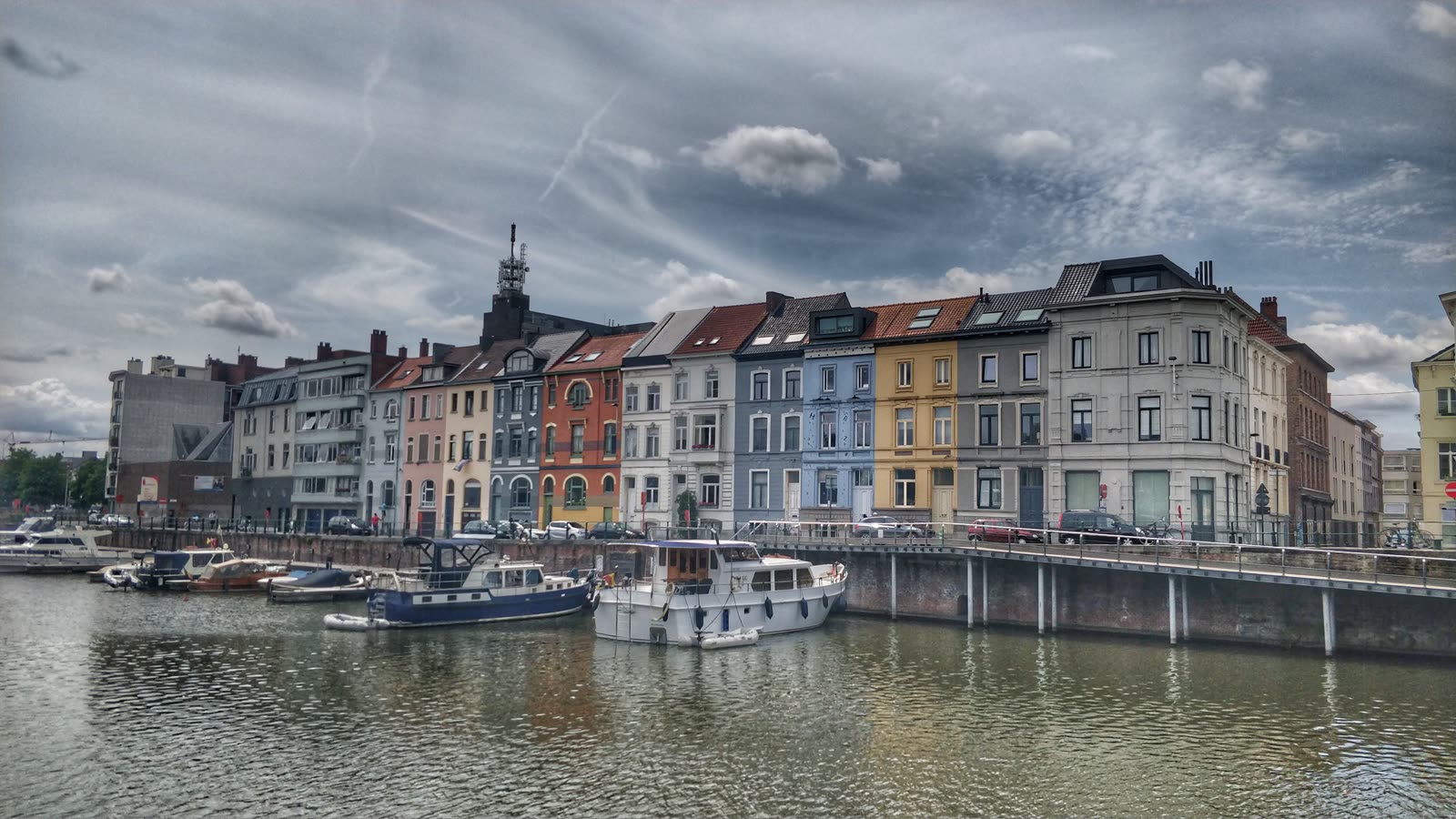
The cover image is useful because it shows the first half of that argument plainly: colored houses, marina edge, and a broad water surface that still feels slightly separate from the central tourist compression.[10] Visit Gent's current city guide still describes Portus Ganda as a restored waterfront within walking distance of the lively centre, while the local guide Time to Momo describes the area as one of the city's most idyllic corners, with a broad wooden landing and a slight holiday atmosphere.[6][7] That is the right tone for the beginning. Do not rush past the water. Let Ghent begin as a confluence, not as a souvenir.
Start Where The Name Starts
Portus Ganda is not just a marina with nice light. Visit Gent frames it directly through origin: Ganda was the place where the Lys and Scheldt came together, and today the same site holds a marina for passing boat traffic.[1] The 2025 city guide adds the recent urban-history layer: this stretch of the river was covered over for cars in the twentieth century and later restored, putting water back into view.[6] Time to Momo gives the local version more bluntly: the Nederschelde was filled in around 1960, the marina arrived in 2005, and the waterway was reopened in 2018.[7]
That history matters because it changes how you stand there. This is not a decorative quay that happened to survive. It is a place the city buried and then partially gave back to itself. The first local move is to spend 8-10 minutes doing almost nothing: stand on the wooden landing, look across the water, and let the facades stay secondary to the meeting of the rivers.[1][6][7] If you need a recognition cue, Visit Gent's Portus Ganda page points to the red sculpture near the Van Eyck swimming pool, the so-called "Ghent Lorelei".[1] Use it as a boundary marker, not as the whole destination.
The second local move is to read the mood correctly. This is a student-quarter edge by day and a calmer waterside corner by evening, not a grand promenade that demands constant movement.[1] Time to Momo's local note about the area feeling vacation-like is accurate because the scale stays loose: moored boats, open water, and enough distance from the denser postcard core to lower your tempo.[7] If Ghent's center often pressures visitors into "more," Portus Ganda is where you start by subtracting.
Then Go Behind The Wall
St Bavo's Abbey is the inward turn that makes Portus Ganda more than a pretty marina. Visit Gent calls it a hidden oasis and places the foundation in the 7th century, when Amand of Ghent tried to convert the inhabitants of Ganda.[2] The longer Historische Huizen story sharpens that into place-history: around 630, Amandus founds an abbey here at Portus Ganda; the cult of Saint Bavo grows; Vikings even winter at the site in 880; the monastery is rebuilt; and the abbey becomes one of the region's strongest religious institutions.[4]
By the 11th century, the abbey reaches its peak, and Visit Gent notes that the complex once included an abbey church whose remains still include the so-called oldest wall in Ghent.[2] Historische Huizen gives the key visual device you still experience today: five-metre-high hornbeam pillars marking the vanished church.[5] This is what makes the site better than a standard ruin stop. It is not only stone remains; it is an outline of former scale, made legible by greenery.
The abbey also stays usefully practical. It is free, reached by bus 16 if you do not want to walk, and currently not accessible for wheelchair users.[3] Visit Gent warns that it is open only for a few hours a week.[2] That limited access is not an inconvenience to work around later; it is something to plan first. The place is valuable precisely because it still feels slightly withheld.
The third local move is to enter the abbey as if the wall were the real threshold, because it is. The Historische Huizen story makes that explicit: pass through the oldest wall in Ghent into the "green church," where hornbeam columns now stand in for the old Romanesque mass.[4][5] The fourth move is to slow down again in the courtyard. Historische Huizen says more than 210 plant species grow among the old stones there.[5] That detail is not botanical trivia. It tells you what kind of afterlife this site has: not museum polish, but masonry sharing space with roots, shade, and weather.
Read The Two Anchors As One District
Visitors often split these places incorrectly. They treat Portus Ganda as a water detour and the abbey as a history detour, when local/community recommendations keep linking them. In the long-running r/Gent sightseeing thread, locals include "St Bavo's Abbey & Portus Ganda" as one recommendation set rather than two unrelated stops.[8] In a more recent thread from August 2025, a local commenter recommends the abbey specifically because it is "slightly out of the way" and "often overlooked."[9] That is exactly the operating logic of this route.
The fifth local move is to keep the east side intact. Do not bounce from Portus Ganda back to the cathedral and then return later. Let the confluence lead into the abbey's absence, because the historical sequence is the point.[1][4] The sixth move is to resist turning the abbey into a speedrun for medieval facts. Yes, John of Gaunt was born there in 1340, and yes, the site was important enough for major Burgundian ceremony later in the century.[4] But the place works best when those facts stay in the background and the spatial reading stays primary: river meeting, wall crossing, green outline, broken scale.
The seventh local move is to use benches, edges, and pauses rather than trying to consume the area like a headline attraction. Community advice around Portus Ganda repeatedly describes the benches, bridge edge, and nearby quiet spots as places to sit rather than to perform sightseeing at top speed.[7][8] This is one of the few central-ish Ghent routes that improves when you stop hunting the next object.
The eighth local move is to treat the article as a 75-110 minute district portrait, not a whole-day plan. Portus Ganda and St Bavo's Abbey are enough. If you append cathedral interiors, shopping streets, or a castle queue, the shape blurs. The whole achievement here is proportion.
8 Local Moves For This Place Portrait
- Start at Portus Ganda, not the Belfry. Ghent reads better from the confluence outward than from the postcard center backward.[1][4]
- Stand on the water edge for 8-10 minutes before walking on. Let the meeting of the rivers do the first explanatory work.[1][6][7]
- Use the red "Ghent Lorelei" only as a cue. It helps orientation, but the real anchor is the water geometry around it.[1]
- Check abbey hours before you leave. The site is free but only open for limited hours each week.[2][3]
- Enter through the oldest wall and pause in the green church outline. The hornbeam pillars explain the lost scale better than a plaque does.[4][5]
- Give the courtyard real time. The abbey is strongest when you notice the overgrown ruin condition, not when you collect it as a quick medieval stop.[5]
- Use bus 16 only as a fallback, not the default. If the weather is decent, the route works best as a continuous district walk; the bus matters mainly for exit or accessibility planning.[3]
- Stop after the abbey. Treat success as a complete east-side reading, not as proof that you should add three more sights.
Non-local Trapline
Mistake 1: Treating Portus Ganda as just a photogenic marina
Better move: read it as the restored confluence where Ghent's origin story becomes physically visible again.[1][6][7]
Mistake 2: Assuming the abbey can be dropped in casually at any hour
Better move: check hours first. The site is free, but its limited opening window is part of the route's operating reality.[2][3]
Mistake 3: Splitting the two anchors across different days or different moods
Better move: keep them in one pass. Local recommendation patterns already treat Portus Ganda and St Bavo's Abbey as a linked east-side experience.[8][9]
Concrete Go Details
- Best window: late afternoon into early evening on a dry day, when Portus Ganda still has light on the water and the abbey can feel green rather than merely grey.
- Time budget: 75-110 minutes for a calm version with actual pauses at both anchors.
- Spend: EUR 0 if you walk; the abbey is free, and Portus Ganda is a public outdoor stop.[1][3]
- Transit fallback: bus 16 serves the abbey area; use it mainly if weather, fatigue, or timing breaks the walking plan.[3]
- Access reality: St Bavo's Abbey is currently not accessible for wheelchair users.[3]
- Recognition cues: the confluence and marina edge at Portus Ganda, the red waterside sculpture, the oldest wall in Ghent, the hornbeam church outline, and the courtyard flora of 210+ species.[1][4][5]
- Recent confirmation: this route uses current Visit Gent and Historische Huizen pages plus a 2025 city guide and 2025 community discussion, so the operating details are not built on old guidebook memory.[2][3][6][9]
Ghent has many places that perform "historic city" on command. Portus Ganda and St Bavo's Abbey do something harder. They show the city before the performance fully starts: a confluence, a mission site, a great church reduced to outline, and a quiet green interior that makes loss legible instead of hiding it. If you want one compact non-food Ghent route that feels local without pretending to be secret, this is the cleanest one.
Sources
- Visit Gent, "Portus Ganda" (official page covering the confluence of the Lys and Scheldt, the marina, the "Ghent Lorelei," and the site's position less than a kilometre from the city heart).
- Visit Gent, "St Bavo's Abbey" (official page covering the 7th-century foundation, 11th-century peak, 1540 demolition, the hidden-oasis framing, and limited opening hours).
- Historische Huizen Gent, "Practical information" (official visitor information covering free admission, bus 16 access, photography rules, and current accessibility limits).
- Historische Huizen Gent, "The story of St Bavo's Abbey" (official historical walk text covering the c. 630 foundation at Portus Ganda, Viking disruption, the oldest wall in Ghent, John of Gaunt's 1340 birth, and the 1540 demolition).
- Historische Huizen Gent, "Green splendour on the edge of the city" (official page covering the five-metre hornbeam pillars, the green church concept, and 210+ plant species in the courtyard).
- Visit Gent, "Official City Guide 2025" (recent official PDF guide confirming the restored waterfront context of Portus Ganda and its walking-distance relation to the centre).
- Time to Momo, "Portus Ganda" (local guide page describing the district's holiday atmosphere, wooden landing, 1960 river covering, 2005 marina opening, and 2018 reopening of the Nederschelde).
- Reddit
r/Gent, "Things to do in Ghent, sightseeing" (community recommendation thread that explicitly groups "St Bavo's Abbey & Portus Ganda" as a useful city stop). - Reddit
r/Gent, "Things to do for history and gothic lovers" (community thread from August 5, 2025 recommending the abbey as slightly out of the way and often overlooked). - Wikimedia Commons, "File:Portus Ganda, Ghent, Belgium .jpg" (photographic image used for this article, showing the Portus Ganda waterfront in Ghent; uploaded July 8, 2019).
Editor’s Pick Review
This article takes today’s merged standard/add-on editor-pick slot because it is the strongest 24-hour candidate on the dimensions that matter for this feed: route usefulness, source depth, local specificity, image-policy compliance, and bilingual reading quality. The English piece keeps the city-travel frame unusually disciplined by limiting Ghent to two linked non-food anchors, then making the confluence, abbey wall, 1540 rupture, opening-hour constraint, and 75-110 minute route shape work as one readable district portrait. Its visual choice is immersive and topic-grounded rather than analytical, while the Chinese edition preserves the same spatial logic with natural cadence, stable terminology, and low translationese across a locally detailed article.