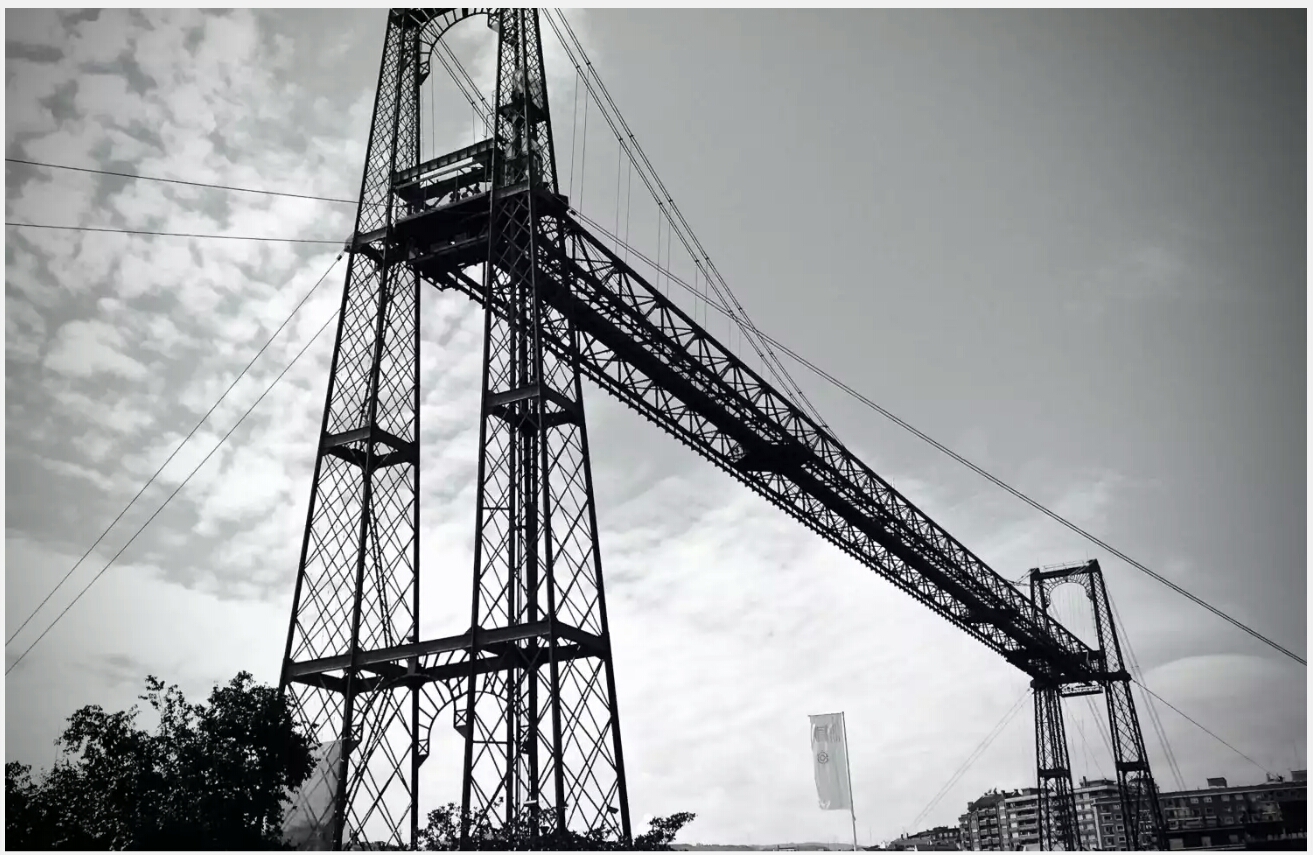
Bilbao has grander museum entries, louder pintxo districts, and prettier single viewpoints than this. The more useful move is narrower: go out to Portugalete, cross the estuary in the Bizkaia Bridge gondola, and keep walking on the Getxo side until the bridge turns into the grand-villa promenade instead of a one-photo stop.[1][3][4][5] In one short sequence, the metropolitan estuary stops being background scenery and starts behaving like a social diagram. The left bank still reads as the industrial margin. The right bank still reads as the bourgeois margin. The bridge is the hinge that makes that difference legible on foot.[3][4]
The official facts already tell you why this works. The Bizkaia Bridge was the first transporter bridge in the world, opened on 28 July 1893, and later gained UNESCO World Heritage status in 2006.[3][4] Visit Biscay's bridge pages keep the class geography blunt: on the left bank, ore and iron were worked; on the right bank, the bourgeoisie settled.[3] The structure itself clarifies the engineering logic. Visit Biscay describes a 160-metre crossbeam with 45 metres of clearance above the estuary, built so people, carts, and later vehicles could cross without blocking shipping.[4] The bridge is not just a monument. It is still a live piece of movement infrastructure.
That live/inert split is exactly why non-locals often use it badly. The bridge has two completely different crossing logics. The tourist walkway at the top is a scheduled panoramic visit: in the current official timetable it runs 10:00-20:00 from Easter to October, or 10:00-14:00 and 16:00-19:00 from November to Easter, with last access 20 minutes before closing.[1] The gondola below is the everyday crossing. CTB lists the ordinary pedestrian fare as EUR 0.60 from 05:00-22:00, rising to EUR 0.80 from 22:00-00:00 and EUR 1.70 from 00:00-05:00.[2] The bridge's own operator adds the practical rhythm that matters most for walkers: outside the late-night fixed departures, the gondola runs continuously and takes about 8 minutes per journey.[1] That is the local key. Use the top if you specifically want the panorama. Use the gondola if you want the estuary to behave like part of the city.
Image context: the cover uses a real Wikimedia Commons photograph of the Bizkaia Bridge with the gondola visible below the iron frame. That is the right documentary image here because the article's entire argument depends on operational reality, not postcard atmosphere. You are meant to see the crossing mechanism itself.[10]
Why the direction matters
Start from Portugalete, not Getxo. Visit Biscay's Portugalete page still frames the town through port history, estuary traffic, and the left-bank industrial buildout, while the Getxo side is repeatedly described through the Grand Villas, sea air, and bourgeois architecture.[5][6] If you cross in that order, the right bank feels like an arrival into another urban temperament. If you do it backwards, you get the same landmarks but a weaker narrative.
Portugalete also gives the bridge more weight before you board it. The town was founded in 1322, grew as a port, and still stretches along about 2 kilometres of estuary edge.[6] The bridge enters that setting as working iron, not as decorative nostalgia. Then, on the far side, the Getxo route settles into the Paseo de las Grandes Villas, a flat coastal walk of 2.3 kilometres from the Evaristo Churruca monument toward Ereaga and Punta Begoña.[5] That second section matters because it shows what the right bank did with the wealth that estuary industry created: palatial façades, eclectic and neo-Basque architecture, and a promenade that still feels designed for display as much as circulation.[5]
Local advice lines up with that sequence. In a recent r/Bilbao thread about bridge prices, residents and repeat visitors keep making the same distinction: the barquilla is the practical crossing, the walkway is the tourist one, and the bridge works best when you stop confusing the two.[7] In another Bilbao day-trip thread, a local recommendation is even more direct: go to Getxo, walk to the Hanging Bridge, and continue along the sea toward the old port rather than treating the bridge as the whole outing.[8] A newer general tips thread says much the same in compressed form: if you make it out to Getxo and Portugalete, take the bridge and the little shuttle boat instead of leaving after the first look.[9]
8 local moves that make the route land correctly
- Use the gondola for your first crossing, not the upper walkway. The CTB fare table and the recent local Reddit thread both make the distinction clear: the everyday crossing is the cheap, practical one; the top deck is a separate panoramic visit.[1][2][7]
- Begin on the Portugalete side if you want the class shift to read properly. Left-bank port and iron first, right-bank villas second: that is the order the estuary history itself suggests.[3][4][6]
- If you are arriving from Bilbao by Metro, treat Peñota as the Portugalete-bank stop and Areeta as the Las Arenas return stop. Visit Biscay's bridge access page points to those two stations as the clean rail approach to each side.[4]
- Keep the bridge crossing short and purposeful. The gondola only takes about 8 minutes, so this is not the moment for a long queue psychology or overplanning problem.[1]
- Commit to at least the first kilometre of the Grand Villas promenade after landing in Las Arenas. Otherwise you reduce the right bank to a station exit and one photograph, which misses the social contrast the route is built to show.[5]
- Save the upper walkway for a second pass or a clear-weather add-on. It has fixed visiting hours, weather sensitivity, and a last-entry clock; the gondola keeps the route robust when conditions are less forgiving.[1]
- Do not rush straight back after the bridge. The Getxo promenade is flat, simple, and lined with exterior-only architecture that does not ask for ticketing or appointments; that makes it the perfect second half after a short infrastructural crossing.[5]
- If your legs and light still hold, keep drifting north and return from Neguri instead of turning immediately at Areeta. Visit Biscay's promenade guide treats Areeta and Neguri as the two practical bookends, and locals repeatedly recommend continuing toward the seafront rather than bouncing back at the bridge.[5][8]
Non-local trapline
Mistake 1: paying for the top walkway because you think that is the normal way to cross
Better move: separate the two products. The official bridge page lists the walkway as a panoramic ticketed visit, while CTB prices the gondola as ordinary public transport from EUR 0.60 in standard hours.[1][2]
Mistake 2: doing the bridge as a single photo and leaving
Better move: cross once and keep walking. The bridge only becomes urban evidence when it resolves into Getxo's 2.3-kilometre villa promenade or back into Portugalete's estuary edge.[5][6][8]
Mistake 3: starting on the Getxo side because it sounds prettier
Better move: start on Portugalete and let the social contrast sharpen in the right direction. The left bank tells the industry story; the right bank tells the display-and-residence story.[3][4][6]
Mistake 4: assuming the panoramic walkway is a frictionless backup plan
Better move: remember the clock. The top walk has seasonal hours and last access 20 minutes before closing, while the gondola keeps running as transport far beyond the sightseeing window.[1][2]
Concrete go details
- Best window: 17:00-19:00 from Easter to October works best for the gondola plus a partial Grand Villas walk; in winter, shift that earlier because the panoramic walkway drops to a 19:00 close and the afternoon split begins after 16:00.[1][5]
- Expected spend: EUR 0.60 for the standard gondola crossing with the transport fare, or EUR 11 if you specifically want the round-trip upper walkway visit.[1][2]
- Queue and reservation reality: the gondola is a working transport link and normally runs continuously at about 8 minutes per crossing; the walkway is the part with a formal visiting clock and a last-access rule.[1]
- Where to stand or pause: first on the Portugalete boarding side to read the iron frame at working scale, then on Muelle de Las Arenas once you land, where the promenade begins converting the crossing into architecture.[5][6]
- Navigation cue:
Bilbao Metro -> Peñota -> Bizkaia Bridge gondola -> Las Arenas / Areeta -> Grand Villas promenade -> optional Neguri return. - Numeric anchors worth keeping: 1893, 2006, 160 metres, 45 metres, 2 kilometres, 2.3 kilometres, 10:00-20:00, 10:00-14:00, 16:00-19:00, 20 minutes, 05:00-22:00, EUR 0.60, 8 minutes.[1][2][4][5][6]
Bilbao does not need another generic river walk. What it does reward is one exact estuary crossing used in the correct order. Portugalete first, Las Arenas second, villas after iron: the city explains itself very quickly once you let the bridge do more than decorate the horizon.
Sources
- Puente Bizkaia, "Rates and Schedules" (official bridge page with current walkway hours, last-access rule, gondola schedules, and approximate crossing time).
- Consorcio de Transportes de Bizkaia, "Transporter bridge" (official public-transport fare page for the ordinary, prolonged, and special gondola service).
- Visit Biscay, "Bizkaia Bridge" (official local tourism page framing the bridge as the first transporter bridge, UNESCO site, and left-bank/right-bank social hinge).
- Visit Biscay, "The Puente Colgante, Bizkaia's triumphal arch" (official local tourism feature with the 1893 opening date, structure dimensions, and Metro access cues for Areeta and Peñota).
- Visit Biscay, "The Paseo de las Grandes Villas in Getxo: the splendour of bourgeois architecture" (official local route guide with the 2.3-kilometre promenade, Areeta/Neguri access, and the bourgeois architectural frame).
- Visit Biscay, "Portugalete, a town with views over the Estuary" (official local tourism page with Portugalete's 1322 foundation, roughly 2-kilometre estuary esplanade, and left-bank historical texture).
- Reddit / r/Bilbao, "Biscaya Bridge" (recent local/community thread clarifying the difference between the tourist walkway ticket and the everyday barquilla crossing, with neighborhood-level practical advice).
- Reddit / r/Bilbao, "Day trips from Bilbao? (solo traveller)" (local/community advice recommending the Hanging Bridge and then continuing along the sea toward the old port).
- Reddit / r/Bilbao, "Best things to do in Bilbao?" (recent local/community thread recommending Getxo, Portugalete, and the bridge or little shuttle boat as a worthwhile metro-side excursion).
- Wikimedia Commons, "File:Puente Vizcaya .jpg" (documentary photograph source page for the bridge image used with this article).