The useful word in Via del Campo 29 Rosso is the last one. Genoa once assigned black street numbers to homes and red ones to businesses at street level; the colour remains part of an address. Keep the R when looking up this particular door.[1] Behind it, the former Musica Gianni Tassio record shop houses a small museum devoted to the city’s singer-songwriters.[2] Before you have heard a note, the address has already told you something about the street: music found its place here through a shopfront.
Via del Campo carries a heavy load of expectations. Fabrizio De André sang about it, and visitors still arrive looking for the place they imagine from the song. An Italian Tripadvisor reviewer, returning after many years, found the street disappointingly changed; a Genoa-based contributor pointed instead to its painted façades and their need for renewed care.[3] Both accounts are useful preparation. Come ready to look at a living street, including the parts that do not arrange themselves into a tribute.
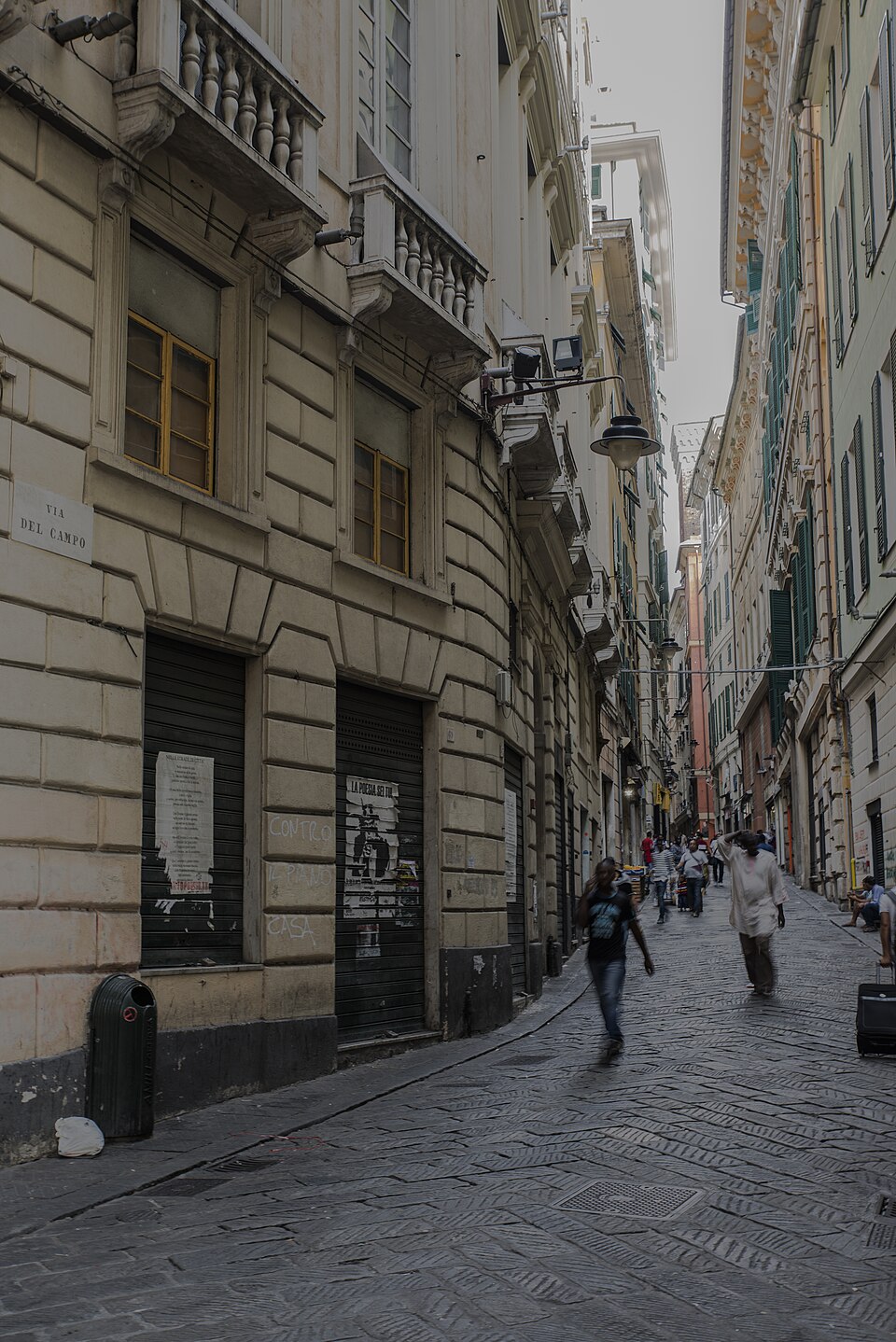
Through the gate, at street pace
For an uncomplicated arrival, use Darsena metro station. The municipal visitor page also places the museum about 10 minutes on foot from Genova Piazza Principe railway station.[5] Find Via delle Fontane and the passage through Porta dei Vacca, the approach shown in the photograph, then continue into Via del Campo.[8] The gateway gives you something physical to recognize in a district where a handful of turns can make a map feel surprisingly abstract.
I would give the street and museum 60–75 minutes, starting around 10:30 on a Thursday or Friday. This is a suggested pace, with daylight for looking up at the façades and time indoors before lunch. Let your eyes travel above the shop signs: the Genoese reviewer’s photographs and commentary draw attention to the painted upper buildings.[3] Stop where people can pass, then move on when a doorway needs to be used. The pleasure here comes from noticing how much frontage, passage and domestic life fit into a narrow strip of city.
The first visitor trap is expecting the street to reproduce a favourite song. A useful counterpoint appeared in the local r/Genova community in December 2025: the maker of Parallele, an audio documentary about Via del Campo and the nearby ghetto, described months spent listening to residents and an effort to avoid both picturesque folklore and crisis stereotypes.[4] You need not listen to the programme to take that approach seriously. Let the people using the street remain people, rather than characters enlisted to complete your musical pilgrimage.
Read the opening hours as carefully as the address
As checked on October 17, 2026, the museum’s own schedule lists Monday, Tuesday and Thursday–Sunday, 10:00–13:00 and 15:00–19:00, closed Wednesday.[2] The midday break matters: an arrival at 13:15 leaves a substantial wait.
The second trap is following a review platform’s hours without checking the museum. Tripadvisor’s listing shows a 14:00 weekend restart, an hour earlier than the museum’s current timetable.[6][2] Use the museum page before setting out; its contact number is +39 010 2474064.[2] This small check does more for the visit than adding another landmark to the walk.
Once inside, resist the third trap: seeing merchandise and deciding you have already understood the place. Italian reviewers describe a compact combination of shop and museum, and several explicitly value its modest scale. One notes the presence of Gino Paoli and Luigi Tenco alongside De André; another describes documents and records that reward attention beyond a quick glance.[6] Walk far enough in to see the collection before deciding how long to stay.
The guitar, photographs and school records recur in visitors’ accounts.[6] My suggestion is to choose one ordinary document as well as the famous instrument. A school report or concert poster gives a different scale to a remembered voice: someone studied, worked, toured and left paperwork behind. You do not need encyclopedic knowledge of Italian songwriting to recognize that change in distance.
A room with something still to say
The museum’s present programme makes the strongest case for keeping the visit open-ended. On October 12, 2026, its operator, Cooperativa Solidarietà e Lavoro, announced Extra-Musica – Voci dal Territorio: three free gatherings about music, memory and urban change.[7] The first is scheduled for October 17 at 17:00, with Bruno Segalini discussing Milan’s Leoncavallo cultural space and its connections to wider questions about cities. A Piero Ciampi event follows on November 7 at 17:00.[7]
These are advertised as free, without reservations. If attending, I would arrive 15–20 minutes early; that is a planning allowance for a small venue, not a reported queue length or a guarantee of a seat.[7] For an ordinary collection visit, the official page lists free entry and no timed reservation requirement.[2] The distinction is useful: a short look at the displays and an afternoon gathering ask different amounts of your time.
Budget €0–10 per person, excluding transport and shopping. Admission is free; the upper figure is simply an optional refreshment allowance, not a quoted local menu price.[2] Buying a record can be its own pleasure, but it need not be the price of entering the story.
When you step outside, look again at the red number. It marks a place where things were sold, collected and passed between people. The current programme adds another use to that same small doorway: somewhere the city can gather to talk about itself. Via del Campo becomes more interesting when you leave it a little room to keep changing.
Sources
- Comune di Genova, guide to entering and verifying civic addresses — historic red and black numbering and the R/N address fields.
- Musei di Genova, “Viadelcampo29rosso” — collection, current opening hours, free admission and contact details; checked October 17, 2026.
- Tripadvisor Italia, “Via Del Campo” — Italian-language street reviews, including Genoa-based Angelo G. Valle’s account and photographs of the façades; reviews published in 2024–2025.
- r/Genova, “Parallele — un audio-documentario su Via del Campo e su chi la abita,” December 22, 2025 — the creator’s account of listening to residents.
- Visit Genoa, “Via del Campo 29Rosso” — Darsena metro access, walking approach from Piazza Principe and the museum’s address.
- Tripadvisor Italia, “Via del Campo 29 Rosso” — Italian-language visitor accounts of the small collection and shop; platform hours compared with the official timetable.
- Cooperativa Solidarietà e Lavoro, “Extra-Musica – Voci dal Territorio,” October 12, 2026 — autumn programme, event times and free admission without booking.
- Alessandro.photographer, “Via del Campo – Genova,” September 24, 2016, Wikimedia Commons — photograph from Porta dei Vacca; CC BY-SA 4.0.