At the centre of Melbourne’s Shrine of Remembrance, a stone waits for a word to become visible in sunlight. The word is LOVE. Each November, the building gives it a brief, deliberate illumination; the rest of the room supplies the darkness that makes it matter.[5] For a visitor, the useful detail is an hour’s difference: the Remembrance Day ceremony observes 11 a.m., while the public can watch the light again at noon.[2]
That distinction is easy to miss. In a January 2026 discussion on r/melbourne, a visitor delighted by the light moving over the stone described it as sunlight. Other contributors explained that the visitor had seen the everyday artificial demonstration, then untangled that effect from the reflected November sunlight and its later direct passage.[3] Their exchange captures the first mistake to avoid: planning a morning around “the ray of light” without deciding which version you mean.
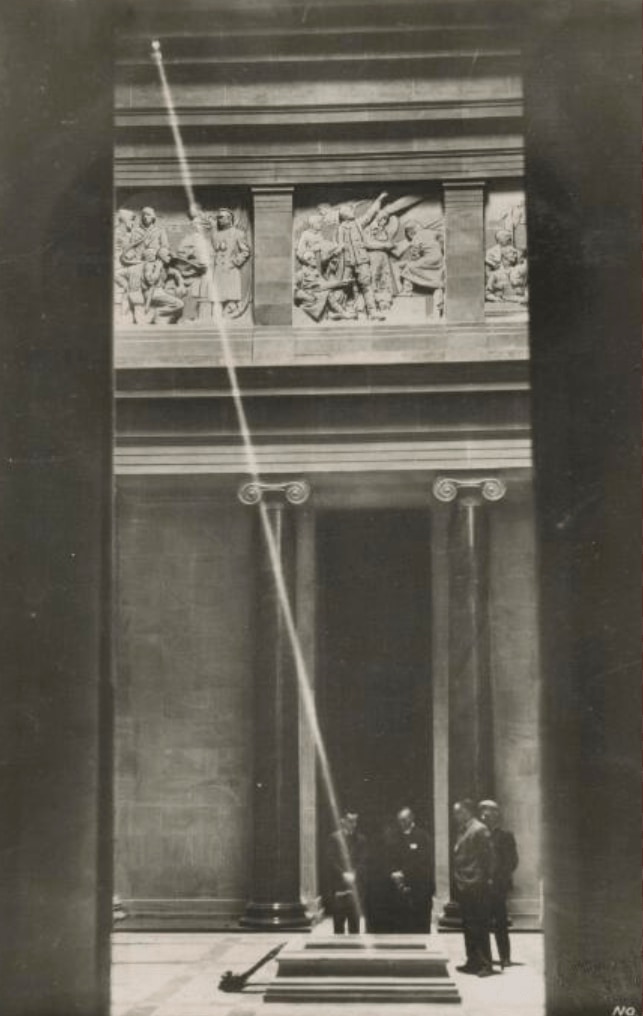
The original arrangement joined architecture to the sun’s position: an opening in the roof sent a beam across the Stone of Remembrance at 11 a.m. on 11 November. Daylight saving shifted that appointment to noon. From 1975, surveyor Frank Johnston and his colleagues used two mirrors to redirect sunlight along the intended path for the earlier ceremony. Afterwards, they remove the mirror in the roof opening, letting the sun make its direct passage at midday.[1]
There is something moving about the practical work behind that precision. A city changed its clocks; people kept returning to adjust the building’s light. The Shrine opened in 1934, when the loss of the First World War remained a household experience across Melbourne. Adam Scroggy’s April 2026 account for Australian Geographic describes a community needing somewhere to remember relatives whose graves were far away.[6] The stone stands for Victorian service people buried overseas or in unmarked graves.[5] Knowing that changes what it means to gather around it.
For Wednesday 11 November 2026, the City of Melbourne lists the public service from 10:30 to 11:30 a.m., followed by the public viewing at midday. Attendance is free, bookings are unnecessary and seating is limited.[2] My suggested window is 10 a.m. to about 12:15 p.m.: time to settle before the service and remain for the light, rather than arriving at the famous hour and leaving as the outdoor crowd begins to move. That is a planning allowance, not a promise of admission to a particular position inside.
Local guide Melbourne Point recommends arriving before 10:30, especially for anyone who needs a seat. Its warning about limited nearby parking also argues for approaching on foot or by public transport.[4] From Flinders Street station, the Shrine gives the distance as 1.3 kilometres. Alternatively, use Anzac station’s Domain Road exit, Exit 4, and follow the path through the reserve. These directions appear in the Shrine’s visitor information updated in March 2026.[7] Check the event listing again before travelling; ceremony arrangements can differ from an ordinary visit.
Finding the monument is easier than finding the appropriate door. On normal days, the visitor entrance is on the eastern side at the lower level; the grand upper entrances serve ceremonial occasions.[6] The same local Reddit discussion includes someone surprised that the public could go inside at all, followed by an explanation that the entrance was around the other side.[3] Avoid the second mistake: inspecting the monumental steps, assuming they tell the whole story, and leaving. On Remembrance Day, ask a staff member where to join the noon Sanctuary access before choosing a place for the service.
The public service takes place outside on the Second World War Memorial Forecourt.[4] A seat there should not be confused with a reserved view of the stone indoors. There is no published timed-ticket system or guaranteed waiting time for the midday viewing in the city listing.[2] Let the staff direct the transition after the service, and keep the next part of your day loose enough to follow their instructions. Do not assume that an ordinary tour booking includes ceremony access.
Prepare for an outdoor spring morning: Melbourne Point advises sun protection or rain clothing as needed, and asks visitors to avoid obstructing other people’s views. It also calls for quiet conversation and discreet photography.[4] Put the phone away for the silence. Later, when admitted to the Sanctuary, choose a position from which you can see the central stone while leaving circulation space; lifting a screen above another person’s head adds little to the experience. Ordinary access to this room is by internal stairs or lift from the galleries.[5]
The light itself remains weather dependent. Johnston describes years when cloud defeated the arrangement despite all the preparation.[1] Come prepared to value the observance even if Melbourne withholds the sun. The uncertainty belongs to the event: the building can position an opening, and the surveyors can align mirrors, but neither can clear the sky.
If your dates fall elsewhere, the everyday demonstration has its own value. The Shrine runs it every half hour from 10:30 a.m. during normal visiting hours.[5] The January community discussion shows how convincing it can be, even for someone who misunderstood its source.[3] Ask for the next demonstration on arrival and see it as an introduction to the design. Mistaking it for November sunlight is unnecessary; dismissing it once you know it is artificial would lose the chance to understand what the room was built to do.
For this independent visit, allow A$0–10 at the Shrine: admission costs nothing, and the upper end is simply an optional donation allowance, not a fee. Transport, refreshments and any separately booked tour are extra. Normal opening hours are 10 a.m.–5 p.m., with last entry at 4:30 p.m.[7] Those ordinary hours are useful for a return visit; they do not override the day’s ceremony arrangements.
When the room opens to the public, look first at the stone rather than up at the roof. The mechanism explains how the light arrives. The small word beneath it explains why the city has kept an appointment with it.
Sources
- Shrine of Remembrance, “Shrine Stories: the Ray of Light,” 4 November 2024 — Frank Johnston interview transcript and archival photograph.
- City of Melbourne, “Victorian State Remembrance Day Service” — current listing for Wednesday 11 November, 10:30–11:30 a.m., public midday viewing, free attendance and limited seating; checked 16 October 2026.
- r/melbourne, “Caught the sun going across the words in the crypt at the shrine yesterday. Really amazing experience,” January 2026 — community discussion of artificial demonstrations, November sunlight and the visitor entrance; anecdotal accounts, with technical claims checked against the Shrine.
- Michael Jones, “Remembrance Day,” Melbourne Point — 2026 local guide to the outdoor forecourt service, early arrival, seating, parking and respectful photography; checked 16 October 2026.
- Shrine of Remembrance, “Shrine highlights,” updated 7 August 2025 — the stone’s meaning and position, half-hour demonstrations from 10:30 a.m., and stairs or lift access to the Sanctuary.
- Adam Scroggy, “Shrine of Remembrance: A place of connection,” Australian Geographic, 21 April 2026 — Melbourne’s commemorative context, the daylight-saving adjustment and the distinction between everyday and ceremonial entrances.
- Shrine of Remembrance, “Plan your visit,” updated 11 March 2026 — free admission, donations, opening hours, distance from Flinders Street and Anzac station’s Domain Road exit; checked 16 October 2026.