At Flag Rock, the most interesting change happens before the sun disappears. People who have been walking stop. The edge of a fort becomes a place to spend time together. Time Out Sri Lanka identifies this southern bastion as a gathering point for sunset; recent visitor reviews describe the open sea, the waves below and the pleasure of an evening here.[1][3] The useful thing to bring is an unclaimed hour.
There is a pleasing reversal in that pause. Flag Rock once helped people communicate with approaching ships: the flags in its name had a practical maritime purpose.[2] Today, many of the people facing the water have nowhere further to go. A place built for watching arrivals has become somewhere to remain.
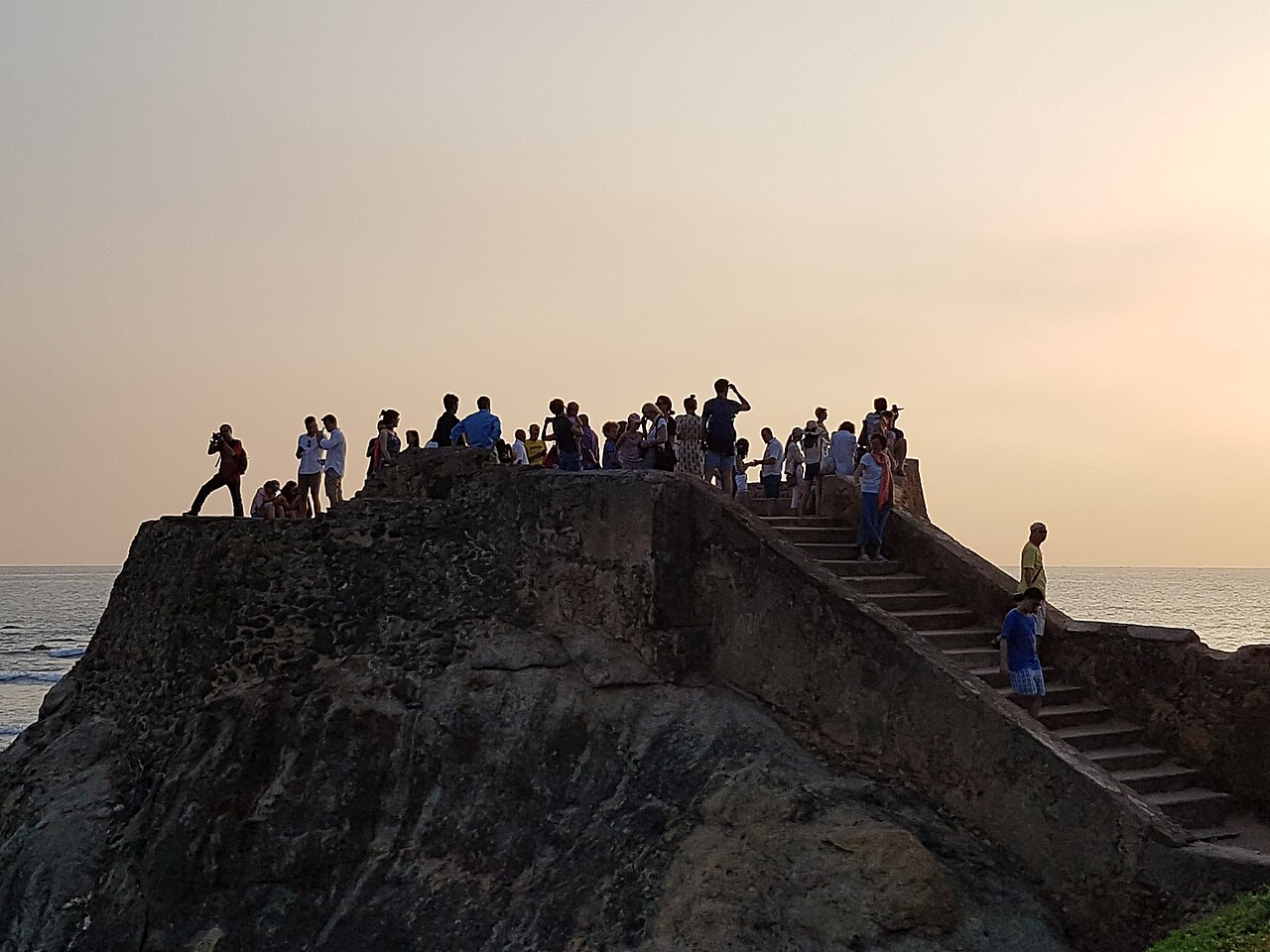
Arrive while there is still time to choose
Make Flag Rock Bastion the destination in your map. From the fort’s main gate, allow roughly 15 minutes on foot through the interior streets towards the southern sea wall. Church Street and Leyn Baan Street are useful approach routes. The white lighthouse lies east of Flag Rock: it helps you orient yourself, but the projecting bastion is the place you are aiming for.[2] This short approach leaves time to notice where the streets open into ocean.
For an October visit, aim to reach the bastion around 17:15–17:25. On 13 October 2026, Galle’s calculated sunset is 17:55, with civil twilight ending at 18:16.[5] That makes a 60–75-minute visit a sensible personal allowance, including the approach. These are planning suggestions, not an organised event schedule. Check the sunset for your own date; arriving at six because “sunset is at six” can cost you the part you came to see.
Choose a weekday if you have flexibility. In a December 2025 discussion on r/srilanka, a contributor identifying themselves as a Galle resident singled out Saturday sunset for the worst traffic, with Fridays, Sundays and holidays also busy.[4] That is one resident’s experience rather than a traffic forecast, but it makes the case for walking the last stretch. Asking a driver to deliver you as close as possible can spend the remaining daylight on a street you could have crossed on foot.
A view without a cover charge
There is no admission ticket or reservation for Flag Rock’s public rampart walk.[2] You are choosing a position among other visitors, rather than waiting for an allocated slot. A busier evening means less space to settle, not a sold-out performance.
The view itself costs LKR 0. For this short stop, a discretionary budget of LKR 0–500 per person is a reasonable self-imposed allowance if you bring water and skip the cafés; it is not a quoted refreshment tariff and excludes transport. Ask a vendor’s price before buying. The local discussion includes complaints about how expensive fort cafés have become even for residents, alongside a visitor’s practical advice to check prices where none are displayed.[4] There is no need to purchase a table to take part in the evening.
Once on the platform, choose a position back from the exposed edge and leave the approach clear. The sea and the projecting stonework provide the view without any need to balance on a parapet. Reviews collected on Wanderlog emphasise the force of the water below; its visitor notes also flag the rocks beneath the edges.[3] Flat shoes and daylight make the uneven surfaces easier to judge.[2]
Watch the water without turning it into a dare
Flag Rock’s divers can draw attention away from the horizon. Time Out’s local coverage describes young men making a steep leap into rocky water.[1] Their familiarity with this particular place is not something a visitor acquires by watching. Stay on the public walkway; do not follow someone down to reproduce the photograph.
Nor should a dive become the appointment around which you organise the visit. It is an informal activity, not a scheduled attraction.[2] An evening without it still has everything needed for this stop: sea, changing light, a stone platform and people finding somewhere to stand. Treat the sunset similarly. Cloud can take away the bright disc without taking away the gathering.
The town behind the photograph
Turn inland once before leaving. Galle’s walls enclose homes as well as visitor businesses. UNESCO specifically identifies the survival of residential and public uses as part of the old town’s authenticity; it also credits local craftspeople with adapting European designs to Sri Lankan conditions.[6] Calling the fort a transplanted European town misses both the work that made it and the people who continue to inhabit it.
That helps explain a friction raised in the local discussion: visitors wonder why vehicles enter a picturesque heritage quarter, while a resident points out that people living there still need to get around.[4] On the approach and return, leave doorways clear and step aside for traffic. Carry your bottle or wrapper out with you. The same discussion records litter complaints; it is evidence of a problem people care about, not permission to add to it.
Leave before fading light makes the rampart footing difficult, then take the interior lanes back. Flag Rock asks for very little expenditure and a modest adjustment of pace. For a while, the old signal station gives everyone facing the sea the same reason to stop.
Sources
- Time Out Sri Lanka, “A Dutch legacy – Galle” — local editorial coverage of Flag Rock’s sunset gathering and divers.
- Lakpura, “Flag Rock Bastion, Galle Fort” — Sri Lankan operator’s account of the signal point, walking approach, free access and practical conditions; consulted 13 October 2026.
- Wanderlog, “Flag Rock Bastion” — Google visitor reviews, including entries dated 5 December 2025 and 8 and 27 February 2026, plus visitor notes on the exposed edges.
- r/srilanka, “Galle—total tourist trap?” — discussion begun 28 December 2025, including a self-identified resident’s account of weekend traffic, café prices and the fort as a residential neighbourhood; individual observations, not a representative survey.
- Time and Date, “Sunrise and sunset times in Galle, October 2026” — 13 October sunset and civil twilight, in local time.
- UNESCO World Heritage Centre, “Old Town of Galle and its Fortifications” — local adaptation of architecture, continuing residential use and the conservation of a living city.
- Peter Addor, “Sunset behind Galle Fort 1,” 3 February 2017, Wikimedia Commons — photograph of the gathering at Flag Rock Bastion, licensed CC BY-SA 4.0.