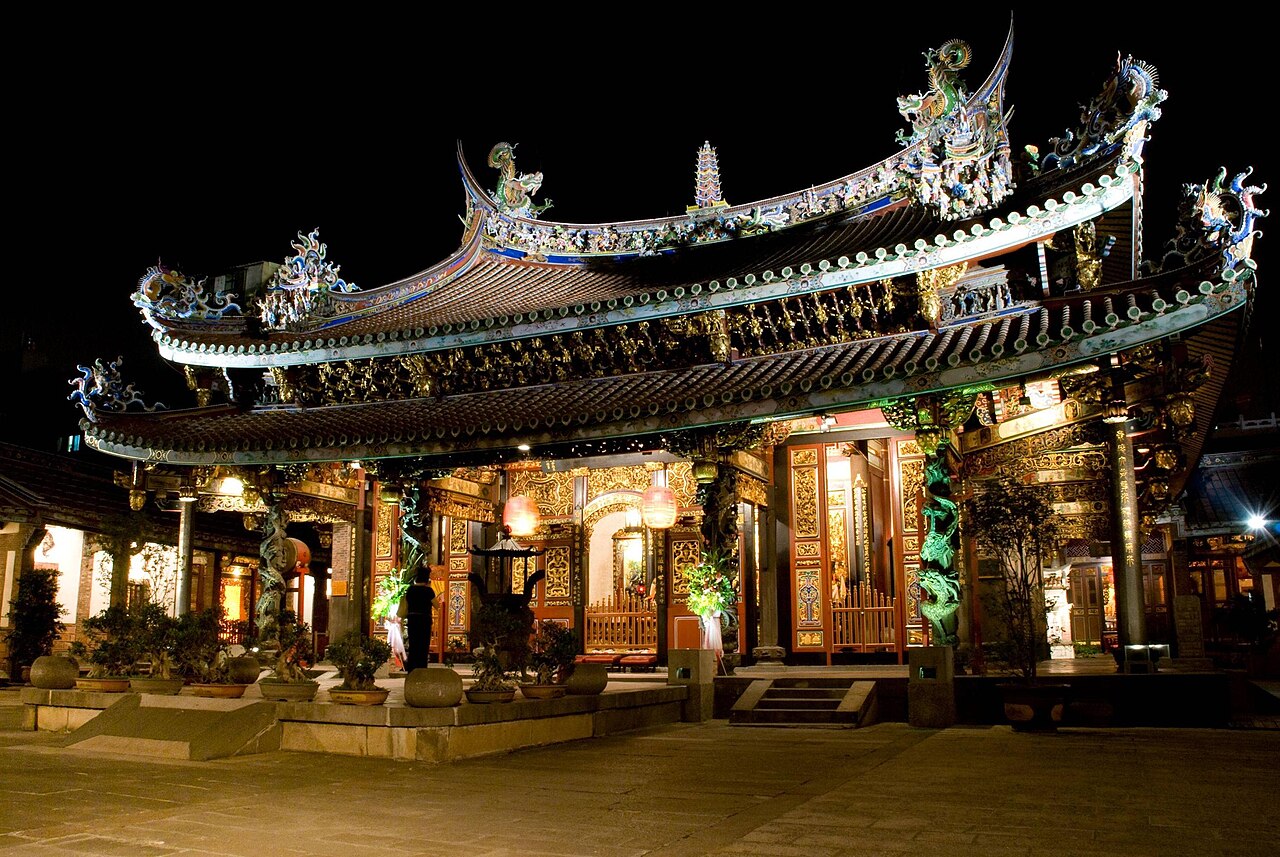
At Dalongdong Baoan Temple, the evening invitation is a doorway full of light. Taiwanese photographer Hans Chen’s account of a night visit moves from the long frontage into a courtyard, then along passages where painted walls and carved beams keep interrupting his progress. People are still praying. The useful lesson in his photographs is how much of the temple lies beyond the first satisfying picture.[1]
Baoan offers a small, absorbing evening in northern Taipei: one temple, enough time to look, and no obligation to turn the outing into a circuit of attractions. Taiwan-based writer Steven Crook singles it out as especially attractive around sunset. His account also makes an essential point about visiting folk temples: a foreign visitor can enter respectfully while worship continues.[2] You do not need to wait outside for the room to become empty.
For an ordinary evening, I would arrive between 18:30 and 19:30 and allow 45–60 minutes. That is a suggested visiting window, not a scheduled performance. Taipei’s Department of Cultural Affairs lists daily opening from 06:00 to 21:00; leave a comfortable margin before closing.[3] Take the MRT to Yuanshan, Exit 2. The temple’s own directions allow roughly 15 minutes on foot: follow Kulun Street, turn right onto Dalong Street, and continue toward 61 Hami Street.[4] Save that address before leaving the station.
The façade can initially feel like the whole destination. Chen’s photographs show why it is worth approaching rather than taking a distant view and moving on: dragon columns, stone lions and lanterns give the entrance a finer scale. He entered beside the main gateway.[1] Use the open visitor entrance indicated on the evening you arrive, then pause where you are clear of people coming through. Let the courtyard introduce the arrangement of halls before choosing a direction.
Baoan is dedicated to Baosheng Dadi, the God of Medicine. Its name carries the protection sought by immigrants from Tong’an in Fujian.[3] That history gives the present activity a human scale. The person beside you may have come with a private worry about someone’s health; the building’s beauty does not make that worry available for inspection. Look at the architecture without trying to read a stranger’s prayer.
A good place to begin looking is upward. The city’s cultural guide describes the 1917 renovation as a competition between teams working on opposite sides of the temple. Woodcarver Chen Ying-bin led one side; Kuo Ta and Wu Hai-tong worked on the other, with ceramic artisans also contributing competing work.[3] The apparent symmetry contains different hands. Compare corresponding details across the space: the interest is in how two makers solve a similar problem.
Then let your eyes come down to the passages. Chen’s night account repeatedly returns to the beams, door decoration and murals beside the main building.[1] Follow that change of scale. A broad view tells you how the hall sits in the courtyard; a few minutes with a single painted panel give you something to remember. There is no need to identify every figure before allowing one composition to hold your attention.
For interpretation, a December 2024 Tripadvisor reviewer offers a practical aid: use a phone’s camera translation on the Chinese signs describing the deities and their stories.[5] Read the label, lower the phone, and look again. Treat the translation as an orientation rather than an authoritative rendering of every religious term. This also avoids the second easy mistake: collecting ornate surfaces without learning what any of them means.
Photography needs the same restraint. Visitor accounts welcome careful looking but explicitly caution against close photographs of worshippers.[5] Stand at the courtyard’s edge when you stop, keep the route to the altars clear, and photograph the roof or a carved detail when people occupy the view you wanted. A person at prayer is under no obligation to complete your composition. The third mistake is confusing permission to photograph a place with permission to photograph everyone in it.
You can simply observe. Crook recommends removing a hat and notes that shoes generally stay on in these temples.[2] Follow posted instructions, and ask temple staff before joining a ritual you do not understand. Visitor reviews report free admission.[5] For this visit, a reasonable personal budget is NT$0–100 excluding transport: zero buys entry; the upper figure is an optional donation allowance, not an admission charge or expected payment. The city’s advance-booking information concerns organized tours; this is a self-guided evening plan.[3]
An unhurried night is one possibility here, not a permanent atmosphere. CNA reported a full courtyard for the opening of the 2026 Baosheng Cultural Festival on April 19.[6] The temple’s programme listed evening opera from 19:00 to 21:30, running through May 14.[7] Those were festival performances, not ordinary nightly entertainment, and their finish time should not replace the regular visiting hours. Check the temple calendar before setting out if quiet matters to you. Leave time to share the space if an event matters more.
In Meiguoren’s 2011 photograph, dragons along the roof stand against a black sky, while the lower light catches the columns and steps.[8] Once inside, give the camera a rest. A carving noticed on the way out, after your eyes have adjusted to the room, may stay with you longer than the façade you came to capture.
Sources
- Hans Chen, “Dalongdong Baoan Temple at night,” Hans Photo, November 23, 2009 — Taiwanese photographer’s account of the entrance, worship, passages, carvings and murals; used as historical observation.
- Steven Crook, “Taiwan After Dark,” Life of Taiwan, August 6, 2018 — local night-visit advice, Baoan at sunset and basic temple etiquette.
- Taipei Department of Cultural Affairs, “Dalongdong Baoan Temple,” updated July 18, 2025; checked October 12, 2026 — hours, tour arrangements, dedication, immigrant history and the 1917 craftsmen’s competition.
- Dalongdong Baoan Temple, “Transportation” — official Yuanshan Exit 2 approach, walking estimate and Hami Street address; checked October 12, 2026.
- Tripadvisor, “Dalongdong Baoan Temple” — visitor accounts of free entry, translating deity labels and respectful photography, including SNottIN’s December 2024 and Manningjen’s October 2023 visits.
- Yang Shu-min, “Baosheng Cultural Festival opens with a full courtyard for family-surname opera,” Central News Agency, April 19, 2026 — recent reporting from the temple’s evening opening ceremony.
- Dalongdong Baoan Temple, 2026 festival programme — April 19–May 14 evening opera schedule; checked October 12, 2026.
- Meiguoren, “Taipei Baoan Temple,” 2011, Wikimedia Commons — source photograph, released under CC0.