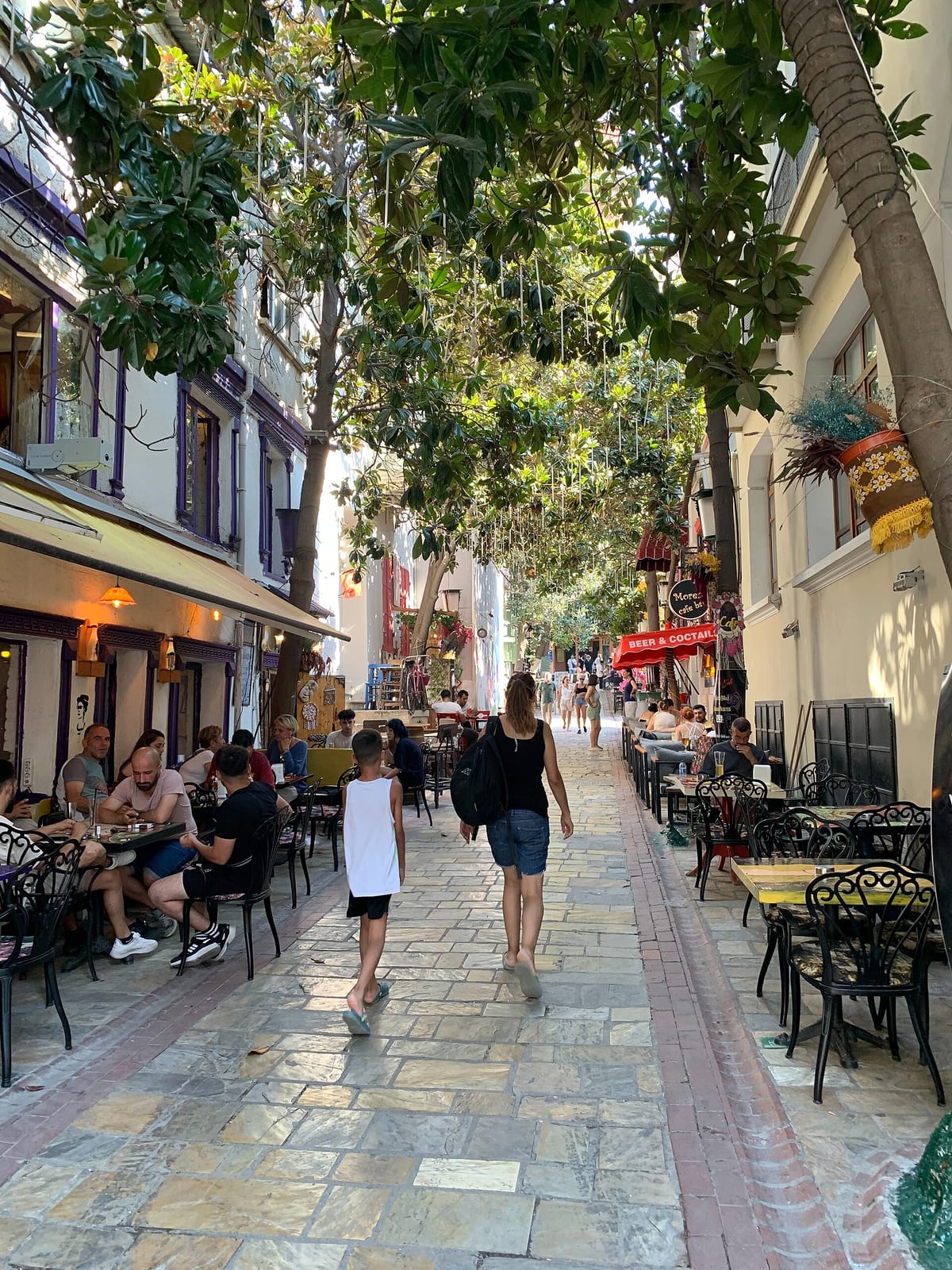
Tarihi Asansör is easy to do badly: ride up, photograph the Gulf of İzmir, disappear. The better evening begins on Dario Moreno Sokağı and ends there too. Enter the lower Karataş lane before dusk, let its cafe tables and old facades establish the scale, take the free lift after the first sunset cluster loosens, then descend into the same street once the lamps are on.
That loop has two anchors and no filler. Dario Moreno Street is the lower room; Tarihi Asansör is the hinge to the upper one. Keeping them together matters because the elevator was not built as a viewing-platform gimmick. It was built to solve a neighborhood problem: two street levels separated by a steep rise and 155 steps [5]. The view came with the infrastructure. It should not erase it.
Keep the night on the lower level
First move: aim for the lower entrance. Put Dario Moreno Sokağı, Karataş into your map, not only Tarihi Asansör. A current local guide identifies Karataş as the nearest tram stop and describes the rest as a short walk [3]. From the coastal side, follow the lane inland until the elevator entrance closes the view. If a route sends you uphill through a web of stairs before you have seen the lower doorway, stop and reset. Community reviews aggregated by Wanderlog repeatedly warn that map directions can deliver visitors to the upper level or into unnecessary stair climbing [2].
Second move: arrive 40–50 minutes before the day's actual sunset. Do not use a fixed clock time year-round; İzmir's evening light shifts too much by season. The buffer is for the street, not for queue anxiety. It gives you roughly 15 minutes below, 10–20 minutes of flexible waiting, and a terrace window that can run 25–35 minutes past sunset without making the outing a race.
Third move: give the lane its own first pass. Walk from the mouth of the street to the lift without claiming a cafe table yet. Notice where chairs narrow the pedestrian line, where people are photographing facades, and where residents still need a clear path. The current community picture is not of a dead heritage corridor: a June 2026 r/Izmir discussion treats the venues on Dario Moreno Street as active evening choices and distinguishes them from the municipality-run premises at the elevator itself [1]. Wanderlog's live review surface likewise carries a February 2026 Google review confirming the street remains an appealing place to walk [2]. The local move is to read that activity before deciding whether you need to buy anything.
Image context: the cover is Robot8A's real August 2023 photograph of Dario Moreno Street, with people occupying cafe tables beneath the trees. It is used because this route begins with the inhabited lane, not with a detached skyline [9].
The street name adds more than atmosphere. İzmir's official visitor guide says the city renamed the lane in 1990 for Dario Moreno, the singer and actor closely associated with İzmir who lived here with his mother for a period [5]. The elevator belongs to another strand of Karataş memory. Jewish philanthropist Nesim Levi commissioned it in 1907 so people could move between Mithatpaşa Street below and the higher neighborhood without relying on the long staircase; its lower inscription records the construction in French and Hebrew [5]. In a few dozen meters, the lane holds Sephardic civic history, popular music memory, and ordinary vertical transport.
The elevator is still infrastructure
Fourth move: read the doorway before joining the lift line. The tower narrows in stages above a stone-and-brick entrance, and the inscription is part of the object, not a prop wall. In May 2026, İzmir Metropolitan Municipality reported a specialist conservation effort at Tarihi Asansör to remove vandalism without damaging historic surfaces [7]. Keep hands, pens, stickers, and bags off the masonry. Take the close photograph quickly, then leave the threshold clear.
Fifth move: treat the lift as shared transport. The official history describes two electric elevators in current use [5]. Let exiting passengers clear the cabin, keep your group compact, and give priority to anyone for whom the lift is more necessity than novelty. Do not hold a door for a staged video. One camera cycle can make a small public connector feel privately occupied.
The practical access contract is unusually generous. Visit İzmir lists the lift and view as free, open seven days a week from 08:00 to 00:00 [5]. The live Google Maps listing checked for publication repeated 08:00–00:00 and showed those hours as phone-confirmed 12 weeks earlier [8]. That is recent confirmation, not a guarantee for every day: maintenance, events, or local instructions can override a directory. Check the listing before leaving and believe a notice at the door over this article.
There is no reservation for the public lift or ordinary viewing terrace. The queue is the variable. Tripadvisor's 2026 review surface includes one visitor who went in April and reported waiting about 30 minutes for an open photo position, then 45 minutes for simple cafe service [4]. That is one person's experience, not a permanent forecast, but it is a useful boundary. At a busy sunset, let Dario Moreno Street absorb ten more minutes instead of treating the lift line as lost time.
Let the first railing rush pass
Sixth move: use the terrace in two passes. On arrival, do not fight for the most obvious central section of railing. Take the first open edge, look across the roofs and gulf for a few minutes, then move once the initial photo wave turns over. The first pass is orientation; the second is the photograph. Keep each rail position brief enough that another person can use it. The terrace works as a shared night room only if nobody mistakes the best angle for a reservation.
Seventh move: keep the public view and the table decision separate. You do not need to order a drink to ride the lift or see the city [5]. If you do want to stay, the municipality lists the 80-seat terrace cafe from 09:00 to 00:00. It lists the 110-seat restaurant from 19:00 to 00:00 and marks the restaurant as reservation-only [6]. Those are different commitments. A free 90-minute street-and-lift loop does not fail because there is no spontaneous dinner table, and a restaurant booking should not be used to skip the lane that gives the place its meaning.
Stay until the gulf loses its reflective brightness and the lower streets begin to read as lines of light—usually 20–30 minutes after sunset is enough. Then leave before the terrace becomes merely a backdrop for the next plan. This is not a rooftop bar crawl. It is a compact piece of public city life with food and drink available at the edges.
Eighth move: descend to Dario Moreno Street. The upper exit can tempt a visitor into an improvised hillside route. Unless that neighborhood walk is a separate daylight plan, take the lift back down and recover your original orientation. The lower lane is calmer after dark, the elevator facade feels taller from below, and the return to Karataş is legible. Ending where you began is what turns two levels into one coherent room.
The visitor trapline
Mistake one: following the pin to the top. The better alternative is the lower Dario Moreno Street approach from Karataş, which preserves the lane, the entrance, and the elevator's actual job in sequence [2][3][5].
Mistake two: arriving at the exact sunset minute. The better alternative is a 40–50 minute lead. Current reviews make crowding real enough to budget for, but the street gives that buffer texture instead of turning it into dead queue time [1][2][4].
Mistake three: assuming the restaurant owns the view. The lift and ordinary terrace access are free; only the restaurant carries the reservation rule. Decide on a table separately and use the public edge without purchase pressure [5][6].
Mistake four: treating heritage surfaces and shared space as a set. The better alternative is quick photography, a clear doorway, short turns at the rail, and no contact with the historic fabric. The city's 2026 conservation work shows that careless marks create real material cost [7].
A compact go plan
- Best window: from 40–50 minutes before sunset to 25–35 minutes after it, for a total of about 75–95 minutes.
- Expected spend: 0 TRY for the two anchors. Cafe or restaurant spending is optional; no current menu price is assumed here [5][6].
- Queue and reservation reality: no booking for the lift or public terrace; hold a 15–30 minute crowd buffer at popular sunsets. The restaurant is reservation-only [4][6].
- Navigation cue:
Karataş tram stop -> Dario Moreno Sokağı lower approach -> Tarihi Asansör -> upper terrace -> same lift down -> Karataş[2][3][5]. - Where to stand: begin along the lane without blocking cafe tables, clear the elevator doorway, take the first open terrace edge, then rotate once for the photograph.
- Same-day check: confirm the live listing and any door notice before relying on the published 08:00–00:00 access window [5][8].
The best part of Tarihi Asansör is not that a machine delivers a panorama. It is that one short street still explains why the machine exists. Dario Moreno Street supplies the voices, tables, paving, music memory, and lower-level scale; the elevator supplies the public connection; darkness returns both to the neighborhood. Keep the lane on each side of the view, and İzmir stays close enough to feel inhabited.
Sources
- Reddit, r/Izmir, "İzmir tarihi asansörün karşısındaki mekanlar nasıl" (June 27, 2026) — recent local community discussion of Dario Moreno Street venues and the municipality-run elevator premises.
- Wanderlog, "Dario Moreno Sokağı" — local review/community surface with Google observations on the lower street, cafe activity, 2026 confirmation, and the map-routing stair trap.
- İzmir Mekan Rehberi, "İzmir Tarihi Asansör Binası" (2025) — local guide confirmation of free access and the Karataş tram approach.
- Tripadvisor, "Tarihi Asansor" (2026 review surface) — current visitor reports used to bound sunset crowd and cafe-service uncertainty.
- Visit İzmir, "İzmir'in En Romantik Terası: Tarihi Asansör" — official city visitor guide for the 1907 origin, 155-step problem, Dario Moreno naming, two lifts, free access, address, and listed 08:00–00:00 hours.
- İzmir Metropolitan Municipality, "Tarihi Asansör Restoran&Kafe" — official capacities, cafe hours, restaurant hours, and reservation rule.
- İzmir Metropolitan Municipality, "Onlar İzmir'in hafızasını vandalizme karşı koruyor" (May 11, 2026) — recent official confirmation of specialist cleaning and conservation work at Tarihi Asansör.
- Google Maps, "İzmir Historical Elevator Building" — live place listing used for the current address, hours, and recent phone-confirmation status.
- Wikimedia Commons, "File:Izmir Aug 2023 12 04 40 379000.jpeg" — Robot8A's real August 2023 photograph of people using Dario Moreno Street, used as the article image.