The invitation to Dyrehaven is sometimes a sound. In an October discussion on Copenhagen’s local Reddit forum, a contributor recommends the park because the red deer stags can be heard roaring across it. Another points out the wonderfully ordinary means of arrival: the train to Klampenborg, with the forest beside the station.[1] A city afternoon can open into something much larger without becoming an expedition.
But October has more than one deer story. The Danish Nature Agency’s seasonal guide places the beginning of the red deer rut in September, then directs October visitors toward fallow deer gathering southwest of Eremitageslottet, the Hermitage Hunting Lodge.[2] A separate ranger’s account describes the red deer’s main rut as roughly three to four weeks from mid-September.[3] The periods can overlap; the useful distinction is that an October visit should not depend entirely on hearing September’s great roaring performance.
Make the open Eremitage plain your destination, with the lodge as your landmark. This keeps the outing small enough to understand: one approach through the park, one stretch of open ground, time to stand still. The animals will decide how much happens there.
The first unnecessary complication is hiring a car for a nature escape. Local forum recommendations repeatedly return to Klampenborg, and DSB confirms that S-train line C serves the station through central Copenhagen.[1][4] Check the live journey before leaving. At Klampenborg, use the park entrance beside the station and orient toward the Hermitage rather than treating the first trees as the whole destination. The Royal Danish Collection gives the station-to-lodge walk as 2.5 kilometres, about 45 minutes.[5] That distance matters more to the afternoon than finding the fastest train.
For a first visit in mid-October, I would set aside 14:00–17:00, with 2½–3 hours for an unhurried return walk and observation. This is a suggested daylight plan, not a wildlife timetable. The two walking legs alone take roughly 90 minutes at the official estimate; checking the return route before stopping prevents a good sighting from swallowing all your walking time.[5] Choose a shorter outing if that distance is uncomfortable, rather than assuming the lodge is immediately inside the gate.
As the trees give way to open ground, resist the urge to keep advancing until an animal fills your phone screen. The Denmark-based writer behind WannaBeEverywhere describes returning through the seasons and watching deer readily from afar, while warning that they can be aggressive during the rut.[6] That is the second visitor mistake: reading an animal’s willingness to remain nearby as an invitation to approach. Bring binoculars, keep your observation point on a road or path, and let the deer cross the view. The park’s ranger explicitly asks rut visitors to stay on the paths and give the animals room.[3]
For October’s fallow-deer activity, use the lodge to orient yourself toward the southwestern side, the area identified in the official seasonal guide.[2] Check the park map before taking a path; “southwest” is a direction for choosing a viewpoint, not permission to cut across a gathering of animals. You do not need the closest position to see that a group has changed shape. Waiting in one place gives you a chance to notice arrivals and departures that disappear when you are busy walking toward them.
This remains a local autumn outing, not merely a scene preserved in old travel photographs. Rungstedspejderne scheduled a deer walk on October 1, 2026, from 17:00 to 20:00, asking participants to bring warm clothing, water, a packed meal and, optionally, binoculars and a headlamp.[7] That event has passed, and its evening hours are not a promise of sightings today. Its packing list is still useful: prepare to be comfortable while standing, not just while walking. Carry your own water and something to eat so that a café stop need not determine when you turn back.
For the park portion, plan on DKK0–60, excluding rail travel. Entry is free, as the local NORD magazine’s autumn guide confirms; the upper figure is an optional personal allowance for a snack or drink bought before arrival, not a park charge.[8] Bringing everything from home keeps the visit at zero beyond transport. An independent walk has no admission queue or reservation slot. The Nature Agency permits picnics, but feeding deer is prohibited, and dogs must remain on a lead.[9] Keep the food for yourself and the watching space clear.
The broad view has a human history as well as an animal rhythm. These were the lands of Stokkerup, whose remaining farmers were displaced when Christian V enlarged the royal hunting park. The farms were demolished, and straight hunting roads converged around the former village; its pond survives southeast of the lodge.[10] The ease with which a visitor can look across this landscape belongs partly to an older desire to pursue animals through it. Following those roads slowly gives them a different use.
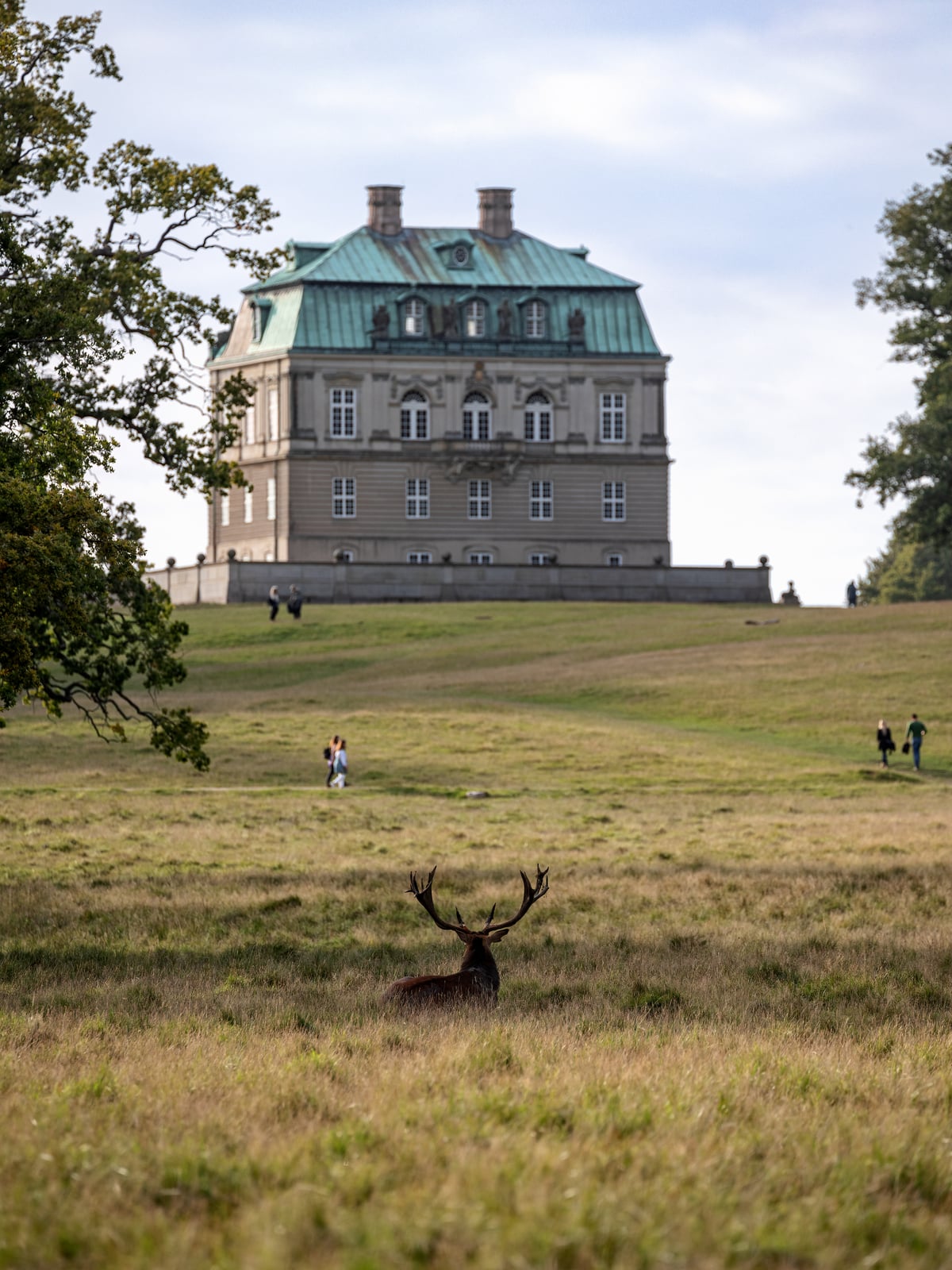
Stig Nygaard’s September photograph holds a stag and the hunting lodge in the same frame.[11] It is a useful image to carry into the walk: an animal with its own concerns, a building made for royal leisure, and enough ground between them to make both legible. In October, allow the scene to change. You may hear a red deer, watch the fallow deer, or spend longer than expected with a quiet patch of grass. The train still takes you back to Copenhagen; the afternoon need not deliver a contest to have been worth leaving for.
Sources
- r/copenhagen, “Cool nature to see close to cph,” October 5, 2024 — local community recommendations for Klampenborg rail access and the autumn soundscape; historical observations, not a live sighting report.
- Danish Nature Agency, “The course of the year in Jægersborg Dyrehave” — red deer in September and October fallow-deer activity southwest of the Hermitage; checked October 13, 2026.
- Danish Nature Agency, “Brølende brunst i Dyrehaven,” August 26, 2022 — ranger Jacob Skriver on rut timing, keeping to paths, distance and the prohibition on feeding.
- DSB, “Klampenborg Station” — official station and line C information; check the live journey and fare before travelling.
- The Royal Danish Collection, “Planlæg dit besøg på Eremitageslottet” — official station-to-lodge distance and walking time; checked October 13, 2026.
- WannaBeEverywhere, “Jægersborg Dyrehave,” page dated September 24, 2024 — Denmark-based repeat visitor’s account, autumn photographs and advice to observe deer from a distance.
- Rungstedspejderne, “Dyrehaven Kronhjortetur 2026,” Danish Scout Association event platform — October 1, 2026 outing and packing advice; recent confirmation of local seasonal interest.
- NORD Magasinet, “Guide: Oplevelser i efteråret,” autumn 2026 — local seasonal listing confirming free access to the deer-rut experience and the need for respectful distance.
- Danish Nature Agency, “Practical information — Jægersborg Dyrehave” — transport, paths, picnics, dog leads and keeping deer wild; checked October 13, 2026.
- Danish Nature Agency, “History of Dyrehaven” — Stokkerup’s displacement, the hunting roads and surviving village pond.
- Stig Nygaard, “Lonely stag at the Hunting Lodge,” September 26, 2021, Wikimedia Commons — source photograph of a red deer stag and the Hermitage Hunting Lodge, CC BY 2.0.