The most useful advice about Tūranga comes from people who stay. In a Christchurch community discussion, one regular describes returning to the same quiet room to work; another cautions against choosing the children’s floor if silence is the aim.[1] Both are describing the same library. Behind its folded golden exterior, Tūranga gives Christchurch several different ways to be together, including the option of barely acknowledging one another.
A weekday visit reported by Sally Blundell for Frank Film found readers in comfortable chairs alongside a much wider repertoire of activity: building with Lego, rehearsing music, sewing and researching. Library manager Chris Hay described a busy building with places for peace and quiet.[2] For a visitor, the pleasure lies in learning that arrangement. Come to look at the architecture, then choose somewhere to spend an unhurried hour.
Come when the whole building is awake
Aim for 60 Cathedral Square, at the Gloucester Street edge of the square. The important opening-time distinction is vertical: on weekdays the ground floor opens at 08:00, while the upper floors open at 09:00. Normal full-building hours are 09:00–20:00 Monday–Friday and 10:00–17:00 Saturday–Sunday. Those are the library’s published hours checked on 13 October 2026; check its location page again for holiday exceptions.[3]
For a first visit, 09:00–10:30 on a weekday is a useful planning window because it leaves time to explore after every floor has opened. It is a suggested itinerary, not a claim that the building will be empty. Allow 60–90 minutes rather than squeezing the library between two appointments. An eight-o’clock arrival works for the entrance level; it does not buy an early rooftop visit.
General entry is free. There is no sightseeing ticket to reserve for an ordinary look around; the local reporting describes a community space where people can simply spend time.[2] Budget NZ$0–10 per person for this stop: zero covers the library itself, and ten dollars is an optional personal spending cap, not a quoted café price. Transport and paid services are outside that allowance. A coffee is a choice, rather than rent for your chair.
A staircase with room to pause
Tūranga was completed in 2018, part of the rebuilding of central Christchurch after the earthquakes. Architectus and Schmidt Hammer Lassen worked with Matapopore Charitable Trust to bring Ngāi Tūāhuriri knowledge into the building’s design. The golden exterior draws on the surrounding hills and harakeke, the flax whose long leaves give the façade another way to be read.[4]
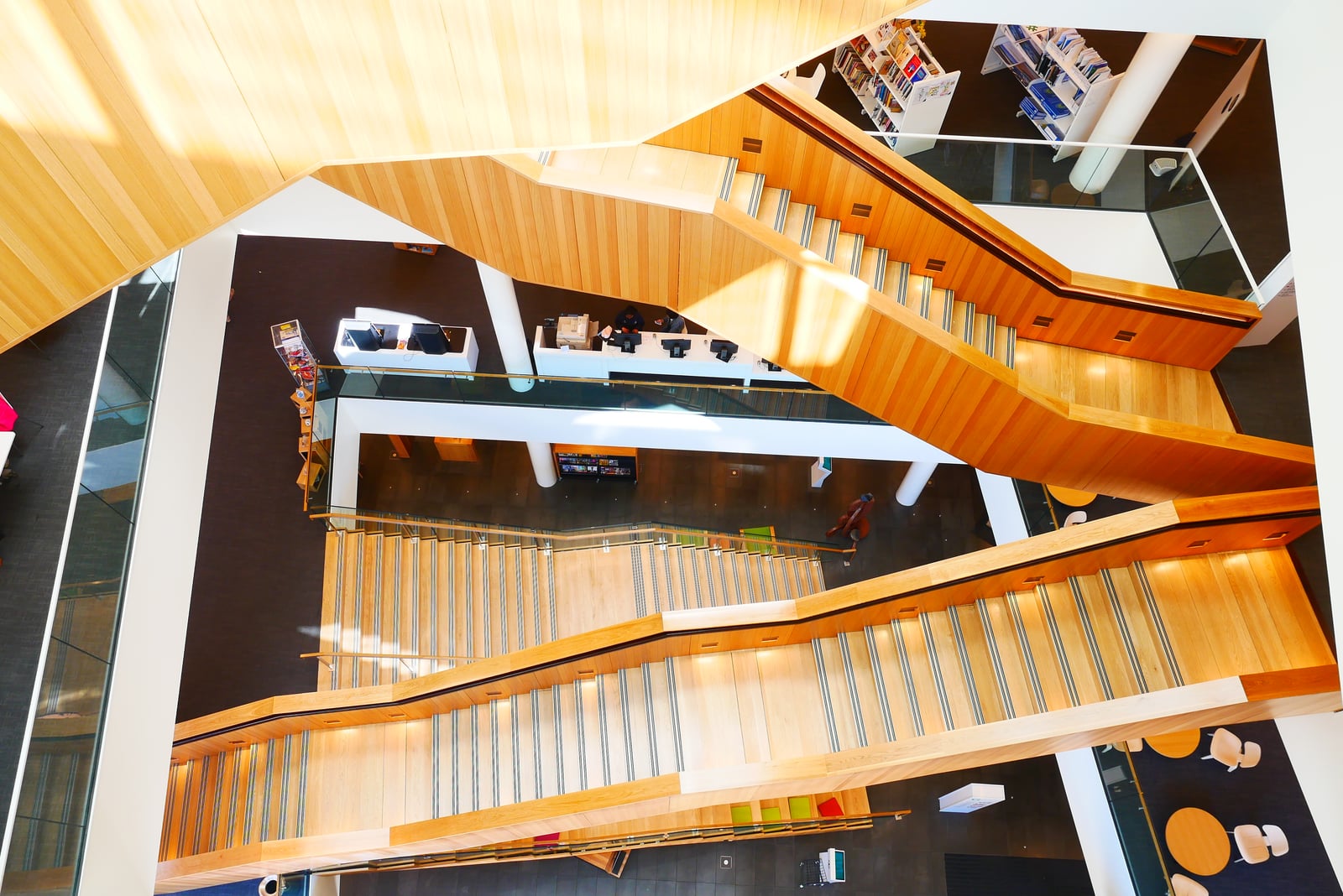
Inside, the open atrium makes the floors visible to one another. Its broad social staircase was designed for gathering, reading and resting as well as movement. Pause on the seating portion and leave the circulation route clear. The architects connect the ascent through the atrium with Tāwhaki’s pursuit of knowledge; the roof terraces also orient the building towards significant places in the wider landscape.[4] The climb has a cultural context as well as a practical destination.
Take it slowly enough to notice those changes in scale: the entrance opening towards the square, the shared space around the stairs, the more particular uses beyond. Photograph the architecture without treating someone’s book, laptop screen or face as part of the exhibit. This remains a working library throughout the visit.
Quiet is a room you choose
The first visitor mistake is to take the first available seat and expect the whole building to hush. The r/chch discussion specifically contrasts the children’s floor with a quiet space upstairs.[1] If you want to read or recover from a morning of walking, look for Wāhi Mauritau / Quiet Place on Level 3. The library asks users to keep noise to a minimum there.[5] Silence your phone before settling in and take conversations elsewhere.
There is a useful distinction between that shared quiet room and the smaller study rooms. The latter sit opposite it on Level 3 and also on Level 4; they accommodate up to four people and operate first come, first served. They cannot be booked. Hired meeting rooms are a separate service.[5] If a small room is occupied, choose an appropriate public seat instead of organising your visit around a room you cannot reserve.
A second mistake is feeling that a visitor needs an errand to justify sitting down. Local reporting emphasises the welcome to everyone, while regular users describe spending time here to work and read.[1][2] You can participate at that ordinary scale. Keeping a bag off an adjacent seat when space is needed is a better contribution than finding something unnecessary to buy.
Two gardens, then a little longer indoors
On Level 4, follow the signs for Ngā Māra / Roof gardens. There are two: the north garden looks over Gloucester Street, while the south garden faces Cathedral Square. Choose the south side if the square is the view you came for; try the other before assuming you have seen the whole outlook. The library identifies indigenous planting and connections to culturally significant places as part of the gardens’ purpose.[6] They reward attention to what is close at hand as well as what lies beyond the railing.
Let the weather decide how long to remain outside. A terrace photograph need not be the end of the visit. Christchurch blogger Ruth Gardner’s account of 7 October 2026 offers a smaller, more revealing scene: she collected books and read for half an hour while waiting for help with her phone.[7] Her visit is recent confirmation of the library’s everyday usefulness, without any special occasion to make it worthwhile.
That is a good pace to borrow. Return to a suitable seat, open a book and allow the building to become familiar. From the square, Tūranga announces itself in gold. Inside, its welcome becomes tangible in the room it gives people to stay.
Sources
- r/chch, “First time in the City Library,” 8–9 September 2024 — local discussion of regular use, the children’s floor and Level 3 quiet reading; individual observations rather than a crowd forecast.
- Sally Blundell for Frank Film, “Tūranga: What a 21st century library can be,” Star / Otago Daily Times, 12 June 2024 — reported everyday activity, comfortable seating, free community space and the library manager’s account of quiet areas.
- Christchurch City Libraries, “Tūranga: Hours & Information” — address, weekday ground-floor early opening and normal full-building hours; checked 13 October 2026.
- Schmidt Hammer Lassen, “Tūranga – Christchurch Central Library” — project architects, completion, cultural partnership, façade, social staircase and landscape orientation.
- Christchurch City Libraries, “Wāhi Mauritau / Quiet Place and Wāhi Rangahau / Study rooms” — Level 3 quiet space, small-room capacity and first-come access.
- Christchurch City Libraries, “Ngā Māra / Roof gardens” — Level 4 locations, north and south outlooks, indigenous planting and cultural connections.
- Ruth Gardner, “Wednesday Wanderings,” Ruth’s Reflections, 7 October 2026 — Christchurch resident’s recent visit to collect books, read and seek technology help.
- Sgerbic, “Christchurch Public Library interior stairs,” 24 November 2019, Wikimedia Commons — photograph of Tūranga’s atrium, licensed CC BY-SA 4.0.