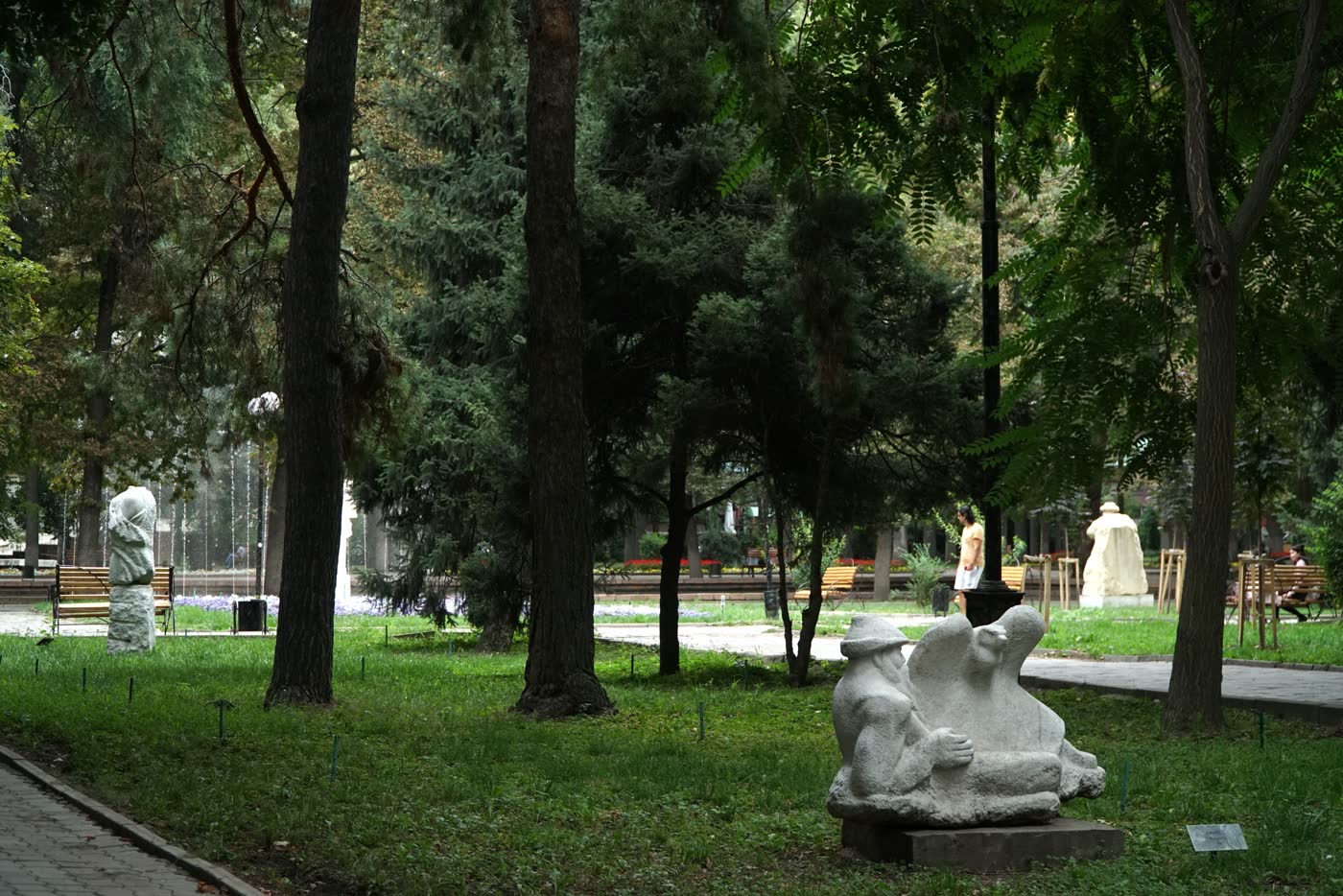
Do central Bishkek as a handoff, not as a monument stop. Start at Ala-Too Square, let the flagpole, Manas statue, museum edge, and Chuy Avenue establish the city's civic scale, then move into Oak Park before the square hardens into glare. The route is small enough to finish in under an hour, but it works because it lets Bishkek show two different habits: the capital as ceremony, and the capital as shade.
This is a street microcosm with two anchors only. Ala-Too is the formal room. VisitSilkRoad calls it the heart of Bishkek and notes the 45-meter flagpole, changing-of-the-guard setting, monuments, museum edge, and nearby Oak Park [4]. Oak Park is the recovery room. Baibol's local destination page describes it as Bishkek's central and oldest park, founded in 1890, with the first trees planted across 2.3 hectares under botanist A. Fetisov, later carrying sculptures, monuments, and the "Twelve cups" fountain area [1]. The local knowledge is in the sequence: use stone first, then trees.
The first move is timing. Use 08:30 to 10:00 if you want the square before traffic, tour groups, and heat gather, or 17:30 to 19:00 if you want the softer civic version, when people drift through after work and the park begins to feel social. Avoid making this a noon route in warm months. The Bishkek mayor's office recently described citywide warm-season planting across key public zones including Ala-Too Square, Oak Park, Pushkin Street, and Chuy Avenue, with roughly 1.6 million annual flowers planned across the capital [2]. That detail is not decoration. It explains how much Bishkek asks central greenery to do: shade, civic pride, cooling, and everyday pause all at once.
Second move: arrive on foot if you are already near the center. A taxi can solve the last kilometer, but it also turns the square into an object outside the street grid. VisitSilkRoad lists bus and shuttle routes that reach Ala-Too directly, while 2GIS keeps the current square pin, photos, local reviews, and nearby transport context visible [4][3]. If you are coming from a hotel within 10 to 20 minutes on foot, walk. You will read Chuy Avenue, the museum edge, and the shift from traffic width to open square more clearly than you would from a curb drop.
Third move: start at the edge, not the middle. Stand first where you can see the flagpole, Manas, the State Historical Museum side, and the flow across Chuy. Then walk into the square only after you understand where people are crossing, lingering, photographing, and moving through. The visitor mistake is to march straight to the center, take the wide shot, and leave. Advantour's guide is useful here because it names Ala-Too as the country's main square and keeps the civic uses in view: festivals, holidays, Independence Day decorations, New Year lights, Manas, the museum, and Oak Park behind the northern edge [6]. You are standing in a working ceremonial field, not just a backdrop.
Fourth move: treat the changing of the guard as a bonus, not a schedule anchor. VisitSilkRoad ties the flagpole area to the guard change, while Advantour keeps the museum, Manas, and Oak Park adjacency in the same central-Bishkek frame [4][6]. If the guard change happens while you are there, step back and let the local crowd shape the space. If it does not, do not wait around until the route goes stale. The better plan is fixed by geography, not by performance: square first, park second.
Fifth move: cross into Oak Park before you think you need it. The entrance is close enough that people often treat it as an afterthought. That is the wrong reading. Baibol divides the park into a garden side for walking among the oaks and a cultural side with monuments, statues, historical buildings, and open-air sculpture [1]. Tripadvisor's Oak Park review page adds the ground-level cue: visitors keep noticing mature trees, seating, fountains, sculpture, and its closeness to Ala-Too [5]. So do not make the park a leftover. Give it 25 to 35 minutes and sit once before you decide whether to keep walking.
Sixth move: use the sculptures as pace control. Oak Park's open-air sculpture does not need a catalog sprint. Walk one path, stop at two or three works, and let the shade do more work than the labels. The park is strongest when you notice how unmonumental some of the best moments are: benches under high leaves, a fountain sound behind trunks, people cutting diagonally through the green, wedding parties appearing and disappearing, office clothes mixed with stroller pace. The place-specific fact that matters is that Bishkek's center is not green by accident. Oak Park began as planted urban infrastructure, and the city still tends public greenery as a central civic system [1][2].
Seventh move: keep the route at public-space price. Core spend is 0 KGS. You do not need a ticket, reservation, taxi loop, or guide to do this version well. Carry small cash only if you want coffee, water, or a snack afterward. If you are linking the route to the State Historical Museum or another paid stop, separate that decision before you arrive. Otherwise the square-park handoff gets buried under the logic of admission desks and opening hours.
Eighth move: stay alert without making the route anxious. Ala-Too is a central civic square; it can host holidays, ceremonies, and security presence, and public-space rules can change around official events [6]. Keep bags close, avoid photographing officers or controlled areas aggressively, and do not plant a tripod where people are crossing. In Oak Park, the etiquette is softer: share benches, keep music low, ask before photographing people up close, and let families and older walkers keep the path rhythm.
The non-local trapline is short. Mistake one is treating Ala-Too Square as the whole visit. Better: use it as orientation, then move to Oak Park while your attention is still fresh [4][1]. Mistake two is arriving at midday and blaming Bishkek for feeling exposed. Better: use morning or late afternoon, when shade, fountains, and ordinary pedestrian movement are doing more work [2][5]. Mistake three is turning the park into a shortcut behind the museum. Better: sit for 10 minutes, then make one slow loop through the sculpture side [1][5]. Mistake four is adding Osh Bazaar, a museum, a mountain day, and a cafe chain to the same hour. Better: let this route stay one central-city read.
Concrete go details: budget 45 to 75 minutes. Start at Ala-Too Square's flagpole side, hold the square edge for 10 to 15 minutes, cross toward the museum/Oak Park side, then give the park 25 to 35 minutes before leaving by Pushkin Street, Chuy Avenue, or a simple map pin from 2GIS [4][3]. Expected spend is 0 KGS unless you add drinks or a museum. There is no normal queue or reservation. Best windows are 08:30-10:00 and 17:30-19:00. Stand at the square's edge first; sit inside Oak Park only after one walking pass; leave before the route becomes a generic central-Bishkek checklist.
Bishkek's center does not need to be oversold. Ala-Too gives you the formal grammar: flag, monument, museum, avenue, state scale. Oak Park gives you the correction: shade, sculpture, benches, planted memory, and people using the center without performing it. The local move is to let one hand you to the other.
Sources
- Baibol Travel, "Oak park" - local destination page covering Oak Park's 1890 founding, 2.3-hectare planting origin, A. Fetisov, garden/cultural sections, fountains, monuments, and sculpture museum.
- Bishkek Mayor's Office, "Bishkek starts greening season - millions of flowers will decorate the city" - official municipal update naming Ala-Too Square, Oak Park, Pushkin Street, Chuy Avenue, and about 1.6 million annual flowers.
- 2GIS Bishkek, "Ala-Too Square" - local map and review surface for the square pin, photos, ratings, transport context, and current navigation layer.
- VisitSilkRoad, "Ala-Too Square" - destination guide covering the square's central role, 45-meter flagpole, guard-change setting, monument cluster, bus/shuttle access, and Oak Park on the perimeter.
- Tripadvisor, "Oak Park - Bishkek" - community review surface for shade, seating, fountains, sculptures, proximity to Ala-Too Square, and current visitor expectations.
- Advantour, "Ala-Too Square, Bishkek" - guide source for Ala-Too as Kyrgyzstan's main square, its festival/holiday role, Independence Day and New Year use, Manas, museum edge, and Oak Park adjacency.
- Wikimedia Commons, "File:Oak Park in Bishkek 2.jpg" - real photograph by Dan Lundberg used as the article image.