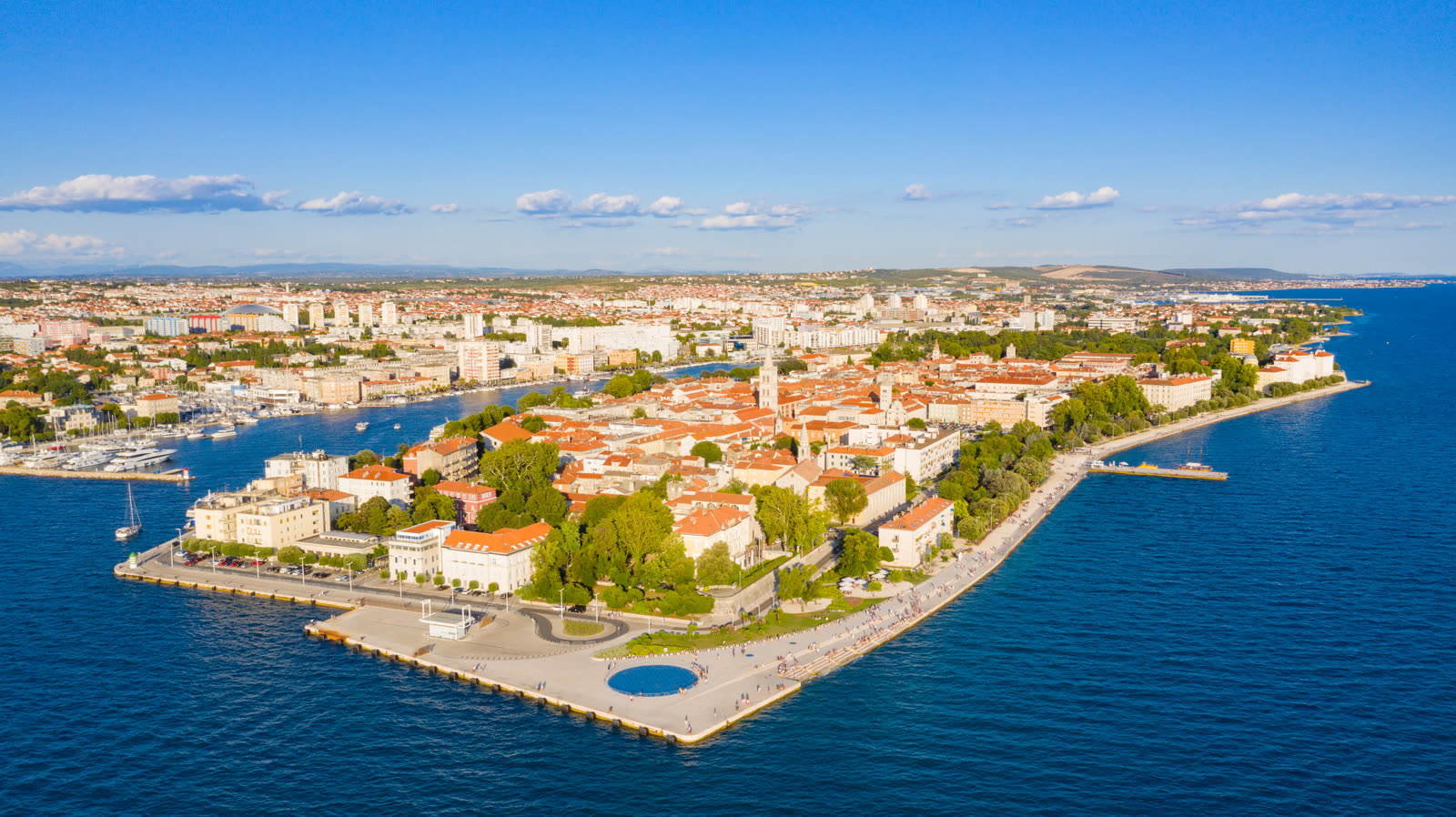
Do Zadar's famous sunset, but do it as a listening ritual before you do it as a photograph. The western tip of the old-town peninsula works best when the Sea Organ gets the first half hour, the Greeting to the Sun gets the darkening sky, and the Riva is allowed to stay a public room instead of becoming a pileup around one glowing disc.
The anchor is deliberately tight: the Sea Organ, known locally as Morske orgulje, and Greeting to the Sun, the solar-light installation beside it. No island boat, no full old-town checklist, no "one last church" sprint. Zadar Region Tourist Board describes the Sea Organ as broad steps hiding resonant chambers that turn rolling waves into shifting tones, and it presents the neighboring Greeting to the Sun as a 300-plate waterfront light installation that comes alive after sunset [1]. The point is not that Zadar has two clever objects. The point is that the city uses two adjacent objects to teach a pace: sit, listen, wait for the light, then move only a few meters.
Image context: the cover uses a real 2019 Wikimedia Commons aerial photograph by dronepicr. It fits this route because it shows both non-food anchors in their actual waterfront setting: the circular solar installation, the Sea Organ edge, and the peninsula geometry around them [7].
First local move: arrive 45 to 60 minutes before sunset, not at sunset. Absolute Croatia's current Sea Organ guide says the installation is always accessible and that the experience changes with light and sea conditions; its practical advice is to reach the steps before the peak sunset crowd rather than hoping to claim space at the last minute [3]. That window gives you one clean decision: sit and listen before everyone stands up. The middle or upper steps usually work better than the lowest edge because you can hear the tones without getting trapped in the wet splash zone if the wind comes up.
Second move: do not expect a song. The Sea Organ opened on 15 April 2005 as part of the redesigned waterfront and won the European Prize for Urban Public Space in 2006, but its power is not concert-hall precision [3]. It is a civic instrument with no performer. Waves, wind, and passing boat wake decide the phrasing. On a flat evening the sound may be quiet enough that chatter covers it; on a rougher evening it can feel too loud near the vents. If the first two minutes disappoint you, stay another ten. The useful visitor skill is patience, not amplification.
Third move: keep the steps social. Wanderlog's updated 2026 Zadar attraction list is useful less for any single review than for its repeated crowd language: Sea Organ sits at the top of the attraction list, Google and Tripadvisor review surfaces are both aggregated there, and the practical themes are sitting, sunset, waves, variable sound, and the adjoining light show [6]. That is exactly how to behave. Sit compactly, keep bags behind your knees, step away from the central flow for photos, and avoid planting a tripod or selfie line where people are trying to descend to the water.
Fourth move: use the old town as the approach, not a taxi drop. The navigation cue is simple: Roman Forum or St Donatus -> Riva waterfront -> northwestern tip of the peninsula -> Sea Organ steps -> Greeting to the Sun after dark. Absolute Croatia places the Sea Organ on the western edge of the Old Town peninsula and notes that it is a short walk from the main sights [3]. Google Maps is still worth checking for the Sea Organ pin before you go, but the better local habit is to walk the waterfront and let the sound arrive before the object fully does [5]. A taxi that tries to solve the last 300 to 500 meters often just converts a clean walk into curbside friction.
Fifth move: shift to Greeting to the Sun only after the sky has actually dimmed. Zadar's tourism music page says the Sun Salutation is best seen at sunset, and Absolute Croatia's recent guide is more specific: stay 30 to 60 minutes after it gets dark for the strongest light show [2][4]. The installation is a 22-meter circle made from around 300 multi-layered glass plates, with photovoltaic modules beneath the stone-level surface [4]. In daylight it can look oddly flat. In the blue-after-sunset hour, it becomes a public floor, a photo object, and a small choreography problem.
Sixth move: stand on the rim first. The non-local mistake is to walk straight into the middle of the circle and stop there, especially with children or a group photo. Better: use the edge, watch how people are circulating, then step in briefly if there is space. The point is not to keep the circle pristine. It is made to be walked across. The etiquette is to keep it moving, keep wheels and hard bag corners off the glass, and give children a boundary before they turn the light field into a running game.
Seventh move: use crowd timing instead of crowd complaint. If the sunset line is packed, do not fight it. Sit a little farther along the steps, let the first phone wave happen, then move after the sun drops. A 20 to 30 minute delay often changes the mood more than changing position does. If a tour group arrives at the circle, return to the Sea Organ for another listening pass. If the wind rises and the lower steps get wet, stay higher and treat the louder organ as part of the weather rather than as a defect.
Eighth move: do not leave when the sun disappears. That is the trap. Many people treat sunset as a finish line; this waterfront is better as a handoff. The official tourist-board page frames the two installations as a combined sound-and-light experience, not two separate checklist stops [1]. So let the sky lose its orange, let the circle brighten, and then walk out only after the first crowd loosens. The best exit is slow along the Riva, with Kalelarga or the Roman Forum as the inner-town return, not a scramble back through the densest edge of the promenade.
The trapline is short. Mistake one is arriving exactly at sunset. Better: arrive 45 to 60 minutes early and choose a step [3]. Mistake two is recording the organ before listening to it. Better: give the wave instrument 10 quiet minutes before the phone comes out [1][3]. Mistake three is treating Greeting to the Sun as a glowing stage. Better: stand at the rim, move through the center briefly, and keep the circulation open [4]. Mistake four is leaving after the solar disc first lights up. Better: wait through the first photo crush and use the darker second half of the hour [2][4].
Concrete go details: expected spend is 0 EUR for both anchors; there is no normal reservation or queue, only crowd density. Best window in summer is roughly 45 minutes before sunset to 60 minutes after dark, adjusted for weather and your actual sunset time. Sit on the Sea Organ steps first, preferably middle or upper, then move to the edge of Greeting to the Sun after the sky dims. Use Google Maps for the pin if needed, but walk from the old-town side rather than treating the waterfront like a ride-share destination [5]. If you have only 40 minutes, give 25 to the Sea Organ and 15 to the light circle. If you have 90 minutes, the place finally relaxes.
Zadar's sunset works because it asks less of you than the postcards suggest. The city does not need you to conquer the view. It needs you to sit on stone, let the Adriatic make an uneven sound, wait until a 22-meter circle becomes visible as light rather than pavement, and leave slowly enough that the waterfront still feels like a local room when you are done.
Sources
- Zadar Region Tourist Board, "The Sea Organ and Greeting to the Sun" - official source for the paired waterfront installations, Sea Organ resonant chambers, Riva setting, and 300-plate light installation.
- Zadar Region Tourist Board, "Music in Zadar" - official tourism context for the Sea Organ, waves moving through tubes, and the sunset timing for the Sun Salutation.
- Absolute Croatia, "Sea Organ Zadar (Morske orgulje): How It Works + Tips" - recent practical guide for access, approach, opening date, 2006 public-space prize, sunset crowd timing, and walking/parking advice.
- Absolute Croatia, "Greetings to the Sun (Pozdrav Suncu), Zadar: best time to visit + tips" - recent practical guide for the 22-meter circle, 300 glass plates, free access, after-dark timing, and maintenance caveat.
- Google Maps, "Sea Organ Zadar Croatia" - local map and review platform used for current pin, pedestrian approach, photos, and local navigation context.
- Wanderlog, "Top 48 things to do and attractions in Zadar" (updated March 17, 2026) - review/community aggregation for Sea Organ, Greeting to the Sun, rating surfaces, sunset notes, wave-dependent sound, and crowd behavior.
- Wikimedia Commons, "File:Aerial view of The Greeting to the Sun and the Sea Organ in Zadar, Croatia (48607771252).jpg" - dronepicr's real 2019 aerial photograph used as the article image.