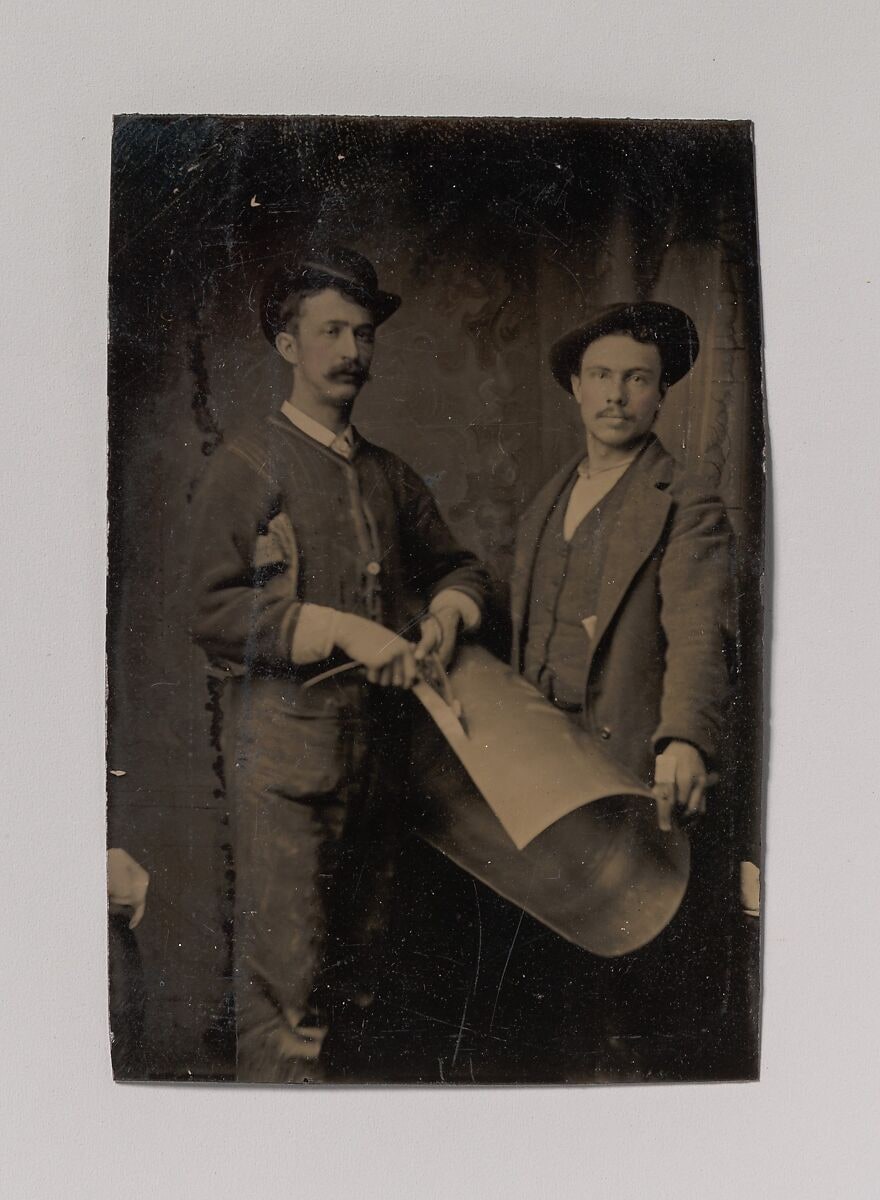
Two tinsmiths hold a curled sheet of metal between them. One has his shears poised at its edge; the other steadies the broad curve. Both wear hats and jackets, and their faces turn away from the work toward the camera. The Metropolitan Museum of Art dates this small, anonymous American photograph to the 1880s and identifies its medium as tintype.[1] The coincidence is irresistible: metalwork pictured on metal.
The name conceals an important distinction. A historical tintype's support is iron, covered with a dark coating, rather than a sheet of tin.[2] That inexpensive support helped turn photography into something a customer could purchase quickly and take away. Understanding the plate explains both the picture's appearance and the practical ingenuity behind a portrait that could fit in a pocket.
The darkness is part of the image
In a collodion tintype, the iron carries a dark lacquer or enamel, a collodion binder and an image made of silver. Where silver particles are sparse, the dark coating shows through. Where the image contains more silver, the surface looks pale against that ground.[2] The apparent shadows belong partly to the material underneath the image.
Technically, this is an underexposed negative made to read as a positive. It does not undergo the familiar second exposure in which a negative is used to print a picture on paper. The camera-exposed plate becomes the finished photograph.[3] Its dark support and pale image work together to give faces, shirts and tools their recognizable distribution of light and shade.
The wet-collodion method required closely coordinated work. A plate was coated, sensitized with silver salts, exposed and developed before the collodion dried; Getty's account of the process emphasizes that preparation through development had to happen within minutes.[4] For a tintype, darkened metal took the place of the glass used for a conventional wet-plate negative.[3][4]
Later tintypes could use dry gelatin, a development the Harry Ransom Center dates to the 1880s.[7] The Met's catalog does not specify the binder in the tinsmiths' plate. The wet method explains the earlier process's demands: the portable finished object came out of a practiced sequence requiring equipment, chemistry and timing.
A quick portrait still required a performance
Colin Harding, writing for the National Science and Media Museum, explains the commercial attraction: a photographer could prepare, expose, develop and varnish a ferrotype, another name for a tintype, within a few minutes. Cheap iron and its resilience made the process particularly useful to itinerant photographers. It could be sold in a modest mount or survive as a loose plate.[3]
Speed changed the transaction, but it did not make every picture spontaneous. A portrait could still be arranged with considerable care. In the tinsmiths' photograph, the chosen tools make the occupation legible within a very small rectangle. The Met records an image only nine centimeters high and six centimeters wide.[1] There is little space for an incidental workshop story: the people, the tools and the sheet must do the explaining.
We should distinguish that visual reading from a reconstruction of the sitting. The museum record does not identify the men or tell us who devised their pose. It cannot establish whether they were interrupted at work or assembled to represent it. What survives is a presentation of skilled labor, with the action held available for inspection.
The material makes that presentation unusually apt. A photograph normally asks us to look through its surface toward the scene. Here, knowing that the surface is metal keeps bringing attention back to the object in our hands. The workers manipulate one sheet; the photographer has prepared another to preserve their likeness.
Several originals from one sheet
The tintype is often described as one of a kind because it supplies no separate negative for making a run of paper prints.[4] Yet that description needs a practical qualification. The Henry Ford's account of tintype production describes cameras fitted with several lenses, recording multiple portraits on a single iron sheet. The resulting images could be cut apart with tin snips and distributed to friends and family.[5]
This is a wonderfully physical solution to the wish for copies. Instead of repeatedly printing from one negative, the photographer made several camera images together, then divided their common support. Each small plate remained an original exposure, even when its neighbor showed much the same pose. The process could produce individual objects efficiently without offering the open-ended duplication of a reusable negative.
That distinction changes what sharing means. A family could leave a sitting with several portraits, but the photographer's equipment and the plate's area helped determine that supply. Giving someone a likeness could mean handing over a piece cut from a sheet. The metaphor of a photograph as a fragment becomes literal.
The Met's brief record leaves the camera used for the tinsmiths' portrait unidentified. Multiple-lens production remains a possibility of the wider medium, not an established fact about this plate.[1][5]
Tough enough to travel, vulnerable enough to remember
The Library of Congress records tintypes sold with cases, frames or paper envelopes, and notes that they could also receive hand coloring.[6] A low-cost process left room for choices about display and finish. A customer bought both a likeness and a way of keeping it close.
Iron's resilience had limits. The University of Illinois preservation guide describes bent plates, disrupted image layers and rust that can lift the coating away from the support.[2] A tintype could tolerate circumstances that would threaten glass while remaining vulnerable to the long material consequences of travel and handling.
The tinsmiths' photograph brings those relationships into unusually clear focus. Their occupation depends on shaping a sheet; their survival as an image depends on the treatment of another. The tintype's achievement was to join photographic detail to a cheap, workable support. A face became something that could be finished, cut, enclosed, given away—and held.
Sources
- The Metropolitan Museum of Art, “Two Tinsmiths Cutting a Curled Sheet of Metal,” 1880s, accession 2015.400.134 — object metadata, dimensions and the archival photograph reproduced here.
- University of Illinois, Preservation Self-Assessment Program, “Daguerreotypes, Ambrotypes, and Tintypes,” tintype section — iron support, collodion and silver layers, tonal appearance and deterioration.
- Colin Harding, National Science and Media Museum, “How to spot a ferrotype, also known as a tintype,” May 25, 2013 — positive appearance, production speed, itinerant photography and mounts.
- J. Paul Getty Museum, “Sally Mann: A Thousand Crossings,” sections “The Collodion Wet-Plate Process” and “Variations on the Collodion Process: Ambrotypes and Tintypes” — wet processing sequence and direct camera originals.
- Jeanine Head Miller, The Henry Ford, “Tintypes,” January 5, 2021 — multiple-lens cameras, portraits made together on one sheet and separation with tin snips.
- Library of Congress, Liljenquist Family Collection of Civil War Photographs, “Ambrotypes and Tintypes” — iron plates, hand coloring and cases, frames or paper envelopes.
- Harry Ransom Center, University of Texas at Austin, “Photographic Prints & Positives,” tintype entry — the distinction between wet-collodion and later dry-gelatin tintypes.