A red rectangle, four dark cones, a ribbon kite: the inventory sounds like the beginning of an abstract painting. In Takis's Magnetic Wall 9 (Red), however, some of the composition occupies the air in front of the canvas. The objects are held near its surface by magnetic attraction and restrained by fine tethers. What looks like a scattering of marks becomes a set of physical relationships. The smallest gap carries the greatest weight.[1][2][3]
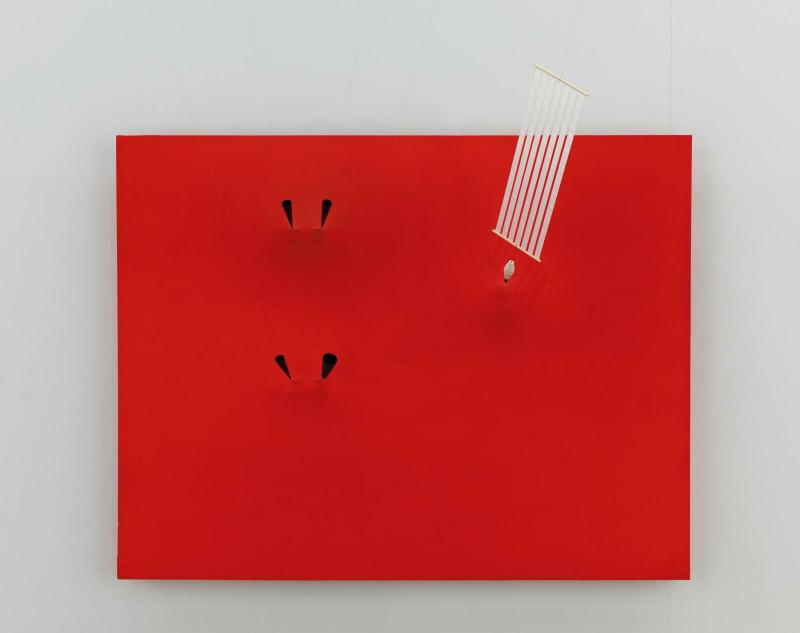
The Centre Pompidou's record specifies acrylic paint on canvas, three electromagnets, wires, four metal cones and a ribbon kite with a float. The canvas measures 178 by 220 centimetres: a substantial field against which those small suspended objects can register. Its catalogue date, 1961 / 1972, differs from the single year 1961 used in the 2019 Tate exhibition coverage. The museum record does not explain the second date, so it would be premature to assign it a particular alteration.[1][5]
In the museum photograph, the cones form two pairs toward the left. Their compact darkness contrasts with the pale, open construction on the right, whose parallel ribbons extend above the red into the surrounding wall. That upper edge is especially revealing. The coloured rectangle ends; the arrangement continues. Fine lines remain visible against the gallery's pale background.
Even the work's classification introduces a useful hesitation. The Pompidou lists it as an installation, under three-dimensional work.[1] We approach a coloured rectangle as though it were a picture, then discover that looking at it involves the space on our side of the surface.
The tether belongs to the picture
Takis began the Magnetic Walls series in 1961. MACBA's exhibition account explains the basic arrangement: magnets behind a monochrome canvas attract metal elements suspended just above it.[2] A painted shape has become an object; the distance that painting might suggest has become a real interval.
The strings matter. “Floating” can suggest a conjuring trick with invisible supports. Conservators Erin Stephenson and Kari Dodson describe elements tethered to a fixed point across from the painting and held close to its magnets.[3] The work asks us to notice a force through its effects, while leaving evidence of the arrangement that makes those effects possible.
That changes the role of a line. In a painting, a line can connect two shapes visually. Here a tether also does a job. Its direction belongs to the composition, but its tension helps keep the composition in place. Follow it with your eye and you move from an apparent mark toward an attachment in the room. The rectangle no longer contains everything needed to account for what you see.
There is a particular pleasure in this double attention. You can enjoy the relation of dark forms to red while also wondering what prevents those forms from touching the canvas. Recognising the mechanism gives the gap a new intensity. The eye starts to attend to separation itself, to the narrow interval between being drawn toward something and arriving there.
Stillness can be an event
Kinetic art is an awkward label if it makes us expect constant, conspicuous motion. Stephenson and Dodson describe the Magnetic Tableaux as holding their elements in stationary suspension.[3] The drama can reside in a position being sustained. A photograph records that position, but cannot by itself establish which forces maintain it or how the work behaves over time.
Kinetica Museum's account recommends an oblique view of the Magnetic Walls, following Takis's own advice.[4] That is an invitation to change the evidence available to the eye. From the front, a hovering object can appear to belong to the coloured plane. A sideways view can separate object, shadow and surface. The viewer's movement helps disclose the work's depth even when the suspended elements appear still.
The red remains essential to the encounter. It gives the scattered objects a common field, allowing the eye to read a composition before it follows the tethers outward. If we treated the canvas merely as a housing for equipment, we would miss the way colour gathers the work back together. If we treated it solely as an image, we would miss the actual distance that interrupts it. The fascination lies in being able to sustain both kinds of looking.
MACBA quotes Takis describing an “action in space” rather than an “illusion of space.”[2] The phrase is useful here without requiring an extravagant claim that gravity has been defeated. The objects retain weight. Their suspension makes the relation between weight, attraction and support available to attention.
Preserving an interval
A conservation account clarifies what is at stake. A Menil Collection photograph showed Magnetic Tableau No. 7 with its suspended elements at a sharp upward angle. Interviewed in 2013, Takis specified that they should be nearly perpendicular to the painting's plane, while allowing some flexibility in their distance from the magnets.[3]
This was a different artwork, and its treatment cannot supply a missing restoration history for Wall 9. It does show why the position of the surviving parts matters. A museum could preserve canvas, metal and string yet change the encounter by arranging them differently. The air between the components has to be understood along with the components themselves.
Return to the red rectangle with that thought in mind. Its most absorbing feature is easy to overlook because it resembles nothing: a little space that remains open. Takis gives that space a physical task. Looking longer means noticing how much must happen for the objects to stay where they are.
Sources
- Centre Pompidou, “Mur magnétique n° 9 (Rouge),” inventory AM 1976-1237 — object record, catalogue date, materials, dimensions and Georges Meguerditchian's photograph of the 2015 Palais de Tokyo installation.
- MACBA, “Takis,” 2019 exhibition press dossier, especially the Magnetic Walls section on page 5 — the series' origin, hidden magnets and the artist's description of actual space.
- Erin Stephenson and Kari Dodson, “Takis and the Fourth Dimension,” in Keep It Moving? Conserving Kinetic Art, Getty Conservation Institute, 2018 — suspension mechanics and the Menil Collection's research on Magnetic Tableau No. 7.
- Kinetica Museum, “Takis” — the Magnetic Walls and the artist's recommendation to view them obliquely.
- Beth Williamson, “Takis,” Studio International, July 18, 2019 — Tate exhibition coverage identifying Magnetic Wall 9 (Red) with the date 1961.