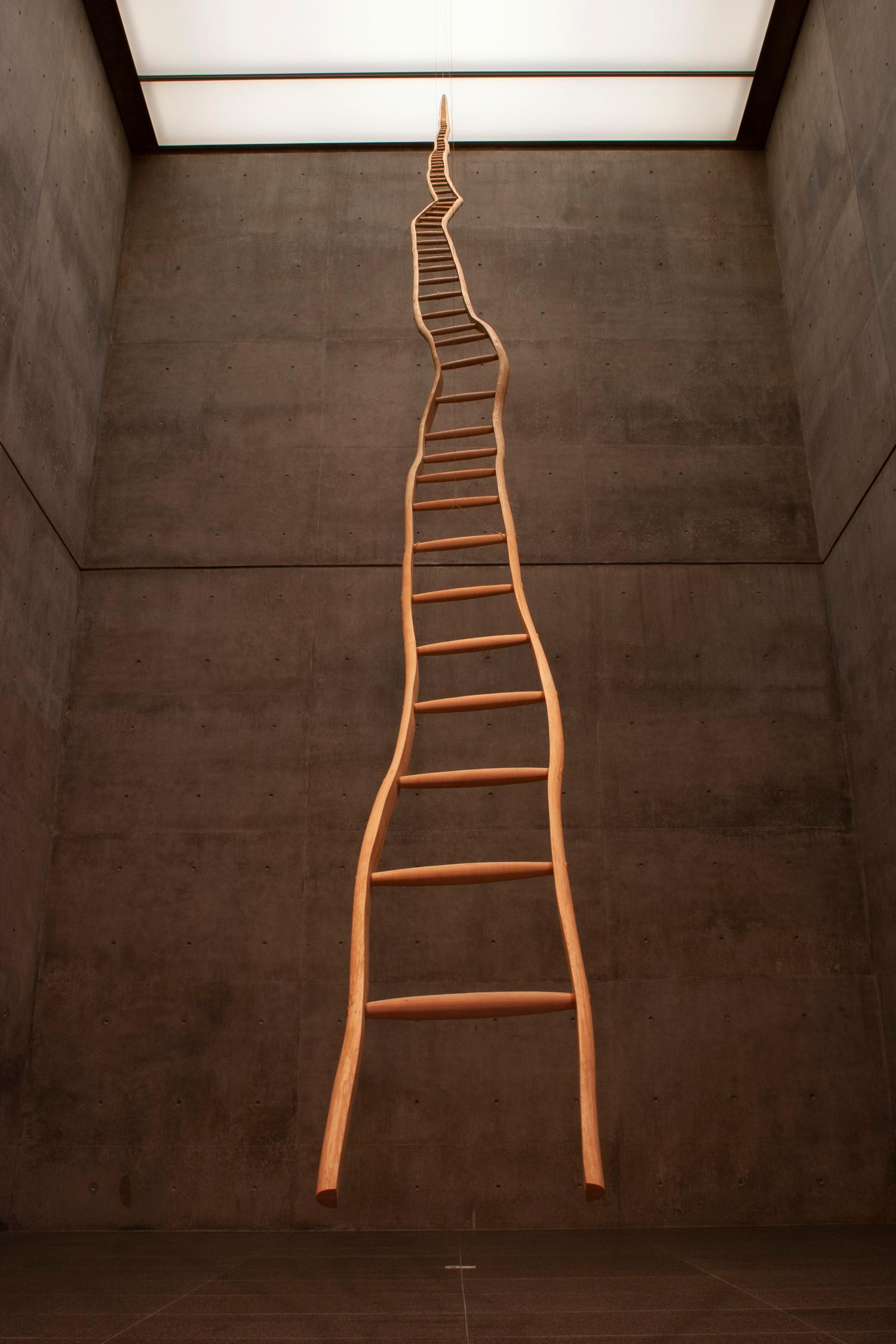
The first obstacle is below the first rung. Martin Puryear’s Ladder for Booker T. Washington hangs in the air, offering the familiar shape of a way up without providing an ordinary place to begin. Follow its wooden sides toward the ceiling and another difficulty appears: the ladder becomes narrower as it rises. The eye can keep climbing long after the body would have run out of room.[1]
The Modern Art Museum of Fort Worth owns the 1996 sculpture. Its thirty-six-foot length contracts in width from twenty-two and three-quarter inches to just one and a quarter.[1] An exceptionally long ladder persuades the viewer to imagine a distance greater than its actual length.
Randy Mallory’s 2003 installation photograph gives that double scale an architectural setting. The concrete gallery supplies broad, regular surfaces against which the ladder’s wavering profile looks startlingly alive. Its upward movement holds the composition together, but the wood never settles into a perfectly straight line. The room offers an orderly enclosure; the object threads an uncertain course through it.[6]
The curves have a material history. Puryear split a single ash sapling lengthwise, joining its halves with maple rungs.[1] The sides share one history of growth, separated and connected again. What might look like a decorative flourish begins with the particular shape of a tree.
There was a practical model, too. During a stay at Alexander Calder’s studio in France, Puryear noticed homemade ladders in the countryside. The Modern’s account of its 2008 retrospective traces the sculpture to that encounter and to his interest in exaggerating perspective.[2] A modest piece of rural equipment supplied a construction method capable of surviving a radical change in scale. The rungs still identify the object instantly, even as its proportions make using it increasingly inconceivable.
That recognition matters. A ladder is unusually easy to read with the body. We know what hands and feet would do, how weight would pass from one step to the next, and why the distance between the rails matters. Puryear can therefore establish an expectation with very little information. Two sides and a sequence of crosspieces are enough to make a viewer mentally rehearse an ascent.
The taper interferes with that rehearsal. Ordinarily, parallel rails seem to converge because they are getting farther away. Here the wood itself narrows, adding a second contraction to the one produced by distance. The museum’s retrospective account explains this deliberate acceleration of recession.[2] Looking upward, we receive more apparent remoteness than the room can physically contain. The top is visible, yet visibility offers little reassurance about reaching it.
The title came afterward. In his 2003 Art21 interview, Puryear explained that he finished the sculpture before naming it for Washington; he began with the sapling and distorted perspective.[3] The object first produced a problem of looking. The name made that problem resonate with a particular history.
Booker T. Washington’s public career joined an extraordinary personal ascent to a disputed prescription for collective advancement. Born into slavery in 1856, he became a leading educator and established Tuskegee Institute in 1881. His emphasis on practical education and economic independence offered opportunities under severe racial constraints. In his Atlanta address of 1895, however, he accepted social separation while arguing for shared economic progress. Critics including W. E. B. Du Bois challenged the accommodation of inequality.[4]
The National Park Service’s account also records Washington’s secret support for anti-segregation activity.[4] That complication deserves to remain in view. A simple opposition between heroic self-help and passive surrender cannot contain his public compromises and less visible actions. The sculpture’s title brings this contested history into the gallery without turning the wooden form into a verdict on every part of it.
Puryear connected the ladder to Washington’s gradualism: the starting position, the goal, and the circumstances governing whether one can arrive.[3] Bodily access diminishes along the route that promises advancement. My reading is that the sculpture asks what a promise of ascent is worth when the conditions of climbing change on the way up.
The Modern’s collection text leaves room for ambition, hierarchy, and the possibility that the summit cannot be reached.[5] These readings need not cancel one another. The ladder’s height can be exhilarating. Its slenderness can make the same ascent seem precarious. A viewer can admire the reach of the structure while doubting the invitation it appears to extend. The attraction is part of the difficulty: without it, there would be little reason to look upward at all.
Puryear also told Art21 that the museum’s historical explanation risked eclipsing the sculpture itself.[3] Return from the name to the joins, from the argument to the narrowing interval between the rails. The history gains force through these physical relationships; they deserve attention in their own right.
At the bottom, the suspended wood still withholds a foothold. At the top, the opening has contracted beyond bodily use. Between them, the rungs keep repeating their ordinary promise: here is the next step. Puryear lets the eye accept that promise again and again, while the rest of us remains on the gallery floor.
Sources
- Modern Art Museum of Fort Worth, “Martin Puryear: Ladder for Booker T. Washington,” object card — 1996 date, ash and maple construction, dimensions, suspension, and the sapling’s shape.
- Modern Art Museum of Fort Worth, “Martin Puryear,” 2008 retrospective — French countryside ladders, the Calder studio visit, construction, and manipulated perspective.
- Art21, “Abstraction and ‘Ladder for Booker T. Washington,’” interview originally published September 2003 — the title’s timing, forced perspective, Washington’s gradualism, and Puryear’s response to museum interpretation.
- National Park Service, “Virginia: Booker T. Washington” — slavery, Tuskegee, the 1895 Atlanta address, criticism, and secret support for anti-segregation activity.
- Modern Art Museum of Fort Worth, “Ladder for Booker T. Washington,” collection record — the work’s historical associations and range of possible interpretations.
- Randy Mallory, photograph of “Ladder for Booker T. Washington” by Martin Puryear, April 22, 2003, UNT Digital Library — installation image from the Randy Mallory Papers, UNT Libraries Special Collections.