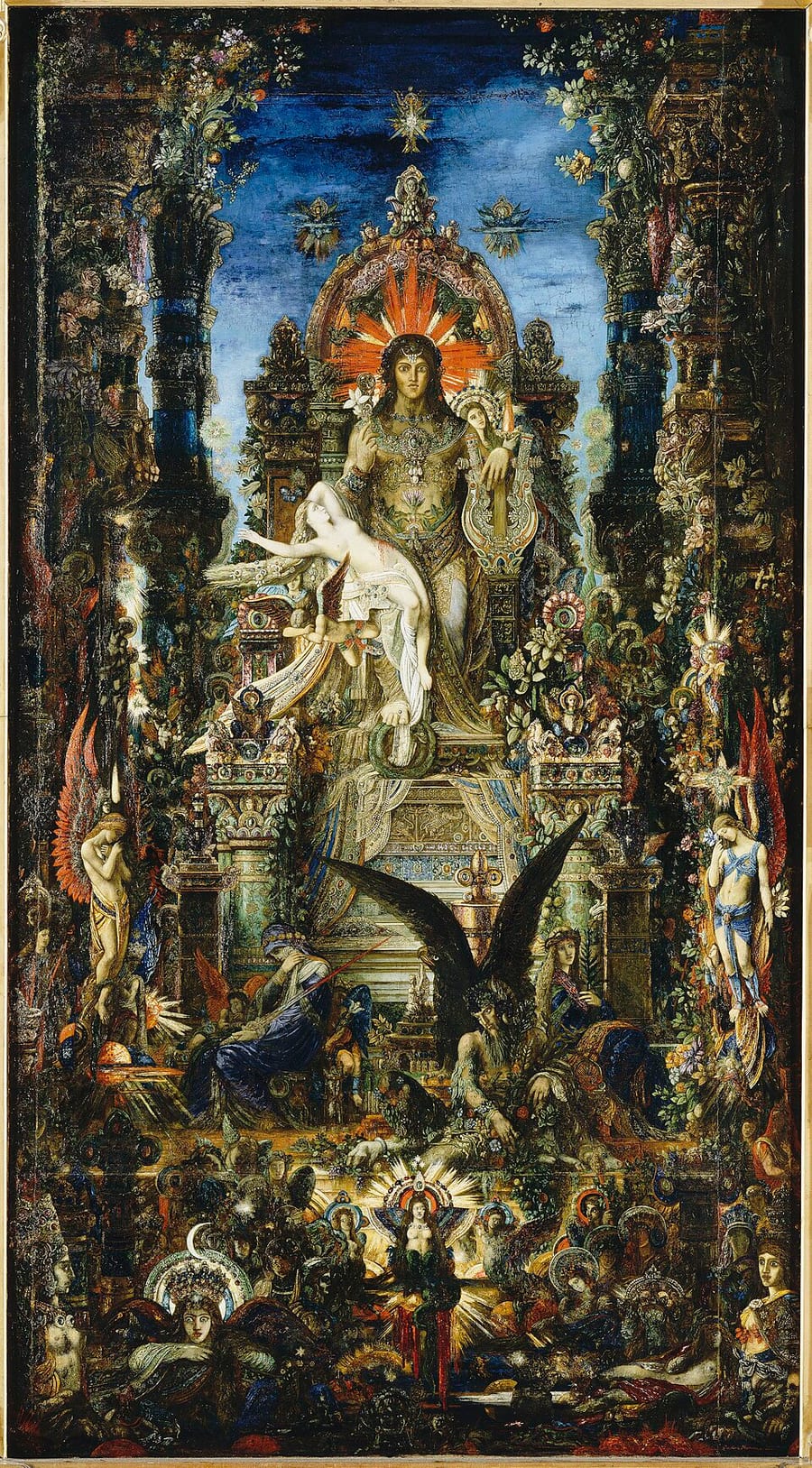
Image context: this post uses a real archival photographic reproduction of Gustave Moreau's Jupiter and Semele from Wikimedia Commons, tied to the painting in the Musée national Gustave Moreau. It is not a generated visual, diagram, chart, or symbolic placeholder. The image matters because Moreau's subject is not only a mythic death; it is the problem of seeing too much at once.[1][5]
Gustave Moreau's Jupiter and Semele is a painting about a fatal request, but it does not behave like a simple narrative picture. The myth is clear enough: Semele asks Jupiter to reveal himself in divine splendor, and the mortal body cannot survive the vision. Moreau's answer is not to paint one bolt, one body, and one theatrical death. He makes the whole canvas become the dangerous revelation.
That is why the painting feels less like an illustration of Ovid than like an image under supernatural pressure. Semele collapses across Jupiter's lap, but she is not alone in the event. Around her, allegorical beings, mythic attributes, vegetation, wings, sphinxes, shadow creatures, jeweled color, and architectural density crowd the scene until the eye cannot isolate a single center for long. The mortal danger in the picture is not only lightning. It is overload.
The Musée Gustave Moreau calls the work a synthesis of Moreau's art and even a kind of pictorial testament: first sketched in 1889, completed in 1895 for Leopold Goldschmidt, later donated to the museum, and built at the imposing scale of about 2.12 by 1.18 meters.[1] Those facts matter because the painting reads like an artist testing how much late style can bear. This is not youthful bravura. It is a final, crowded argument about what painting can do when natural sight is no longer enough.
The myth is a trap about proof
Ovid's version gives the plot its cruel precision. Juno, jealous of Semele, disguises herself as the old nurse Beroe and persuades Semele to demand that Jupiter appear as he does to Juno herself. Jupiter has already sworn to grant the boon. He tries to soften his force, but even moderated thunder destroys her mortal body; the unborn Bacchus is rescued and completed in Jupiter's thigh.[3]
Moreau keeps that structure, but he shifts the emphasis. In Ovid, the fatal mechanism is a promise wrongly used. In the painting, the fatal mechanism is vision. Semele wants proof of divinity, and the proof arrives as something no human sensorium can process. The result is not simply punishment for curiosity. It is a catastrophe of scale: mortal desire asks for divine evidence, and divine evidence arrives without a human limit.
This is why Semele's body matters so much. She does not look like a figure merely struck from outside. She looks overwhelmed from within the field of the god's presence. Jupiter sits frontally, luminous and calm, less like a lover in crisis than like the impossible source of the crisis. The painting makes his composure terrifying. He does not need to act violently. His being is already too much.
Jupiter becomes a poet god
Moreau's Jupiter is not the standard thunder-father. The museum points out that he is beardless and holds a lyre, an attribute more usually associated with Apollo or Orpheus, which turns him into a poet god.[1] That alteration is crucial. Moreau is not only staging divine power as force. He is staging it as art.
The lyre changes the whole picture. If Jupiter were shown only as a storm god, Semele's death would be a problem of raw energy. With the lyre in his hands, the revelation becomes aesthetic, musical, and visionary. Beauty itself becomes dangerous. The god's splendor is not separate from composition; it is composition raised beyond the mortal threshold.
That is also why the painting's ornament cannot be dismissed as excess. Moreau's art page says he wanted painting to be a mental art, not mere imitation of observed nature, and it singles out Jupiter and Semele as an example of his belief that painting should rival the intense richness of enamel.[2] The jeweled surface, the crowded figures, the saturated glow, and the hard-to-parse details are not decorative padding around the story. They are the story's method. The canvas gives the viewer too much because Semele asked to see too much.
The lower world keeps speaking
The painting is often remembered upward: divine glory, vertical ascent, the soul moving toward spiritual regions. Moreau certainly builds that climb. The museum describes the painting's vertical development as the path the soul must take toward increasingly spiritual areas.[1] But the lower half is just as important because it refuses to let transcendence become clean.
At the base of the throne, the museum identifies Death with a bloodied sword and Sorrow crowned with thorns, holding a lily. Moreau saw them as the tragic basis of human life.[1] Nearby are Jupiter's eagle, Pan with cloven hooves, Hecate in the darkness below, shadowy hybrid beings, and two sphinxes that guard the flock of underworld enigmas.[1] This is not a decorative undercarriage. It is the painting's moral weight.
Semele's vision reaches upward, but the painting insists that revelation has roots in death, grief, animality, night, and unsolved riddles. The divine does not erase the chthonic. It rises out of it. Moreau's verticality is therefore not a clean ladder from earth to heaven. It is a pressure column: underworld, flesh, love, death, desire, art, and spirit stacked in one difficult order.
That makes the image stranger than a conventional morality scene. Semele is not simply below and Jupiter above. She lies at the point where the whole system crosses: human love, divine splendor, birth, death, music, and allegory all converge in one body that cannot survive convergence.
Symbolism turns explanation into atmosphere
The painting belongs naturally to Symbolism, but that label can make it sound more orderly than it is. The Art Story describes Moreau's paintings as visionary, otherworldly, macabre, and invested in ambiguous symbols where divine and mortal beings often stand in conflict.[4] Jupiter and Semele fits that account, but the important word is ambiguous. Moreau's symbols do not line up like a glossary.
The viewer can identify parts of the system: lyre, eagle, sphinx, Pan, Hecate, Death, Sorrow, lily, throne, lightning, Semele, Jupiter. Yet identification does not solve the painting. The more names we attach, the more densely the picture resists closure. A guidebook reading can help us enter the canvas, but it cannot make the canvas quiet.
This is the work's most modern feature. Moreau does not abandon tradition; he overloads it. Classical myth, Christian sorrow, occult darkness, poetic music, and ornamental luxury share the same pictorial air. The result is not eclecticism as sampling. It is syncretism as pressure: too many inherited systems all claiming the right to explain desire, death, and transcendence.
Looking repeats Semele's error
The painting makes the viewer perform a softened version of Semele's mistake. We ask for the revelation to become legible. We want the canvas to give itself up: what is this figure, what does that symbol mean, where should the eye rest, what is the correct hierarchy? Moreau keeps offering answers and then making them insufficient.
From a distance, the composition seems hierarchical: god above, mortal below, underworld beneath, ascent implied. Up close, the hierarchy loosens. Small creatures and allegories pull attention away from the central pair. Pattern competes with body. The god's calm face competes with the lyre, the throne, the lower darkness, and Semele's exposed collapse. The canvas teaches that revelation is not the same as clarity.
That is why the painting's beauty is not restful. It has the splendor of a reliquary and the congestion of a fever dream. Gold, green, red, flesh, black, and pale ornament gather into an image that feels precious and almost suffocating. Moreau wanted painting to transport the viewer into another world rather than simply reproduce reality.[2] Here, that transport is not gentle. Another world arrives with no simplified map.
The testament is a warning
If Jupiter and Semele is Moreau's pictorial testament, it is not a serene one. It says that painting can still carry myth in the late nineteenth century, but only if myth is allowed to become unstable again. The old story is not dead; it is dangerously alive because it can absorb allegory, theology, eroticism, ornament, and psychic dread without resolving into one lesson.
Semele dies because she asks the god to appear without disguise. Moreau's painting suggests that art has the opposite problem: it can reveal only through more veils, more signs, more surfaces, more delays. The painting does not show divine light by emptying the canvas. It shows divine light by making the canvas almost impossibly full.
The result is a close reading that never quite closes. Every explanation leads to another figure, another symbolic register, another region of the surface. Moreau made a painting in which the mortal eye survives only by failing to master the whole. Semele wanted the god directly and was destroyed. We get the safer aftershock: a canvas that lets us look, withdraw, return, and learn that some images are strongest when they remain too crowded to solve.[1][2][3]
Sources
- Musée Gustave Moreau, "Jupiter and Semele [Jupiter et Semele]" - official collection record with date, commission history, dimensions, iconography, and interpretive notes on Jupiter, Semele, Death, Sorrow, Pan, Hecate, and the painting's vertical structure.
- Musée Gustave Moreau, "The Art of Gustave Moreau" - museum essay on Moreau's mental art, enamel-like richness, drawing practice, dreamlike aim, and the role of Jupiter and Semele in his color theory.
- Theoi Classical Texts Library, Ovid, Metamorphoses, Book 3 - English translation of the Semele episode, including Juno's disguise, Semele's fatal request, Jupiter's reluctant appearance, and Bacchus's rescue.
- The Art Story, "Gustave Moreau Paintings, Bio, Ideas" - artist overview and work note on Jupiter and Semele, Symbolism, mythic ambiguity, syncretic spirituality, and Moreau's late pictorial density.
- Wikimedia Commons, "File:Jupiter and Semele by Gustave Moreau.jpg" - photographic image source for the article cover, with the public-domain artwork reproduction and file metadata.