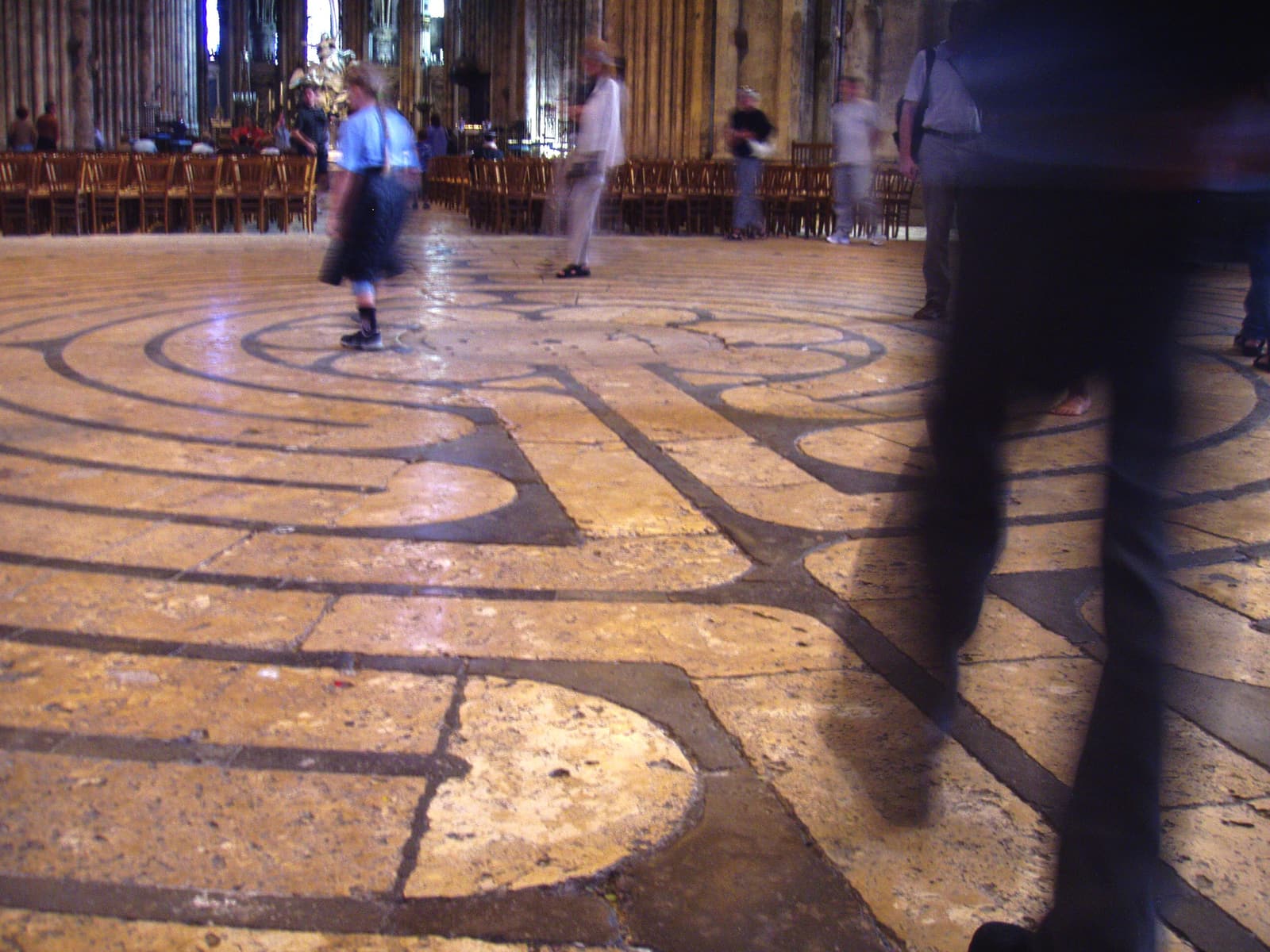
Image context: this post uses a real photograph of visitors walking the stone labyrinth in Chartres Cathedral, not a plan, diagram, chart, or generated image. The motion blur matters: the artwork is not only a pattern seen from above, but a line experienced by bodies moving through the nave.[6]
The Chartres labyrinth is often reproduced as a tidy diagram, and the diagram is the easiest way to misunderstand it. On paper, the design looks like a solved pattern: an eleven-circuit path, turns nested inside turns, a center waiting for arrival. On the floor of Chartres Cathedral, it behaves differently. It is not an emblem first. It is a piece of stonework that asks the body to slow down, turn back, lose the habit of direct progress, and look at Gothic space from below.[1][2]
That is why a theme essay suits the labyrinth better than a fact-card summary. The object sits between architecture, devotion, drawing, paving, and performance. The official cathedral page describes it as a path that invites pilgrimage, and the current practice of clearing it for walking on Fridays keeps that bodily function visible.[1] But even if one approaches it as art rather than devotion, the basic proposition remains strong: Chartres places a disciplined line where a visitor expects open floor, then makes that line reorganize time.
A Line Instead Of A Maze
The first correction is simple. The Chartres labyrinth is not a maze in the modern puzzle sense. A maze multiplies choices and rewards escape. A labyrinth of this kind gives one path. Its drama comes not from choosing correctly, but from continuing after progress becomes hard to read. You move toward the center, then away from it. You seem near arrival, then the path sends you outward again. The work turns certainty into rhythm.[1][2]
That distinction matters because it changes the meaning of intelligence. A maze flatters the quick solver. The Chartres labyrinth disciplines the impatient viewer. It does not ask, "Can you find the way?" It asks, "Can you remain inside the way when the route refuses your preferred speed?" The line is already there, but the body has to agree to it.
This is where the floor becomes art rather than ornament. The design is made from stone, but its medium is duration. The path's turns convert walking into measured attention, and measured attention is one of the cathedral's basic artistic languages. Stained glass slows reading by filtering narrative through colored light. Sculpture slows doctrine by giving it bodies, folds, faces, and portals. The labyrinth slows movement by turning a straight nave into a coiled itinerary.[3][4][5]
The Body Is The Measuring Tool
The temptation with Chartres is to jump immediately to symbolism. There is no shortage of claims about lunar systems, hidden alignments, lost rituals, or secret meanings. The better place to start is with scale. Jeff Saward's Chartres Cathedral Labyrinth FAQ is useful precisely because it separates plausible description from overconfident legend. It notes that no surviving documents record exactly when the labyrinth was constructed, warns against treating common path-length numbers as certain, and gives a carefully reasoned estimate of roughly 262.4 meters from entrance to center.[2]
That kind of caution improves the looking. A path of that length does not need a sensational theory to matter. It is already a major intervention in the nave. If a visitor walks it, the floor has taken command of several minutes of attention. If chairs cover it, the buried pattern still changes the idea of the nave: underneath the ordinary use of the church lies another instrument, waiting for the room to be cleared.
The pathway's narrowness also matters. Saward reports an average path width of about 34 centimeters, separated by stone walls of about 7.5 centimeters.[2] Those numbers make the design feel less like a decorative carpet and more like a calibrated track. One does not stride across it grandly. The line makes walking modest. It lowers the body into foot placement, balance, and repeated turning. The viewer becomes a measuring device.
This is a quiet reversal of Gothic spectacle. Chartres is famous for verticality, windows, porches, and towers. Tourism materials rightly emphasize the cathedral's sculpted doorways and its extraordinary stained glass, including 176 windows in outstanding condition.[4] The labyrinth refuses that upward pull for a while. It insists that looking down can be as serious as looking up.
The Floor Talks To The Windows
That downward attention does not isolate the labyrinth from the rest of the building. It clarifies the building's larger intelligence. Chartres was classified as a World Heritage site in 1979, and the cathedral's own heritage account foregrounds its status as a masterpiece of human creative genius.[3] The point is not that every part says the same thing. It is that the parts coordinate different forms of perception.
The windows teach through light. The official stained-glass page stresses that Chartres glass reveals images, stories, senses, and symbols when crossed by light, and it describes the cathedral's glass as an exceptional collection associated with the famous "blue of Chartres."[5] That language is vertical and luminous: eyes rise, color enters, narrative appears above ordinary reach.
The labyrinth works by a contrasting logic. It has little of the window's glow. Its lines are dark against pale stone. Its wear is close to the feet. Its revelation is not a burst of color but a change in pace. Yet the two systems belong together. Both refuse instant consumption. The window makes narrative depend on light and angle. The labyrinth makes arrival depend on repeated physical turns. In each case, the artwork teaches that understanding is not the same as possession.
This is why the labyrinth is more than an interesting floor feature. It makes the cathedral's didactic ambition tactile. A viewer may read a sculpted portal, study a glass cycle, or walk a floor line; each act is a different way of submitting attention to a made order. The labyrinth brings that order down to the body's smallest negotiations.
Myth Is Too Easy
The Chartres labyrinth has attracted modern spiritual and esoteric enthusiasm, and that is understandable. It is a powerful survival: a medieval floor pattern in a cathedral already saturated with symbolic systems. But the richest reading does not require turning every curve into a code. In fact, the stronger discipline is to let uncertainty remain part of the object.
Saward's FAQ repeatedly pushes back against unsupported certainties: the construction date is undocumented, the original purpose cannot be fully recovered, and several attractive stories about the center, the path, and the perimeter lack firm evidence.[2] That does not make the labyrinth empty. It makes it historically alive. The work survives with enough force to invite meaning, but not enough documentation to let meaning close around it.
For art writing, that is a useful ethical limit. The labyrinth should not be flattened into either skepticism or fantasy. Skepticism alone reduces it to paving. Fantasy alone replaces the stone with our wish to possess a secret. The actual object is more demanding. It asks us to hold material fact, liturgical setting, medieval craft, modern practice, and interpretive gaps at the same time.
Walking As Close Reading
Close reading is usually a literary phrase, but the Chartres labyrinth shows how physical it can be. To walk the line is to read with the soles of the feet. Repetition becomes syntax. Reversal becomes punctuation. The center is not a prize but a pause made meaningful by the route that delayed it.
The photograph used for this post captures that better than an immaculate overhead drawing could. Visitors blur across the stone. The pattern is partly blocked by bodies. The cathedral interior recedes into chairs, columns, and filtered light.[6] Nothing in the image looks like a clean abstraction. That is the point. The labyrinth's beauty depends on use, obstruction, resurfacing, and the strange dignity of a floor that has learned to hold centuries of footsteps.
Seen this way, Chartres does not merely contain a famous labyrinth. It stages a conflict between the desire to see the whole and the necessity of proceeding step by step. A diagram gives the whole too quickly. The floor gives it back slowly, under the pressure of the body. The line in stone teaches the viewer that sacred space is not only entered. It is paced.
Sources
- Cathédrale Notre-Dame de Chartres, "The Labyrinth" - official page on the labyrinth as a path, pilgrimage practice, Friday walking access, and contemporary interpretive framing.
- Jeff Saward, "The Chartres Cathedral Labyrinth FAQ's," Labyrinthos - technical and historical FAQ on undocumented construction date, path length estimates, path width, center traditions, lunations, and unsupported legends.
- Cathédrale Notre-Dame de Chartres, "A World Heritage" - official page on Chartres's 1979 World Heritage classification and criteria, including its status as a masterpiece of human creative genius.
- C'Chartres Tourisme, "Cathédrale de Chartres" - visitor and heritage page describing the cathedral's medieval importance, nine sculpted doorways, and 176 stained-glass windows.
- Cathédrale Notre-Dame de Chartres, "The stained glass windows" - official page on the cathedral's stained glass, Chartres blue, light, narrative imagery, and interactive window interpretation.
- Wikimedia Commons, "File:Labyrinth at Chartres Cathedral.JPG" - Daderot photograph of visitors walking the labyrinth at Chartres Cathedral, used as the article image source.