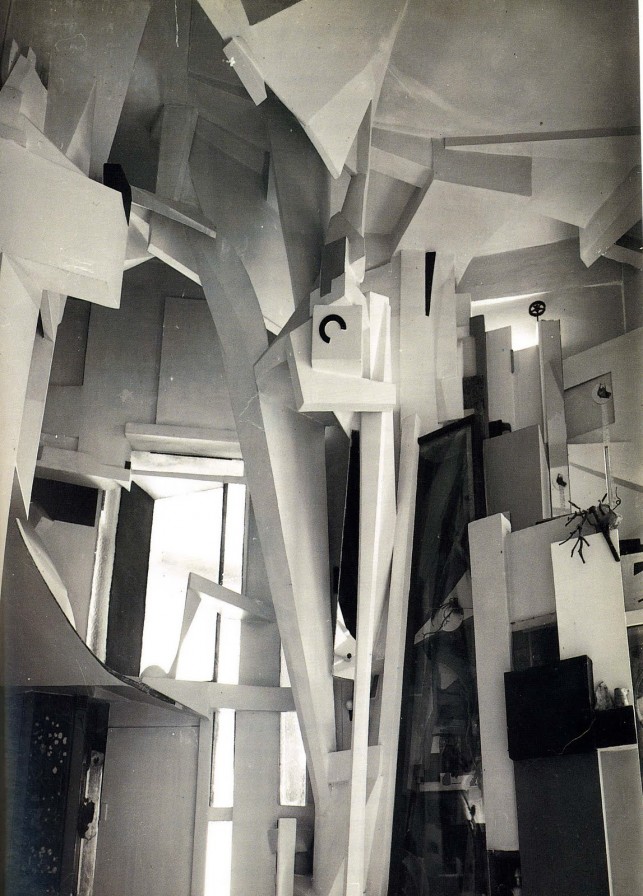
Kurt Schwitters's Merzbau is usually introduced as a lost installation, but loss is only the outer frame. The more useful way in is technical: Schwitters made collage stop behaving like a flat arrangement and start behaving like a room. In the Hanover family house where he worked for years, scraps, personal objects, plastered forms, niches, columns, and white angular growths pushed the logic of Merz into architecture. The result was not simply a studio full of artworks. It was a studio turning into artwork.[1][2]
That distinction matters because Merz began from fragments. North East Museums' Hatton account describes Merz as Schwitters's one-man movement, built from found and discarded everyday materials, with the word itself taken from a fragment of print from Commerzbank.[2] The Merzbau asks what happens when that fragment logic refuses to stop at the edge of the board. The answer is not "bigger collage" in a simple sense. The answer is a new medium: room-collage.
Collage Became A Spatial Contract
In a paper collage, the viewer sees fragments brought into relation from the front. The edge of the board keeps the experiment bounded. In the Merzbau, relation became navigable. A visitor would have had to enter the work, turn, look up, peer into recesses, notice a protrusion, lose a line behind a column, and understand the room by moving through partial views. That is why the surviving Redemann photograph is so charged. It shows angular white structures crowding the interior like a self-growing geometry, but it also shows limits: a window, a wall, shadows, dark inserts, and small found-object details that prevent the room from becoming pure abstraction.[1]
The technique is important here. Schwitters did not abandon the found object when the work became architectural. Hatton Gallery's account of the later Elterwater Merz Barn says found objects were incorporated into the work and then partly covered with decorator's plaster and paint, giving the three-dimensional collage an abstract quality.[2] Read backward to Hanover, that procedure helps explain why the Merzbau can look at once constructed and fossilized. Objects are not merely displayed. They are embedded, concealed, transformed, and made to press against the surfaces around them.
This is the first lesson of the Merzbau as technique: collage does not only mean adding visible pieces. It can also mean building a structure in which some pieces disappear into the work while still determining its form. A fragment may be hidden under plaster, but its former presence changes the surface. The artwork keeps a memory of matter even when matter is no longer legible as itself.
The Room Kept Changing
The Merz Barn context history and Hatton's institutional account give the essential timeline: Schwitters began the Hanover Merzbau in the 1920s, left Germany in 1937, and the house and work were destroyed in a 1943 bombing raid.[1][2] Those dates are not incidental. A long working span makes the Merzbau a process, not a single completed object. The work was accretive. It developed by addition, revision, dedication, and reorganization.
That changing condition separates the Merzbau from a finished sculptural interior. The context history notes that Schwitters commissioned photographs from three viewpoints in 1933 and that those images have shaped later understanding of the lost work.[1] A photograph can show the room's sharp planes, columns, and grotto-like structures, but it cannot restore the sequence by which the room grew. It cannot show yesterday's arrangement yielding to tomorrow's insert. It cannot fully capture the fact that a lived environment was becoming a total artwork over time.
The best analogy is not a monument but a system of decisions. A new object could be brought in. A niche could be dedicated. A column could absorb memory. A white plane could regularize a set of messy elements. The work therefore joined two pressures that often pull apart: private accumulation and formal discipline. It was personal, full of relic-like associations and dedications; it was also severe, angular, and increasingly abstract.[1][4]
That doubleness keeps the Merzbau from being only an eccentric room. A hoard preserves things by accumulation. A Merzbau changes things by relation. Schwitters was not simply storing fragments of modern life; he was forcing them to become spatially answerable to one another.
White Paint Did Not Make The Room Pure
The archival photograph can tempt a viewer to read the Merzbau as a white modernist cave: all facets, columns, and brightness. That reading is too clean. The white surfaces matter because they unify, but they do not erase the work's dirty origin in scraps, souvenirs, debris, and personal matter. They create a field in which embedded fragments can become harder to identify and more powerful as pressure.
This is where the Merzbau differs from a collage that celebrates the readable scrap. In The Cherry Picture, a viewer can still pick out cloth, cork, print, wrapper, and image.[2] In the Merzbau, some of that material intelligence becomes architectural. The room does not ask every piece to advertise its origin. Instead, it asks the viewer to sense that the abstract form has been made from lived residues. The angular skin is not a denial of clutter; it is clutter converted into structure.
Hatton's account of Schwitters's larger Merz practice is useful because it keeps art and life in the same frame. It describes Merz as an effort to close the gap between art and life by using found and discarded everyday materials, and it notes that in the Merzbauten Schwitters applied collage to his living environment itself.[2] That last phrase is the technical breakthrough. A room is not a neutral support. It contains habits, visitors, dust, windows, repairs, family history, and ordinary movement. By turning the room into collage, Schwitters made those conditions part of the medium.
Reconstruction Is Part Of The Afterlife
Because the Hanover Merzbau was destroyed, every later encounter with it is mediated. The Redemann photographs, Schwitters's related writings, archival memories, and later reconstructions do not simply illustrate the work; they have become part of how the work survives. The Merz Barn context history notes that Peter Bissegger's 1983 reconstruction was made from photographs and advice from Ernst Schwitters, while the reconstruction site itself identifies Harald Szeemann as the initiator and Bissegger as the commissioned maker of the project.[1][3]
That reconstructed status should not be treated as an embarrassment. It clarifies the Merzbau's central problem. If a work is a changing environment, what exactly is being preserved: a look, a room, a method, a memory, a scale relation, or a permission to keep rebuilding? Bissegger's reconstruction can never be the original living room in Hanover. But it can preserve the spatial proposition: Merz is not only a board, a page, or a witty label. It is an environment that makes a viewer inhabit collage.[1][3]
The Elterwater Merz Barn sharpens the same issue from Schwitters's final years. Hatton Gallery records that Schwitters began the Lake District Merz Barn in 1947, intended to work across the whole structure, and concentrated on one wall as his health failed; after his death in January 1948, the unfinished wall was eventually removed, restored, and preserved in Newcastle.[2] The Guardian's 2024 account of renewed restoration efforts around the Cumbrian site shows how active that afterlife remains: digital scanning, facsimile making, conservation, and site planning all continue the question of how to keep a Merz environment legible after damage and displacement.[4]
That afterlife fits the original better than a pristine museum story would. Merz was always made from pieces that had changed context. A bus ticket, wrapper, bit of wood, or personal relic became art by being moved, attached, painted over, or made to answer another piece. The Merzbau itself now survives through a comparable chain: room to photograph, photograph to reconstruction, barn wall to gallery, scan to possible facsimile, archive to new looking.[1][2][3][4]
Why The Technique Still Feels Radical
The Merzbau's radical force is not that it predicted installation art in a vague historical way. It is more specific. It showed that an artwork could be an accumulating interior, that collage could have depth, that memory could be built as niches and planes, and that abstraction could arise from ordinary debris without pretending to be detached from ordinary life.
That is why the Redemann photograph still matters. It is not a substitute for the lost room, but it gives the eye enough evidence to understand the technical wager. The white forms push outward and upward; the dark recesses keep secrets; the window confirms that this was once a domestic room; the small objects resist total formal purification.[1] You can feel the work caught between home, chapel, grotto, archive, and sculpture.
Schwitters made collage big enough to enter, but he did not merely enlarge a method. He changed its obligations. In the Merzbau, a fragment no longer had to remain readable as a fragment. It could become support, surface, memory, obstruction, dedication, or hidden pressure. The room became the medium because the room could hold all those states at once.
That is the durable lesson. Collage is often described as a modern art of breaking and recombining. The Merzbau adds a harder possibility: recombination can become a place, and a place can keep changing until it becomes impossible to separate artwork from the life that built around it.[2]
Sources
- Merz Barn Langdale, "Merz Barn in context" - history page on the Hanover Merzbau, the 1933 photographs, destruction in 1943, Bissegger reconstruction, later Merzbauten, and the Elterwater Merz Barn's survival chain.
- Hatton Gallery / North East Museums, "Kurt Schwitters' Merz Barn Wall" - institutional page on the Elterwater Merz Barn Wall, Schwitters's Merzbauten, found objects, plaster, paint, the four Merz buildings, and the Newcastle preservation chain.
- Peter Bissegger, "The Reconstruction of Kurt Schwitters' MERZ Building by Peter Bissegger, 1981-1983" - reconstruction project page on Harald Szeemann's commission, the Sprengel Museum installation, and the reconstruction's exhibition history.
- Jonathan Jones, "The Cumbrian barn-stormer: is Kurt Schwitters' last masterpiece finally about to be restored?" The Guardian, September 16, 2024 - recent report on Factum Foundation's restoration plans for the Merz Barn site and the wall's preservation history.
- Museum of Modern Art, MoMA-hosted JPEG of Wilhelm Redemann's 1933 photograph of Kurt Schwitters's Hanover Merzbau - source image file downloaded for the article cover.