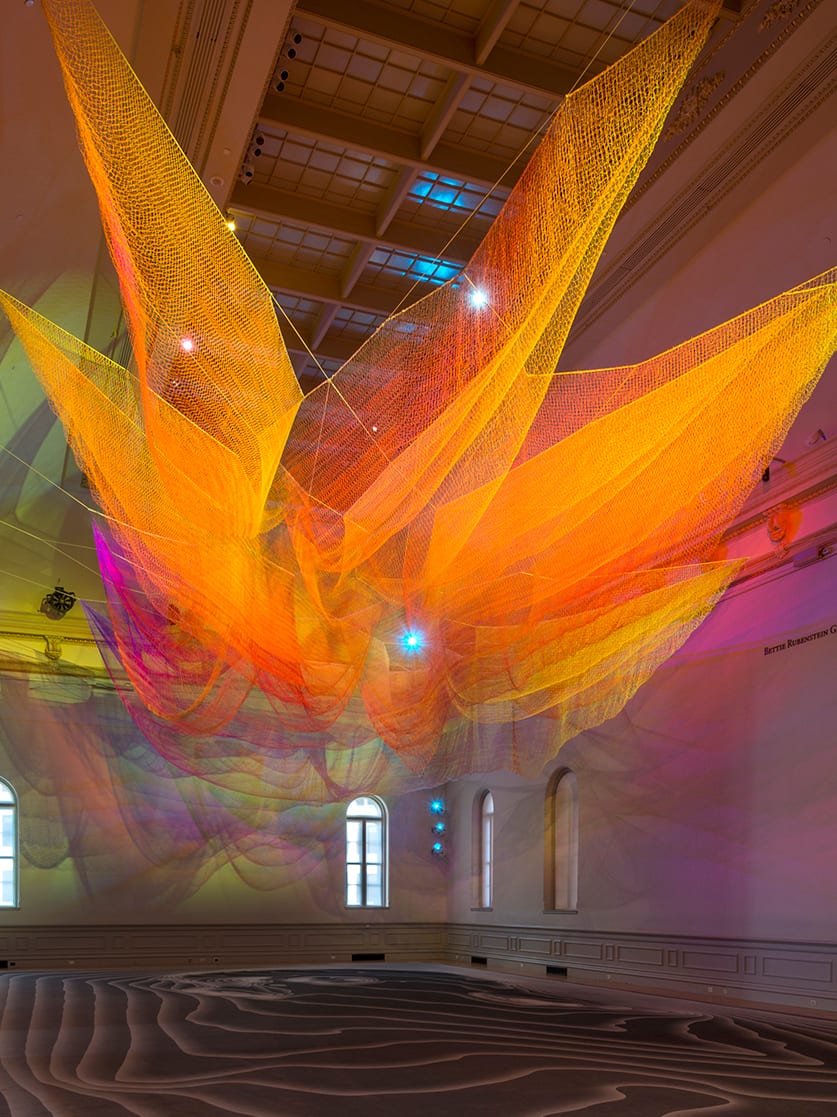

Janet Echelman's 1.8 Renwick is easy to mistake for spectacle: a floating orange net, color washing the walls, visitors looking up from the floor. The short Smithsonian interview embedded below is useful because it pulls the work away from that first impression. It shows Echelman describing an artwork that is not simply suspended in a beautiful room, but built from a collision between physical data, handwork, architectural scale, and a visitor's changed sense of time.[1]
The Smithsonian American Art Museum describes the 2015 installation as a work of knotted and braided fiber with programmable lighting and wind movement above a printed textile floor, installed in the Renwick Gallery's Grand Salon.[2] Studio Echelman's project page adds the commission context: the Smithsonian asked Echelman to transform the Grand Salon for WONDER, the Renwick Gallery's reopening exhibition after a two-year renovation.[3] That matters because the piece is not a portable ornament dropped into a neutral box. It is a room-sized arrangement of ceiling, walls, light, air, carpet, and bodies.
The title is the anchor. Both the Smithsonian and Studio Echelman connect 1.8 Renwick to data recorded after the March 11, 2011 Tohoku earthquake and tsunami, whose force shifted Earth's axis and shortened the day by 1.8 millionths of a second.[2][3] Echelman takes that almost impossible number and refuses to turn it into an infographic. The work does something stranger: it makes a measurable planetary disturbance behave like a changing atmosphere. The installation photograph used for this article shows why a still image helps but cannot finish the job. The net, lights, wall shadows, and floor textile all belong to one spatial event.[4]
Before watching, hold one question in mind: what happens when scientific data stops being a fact to read and becomes a condition you stand under?
Data without the diagram
The first viewing note is negative: notice what the video does not ask from the viewer. It does not present the earthquake data as a chart, map, timeline, or scientific illustration.[1] The number behind the title remains important, but the work's intelligence lies in avoiding the usual explanatory image. A tsunami can be measured; the emotional fact of planetary motion is harder to measure. Echelman's installation sits exactly in that gap.
That gap is why the work belongs in an art frame rather than in a science-museum display about seismology. The point is not to teach the mechanics of the Tohoku earthquake. The point is to turn a nearly abstract datum into a bodily problem. If the day can be shortened by an event far away from the room, then time is not the smooth background we imagine. The room asks the visitor to feel time as something elastic, vulnerable, and shared.
Studio Echelman's material description reinforces this reading. The project uses high-strength fibers, programmed LED lighting, a DMX controller, recycled-netting carpet, and a large soft floor element; the net spans tens of feet in length, width, and depth.[3] Those details matter because the work's softness is engineered. It looks like a wave or cloud, but it depends on tensile calculation, lighting choreography, material testing, and installation labor. The result is a piece that feels weightless without being casual.
This is the article's main annotation for the video: do not separate the poetry from the engineering. Echelman's language around time and interconnection can sound airy if treated as a slogan, but the installation is materially precise.[1][3] The net has to hang, the light has to move, the floor has to receive bodies, and the shadows have to keep the walls active. The art is not data plus decoration. It is a data source translated through structure until the viewer experiences information as space.
The floor is part of the sculpture
The Smithsonian page notes that the projected shadows and vivid colors invite viewers to lie down on the carpet and contemplate the work.[2] That invitation is not a museum gimmick. It changes the ethics of looking. Most gallery viewing keeps the visitor upright, mobile, and slightly detached: walk, glance, read the wall label, move on. 1.8 Renwick asks for a lower posture. When someone lies down, the work stops being a thing across the room and becomes a temporary ceiling.
That bodily reversal is the installation's quiet force. A visitor looking up from the floor sees the Grand Salon's historic cove ceiling through a hanging system of fiber and light. Architecture becomes weather. A net becomes a sky. Shadows drift across walls that would otherwise read as fixed museum surfaces. The viewer's body is not outside the artwork's logic; it completes the circuit by changing speed.
The floor textile matters for the same reason. Studio Echelman describes it as a soft 4,000-square-foot carpet echoing the topography of the aerial form.[3] The floor is not just a comfort pad for spectators. It turns looking into immersion by giving the lower half of the room its own visual rhythm. The net above and the printed field below answer each other, so the visitor is held between two translations of the same wave-like thinking.
This makes the work less like a sculpture on display and more like a temporary climate. The programmed light changes the net; the net casts shadows; the walls register the shadows; the floor gathers bodies; bodies change their angle of attention. Echelman has often been associated with public aerial sculpture, but here the most important public gesture is inward. The Grand Salon becomes a collective pause.
Softness as a way to handle scale
The hardest fact in 1.8 Renwick is scale. The Tohoku earthquake and tsunami were catastrophic events, and the title's time shift points to planetary consequences. A literal memorial mode could easily become too heavy for this room; a purely decorative mode would become evasive. Echelman's solution is softness, but not softness as avoidance. The work uses fiber, suspension, light, and shadow to let the viewer approach enormous force indirectly.
That indirectness is why the Smithsonian interview works as an annotated viewing rather than merely as a promotional clip.[1] Echelman does not need to over-narrate the installation. The short video gives just enough conceptual framing for the viewer to understand that the work is about cause, effect, cycles, and interdependence, then the installation carries those ideas visually. Its form looks unstable, but its instability is controlled enough to be held in a public room.
There is also a productive tension between hand and computation. The work begins from recorded data and depends on engineering systems, yet the visible surface remains mesh, knot, braid, and twine.[2][3] That mixture keeps the piece from feeling like technological spectacle. It is not a screen. It is not a digital projection pretending to be sculpture. It is a physical net animated by light and air, using contemporary systems to recover older sculptural questions: how does form occupy space, how does material hold tension, and how does a room teach the body to look?
The installation's beauty is therefore a method, not an escape. The warm orange and yellow mesh may pull viewers in first, but the longer experience is less about color than relation. A catastrophe in the Pacific becomes a change in the length of the day. A number becomes a title. A title becomes a net. A net becomes a room. A room changes how strangers arrange themselves in public.
What to carry away
The best way to watch the Smithsonian interview is to treat it as a threshold, not as the full artwork.[1] It gives the conceptual key, but the installation itself asks for slowness. If a reader cannot visit the Renwick Gallery, the video and photograph still reveal the central lesson: 1.8 Renwick turns a remote planetary event into a shared condition of attention.[1][4]
That is why Echelman's work avoids the weakness of much data-driven art. It does not ask the viewer to admire the cleverness of converting a dataset into a shape. It asks the viewer to feel what conversion costs and enables. The data loses legibility as data, but gains force as experience. The visitor loses the usual upright authority of museum looking, but gains a temporary place inside the artwork's weather.
In that exchange, 1.8 Renwick becomes more than a spectacular suspended sculpture. It is a meditation on scale made intimate without becoming small. The work lets a room remember that time is physical, that air can be shaped, and that looking sometimes begins when the museum visitor finally lies down.
Sources
- Smithsonian American Art Museum, "Janet Echelman Interview for WONDER at the Renwick Gallery" - YouTube video embedded in this post.
- Smithsonian American Art Museum, "Janet Echelman: 1.8 Renwick" - exhibition page and object description.
- Studio Echelman, "Earthtime 1.8 Renwick, Washington D.C., 2015" - project page with commission, materials, dimensions, and design notes.
- Wikimedia Commons, "File:Janet Echelman 1.8 Renwick.jpg" - installation photograph used as article image.