
Charles and Ray Eames begin Metropolitan Overview with fountains and flutes, not a computer.[1][3] Water rises across the screen; the museum facade follows; then the film moves through the crowds, rooms, objects, and circulation problems of The Metropolitan Museum of Art. Only after establishing that bodily approach does it unveil its technological future: catalog terminals, customized tour printouts, small screening booths, and a vast Information Hall designed to help visitors find relationships across an overwhelming collection.[1][3]
That order is the film's argument. Seen in 2026, its chunky consoles invite an easy prophecy story: the Eameses foresaw the digital museum. They did, in part. But prediction is the least interesting thing here. Their sharper idea was that orientation is a form of care. A museum fails before any artwork is misunderstood if its scale makes people feel that the collection belongs to someone else. The proposed machines were therefore not destinations. They were pieces of a larger welcome, joining staff, maps, films, stored objects, timelines, seating, and routes into what the narration calls a “good host anticipating the needs of his guest.”[1][3]
The nine-minute film matters as an archival object because it preserves a future that was persuasive enough to be filmed but never built in this form.[2][4] It catches the Eames Office near the end of Charles and Ray's four-decade partnership, translating an architectural model into a lived museum experience. Its small figures and simulated visitors do something that a plan cannot: they make institutional intention visible as posture, pause, choice, and movement.[3]
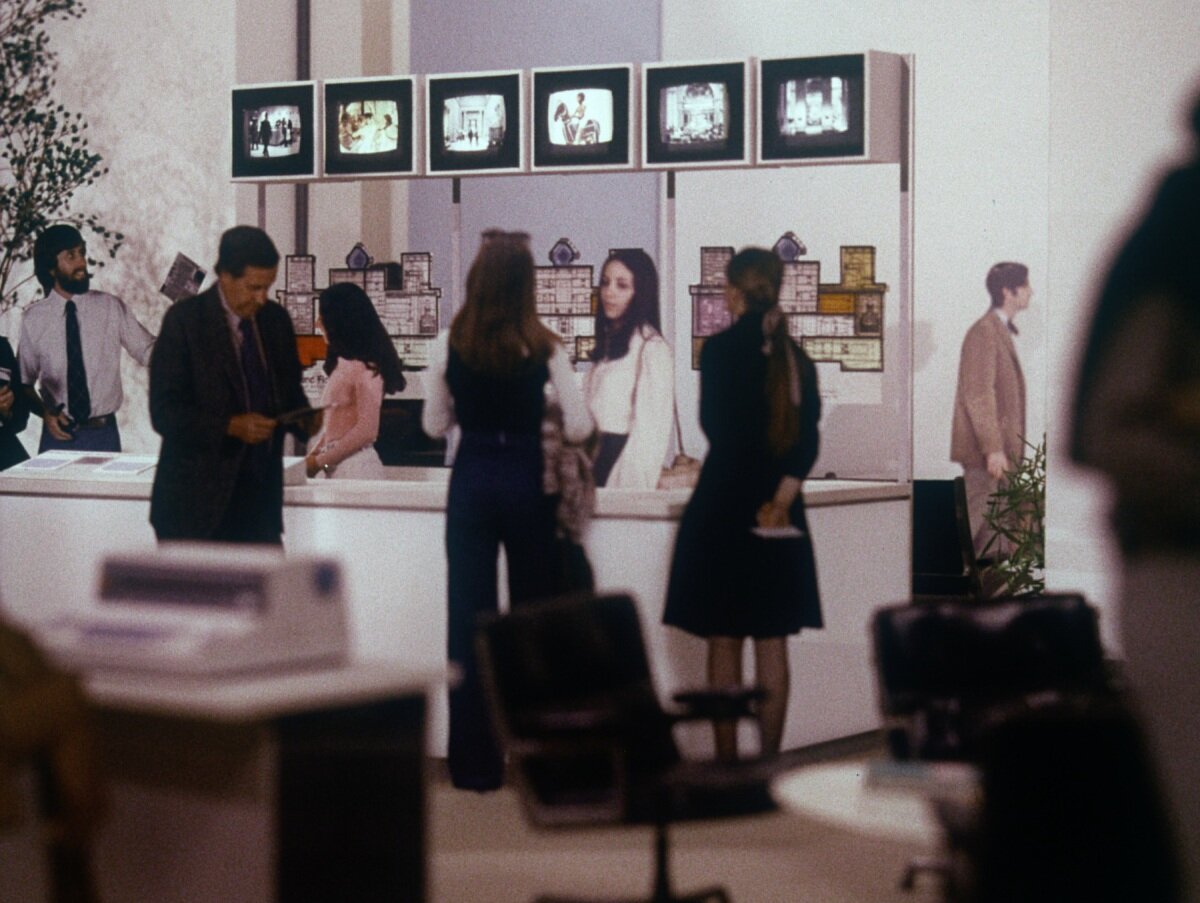
Image context: the cover is a genuine 1975 film still, credited by the publishing source to the Eames Office via The Met. It directly matches the work discussed: the imagined information desk, overhead monitors, floor plans, staff, and visitors condense the film's central claim that museum technology should support a shared public room rather than replace one.[7]
A proposal at the hinge between expansion and explanation
The Met commissioned the project in 1975, at the opening of what it called its second century and just after the Robert Lehman Wing had opened. Director Thomas Hoving asked the Eames Office to consider how the institution might move from physical growth toward deeper development of the visitor experience.[2][3] Charles and Ray answered in two parts: an intricate architectural model proposing a new wing and a reworked foyer, and Metropolitan Overview, a film that supplied motion, rationale, and emotion to the silent model.[2][3]
This was not an unexpected detour for designers known popularly for chairs. The Eames Office had spent decades treating exhibition, film, photography, architecture, toys, and information design as related practices. Mathematica in 1961, the IBM Pavilion at the 1964–65 New York World's Fair, and A Computer Perspective in 1971 had already tested the idea that a difficult history could be encountered at several levels at once: as image, object, sequence, spatial arrangement, and specialist detail.[3] Their bicentennial exhibition The World of Franklin and Jefferson was also touring in 1975–77, reaching The Met in March 1976.[3] Metropolitan Overview belongs to that lineage of dense, carefully staged learning environments.
The proposal also belongs to a more contentious institutional history. Paul Goldberger later reported that Walter Annenberg offered $40 million in 1976—half for construction and half for ten years of operations—for a Met communications center resembling the Eames vision. It was never built. Disputes gathered around the donor, Hoving's role, expansion into Central Park, and a fear that screens and computers might cheapen direct contact with art.[6] Those objections make the film more, not less, useful. They show that the question it raises was never simply whether a museum could adopt technology. The question was who would control the new layer between visitor and object, and whether mediation would enlarge attention or capture it.
Video provenance
The embed is The Met's official YouTube publication of Metropolitan Overview. The Eames Office identifies the original as a nine-minute film made in 1975, using live action, animation, and still photography of the scale model, with music by Elmer Bernstein.[4] The Library of Congress preserves the associated 1974–75 film material within the Charles Eames and Ray Eames Papers.[5] The Met released this restoration in 2025 through its From the Vaults program after restoration by the Library of Congress, returning a once-internal proposal to public view.[2]
The model turns administration into a scene
The first close-reading lesson is that the model is not shown as a pristine architectural trophy. The camera passes low among one-inch visitors, then cuts between miniature galleries, live museum crowds, city views, and individual works.[1][3] Scale keeps changing. An aerial image makes The Met look like a vast machine at the edge of Central Park; the next human-scale view returns attention to someone stopping at a panel or trying to choose a route.[1][7] The film repeatedly converts an institutional abstraction—“the visitor”—back into people with different speeds and purposes.
That movement is why the period texture matters. The film does not hide its simulation. Hairstyles, clothing, glowing cathode-ray screens, printed brochures, model trees, and tiny model figures keep the proposal visibly anchored in 1975.[1][7] Yet the mixture is emotionally effective because the future is presented through ordinary gestures. Someone consults a display. A hand reaches toward a terminal. A family leans into a glass screening booth. Visitors ask staff for help beneath a row of monitors.[1][3] No single gesture is futuristic. The design ambition lies in coordinating them.
Film gives the Eameses an advantage over a blueprint: it can rehearse hospitality. A plan can locate a counter, but a moving image can suggest hesitation before the counter, conversation across it, and renewed movement after it. The proposal becomes less a building than a sequence of permissions. You may enter without already knowing where to go. You may begin with one object, a broad period, a film, a question, or a printed path. You may be a child, a local citizen, a scholar, or an out-of-town visitor and still possess a legitimate starting point.[1][3]
The Information Hall is a collage, not a search box
The film's most durable invention is the Information Hall. Its large timeline would place selected objects from storage among photographs, text, and other contextual material so that the collection no longer appeared as “one precious thing after another.”[1][3] The phrasing identifies a genuine museum problem: masterpieces can become mutually isolating when every label asks for reverence but the room offers no connective tissue. The Eames answer was spatial collage. Successive and overlapping civilizations would be made visible together, and visitors could walk through chronology rather than merely read it.
Computers enter inside that physical argument. One terminal would search the catalog; another could produce a customized tour. Screens would carry museum information and news from the wider worlds of art and archaeology. Small glass booths would hold viewers who wanted to concentrate on a short film.[1][3] These are separate modes of attention, not one compulsory interface. Public orientation happens at the desk and timeline; private focus happens inside the booth; the personalized route sends the visitor back into shared galleries. The machine's job is to return a person to objects with a more purposeful path.
This is also where the film differs from today's phone-led museum experience. Personalization now often shrinks the institution into a device already owned by the visitor. Metropolitan Overview imagines personalization as public infrastructure. The monitors are visible to a room. Staff remain central. Printed routes become things that hands can point at together. Even the computer terminal has architectural weight. Technology does not float above the museum; it has to take up space, create a queue, and answer to the social life around it.[1][3]
A good host still chooses the seating plan
Hospitality is generous, but it is not neutral. A host anticipates needs while also deciding what counts as a need. The central timeline would have selected which civilizations overlap, which stored objects reappear, and which paths become legible. A customized tour would feel personal while drawing from institutional categories built in advance. The film's confidence in universal understanding can therefore obscure the contested labor of naming, ordering, translating, and explaining a global collection.[1][3]
The proposal offers the child, citizen, tourist, and scholar as different users, but it does not linger on conflicts among them, on barriers of language or disability, or on how contested provenance and institutional authority shape a visitor's relation to the collection. That is not a reason to dismiss the film. It is the boundary that makes its design ethics worth examining. Better orientation can widen access; it can also make one official map feel inevitable. The Information Hall would have been both welcome and editorial argument.
What keeps the film from collapsing into technocratic confidence is its return to curiosity. Its machines do not claim to explain the collection completely. They help a visitor locate a footing from which looking can begin.[1][3] This is the distinction many contemporary cultural interfaces lose. Convenience is not the same as welcome, and information is not the same as relation. A good museum guide should not eliminate uncertainty; it should make uncertainty navigable enough that a person wants to continue.
The future that survived is a standard of care
Charles Eames died in 1978, making the Met projects among the last major works of his partnership with Ray.[3] The unbuilt proposal could have remained a footnote inside an archive. Its 2025 restoration instead lets the model perform one more act of persuasion, now for viewers living with the digital systems it once treated as speculative.[2][5]
The film's computers have aged into charming objects. Its harder standard has not aged at all. Every layer between a person and an artwork—entrance, label, map, search result, app, guard, seating area, recommendation—communicates who is expected to belong. Metropolitan Overview asks a museum to treat those layers as design rather than administrative residue. Its future is valuable not because it guessed the terminal. It is valuable because it made the interface answerable to hospitality, and then made hospitality visible as serious cultural work.
Sources
- The Met, “Metropolitan Overview, 1975 | From the Vaults” (official YouTube publication of the restored Charles and Ray Eames film).
- The Metropolitan Museum of Art, “Metropolitan Overview, 1975” (official film page with proposal and 2025 Library of Congress restoration provenance).
- Kelsey Rose Williams, “Reimagining The Met with Charles and Ray Eames,” The Metropolitan Museum of Art (June 18, 2025).
- Eames Office, “Metropolitan Overview” (official work record with date, media, purpose, score credit, and running time).
- Library of Congress, “Metropolitan Overview film, 1974–1975,” Charles Eames and Ray Eames Papers, MSS83006.
- Paul Goldberger, “The Eames Team,” The New Yorker (May 17, 1999), including the later Annenberg communications-center proposal and controversy.
- Ravail Khan, “Watch: Charles and Ray Eames' 1975 vision to reimagine the Metropolitan Museum of Art,” designboom (June 19, 2025), source page for the archival film still used as the cover image.