Christo and Jeanne-Claude's The Gates is easy to reduce to its numbers: 7,503 saffron-colored gates, 23 miles of Central Park pathways, a run from February 12 to February 27, 2005, and a title that stretches the project back to its first proposal in 1979.[1][2] Those figures are useful because they make the scale real. They also risk making the work sound like a logistical stunt that happened to be orange.
The better way into The Gates is slower. The work mattered because it made winter walking feel public in a new way. It did not put a monument in Central Park and ask viewers to gather around it. It multiplied a simple frame until the park's existing paths, turns, bridges, slopes, and crowds became the medium. The object was temporary, but the experience was cumulative: a person entered one gate, then another, then another, until the park stopped being background scenery and became a civic instrument for moving, looking, and sharing weather.[1][3]
A Frame That Refused To Stay Singular
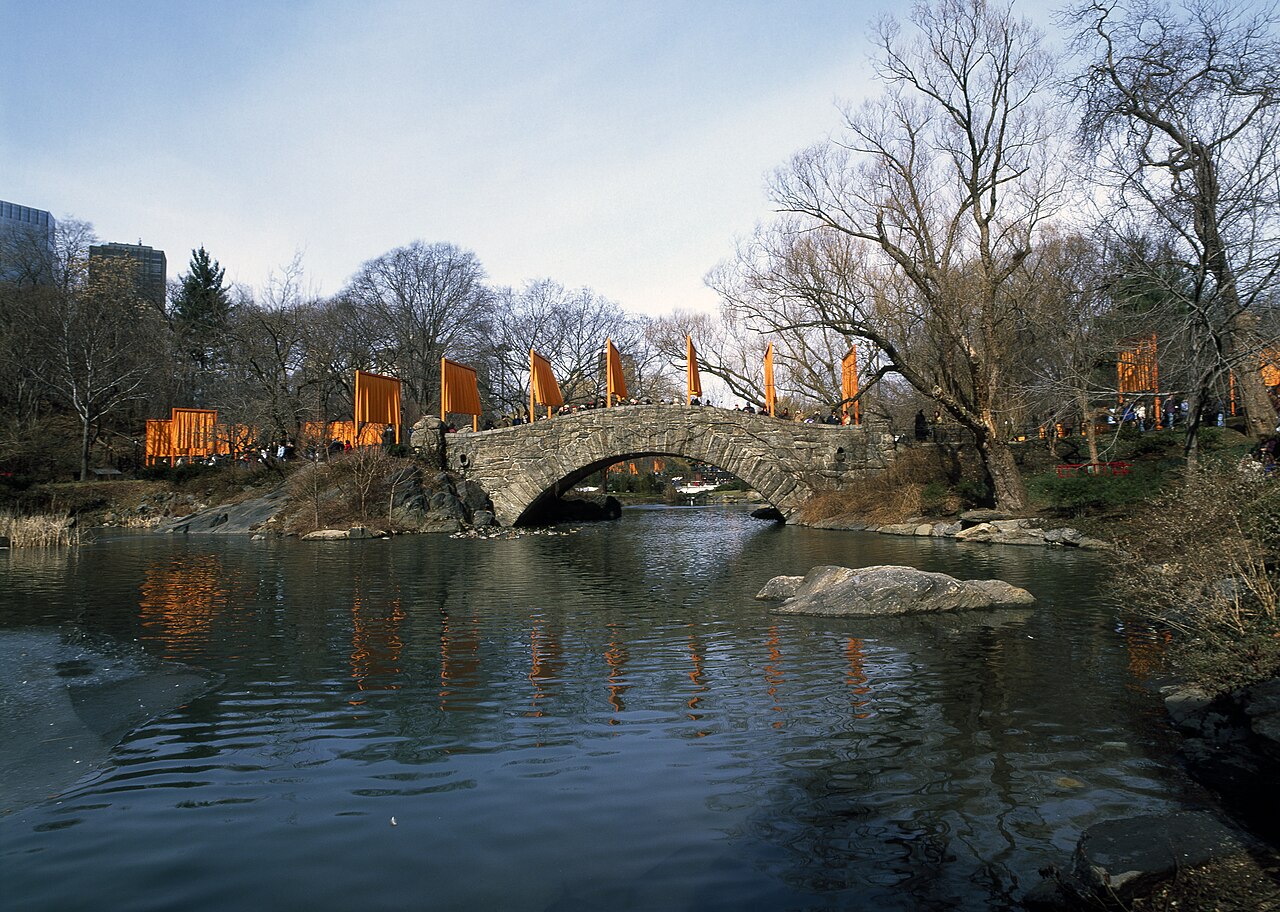
Each gate was simple: a rectilinear vinyl frame resting on steel footings, with a loose saffron fabric panel hanging from the top.[2] Simplicity was not a weakness. It was the condition that let the work spread. One gate would have been a prop. Thousands of gates turned repetition into atmosphere.
That repetition did not flatten Central Park into one image. It did the opposite. The frames made difference visible. A straight path became a corridor. A curve became a slow reveal. A bridge became a threshold inside another threshold. Bare winter branches sharpened the color, and the fabric changed with wind and light. The official project record and Whitney collection page both make the same structural point from different directions: the work was not only a sequence of objects, but a site-specific public system laid across Central Park's pedestrian network.[1][2] The installation did not compete with the park by adding a separate spectacle. It made the park's existing circulation newly legible.
This is why the color mattered so much. Saffron was not only a striking hue against gray February trees. It worked as a public signal. It told walkers that the familiar route had been temporarily claimed by attention, not by ownership. People who already knew Central Park could rediscover it by following the fabric. Visitors could enter without needing specialist knowledge. The color made a difficult artwork look open, but the openness was carefully engineered.
Permission Was One Of The Materials
Christo and Jeanne-Claude often insisted that their temporary public works were self-financed and built through long civic negotiation rather than through permanent possession. The Whitney's object page for a related Gates project work emphasizes the bureaucratic, technical, and civic planning behind the Central Park installation, and notes that the artists funded such large-scale projects through the sale of preparatory studies and sketches.[2] That financing model is not a side note. It changes the artwork's ethics.
The project did not arrive as a sculpture shipped to a neutral site. It had to pass through municipal approval, park stewardship, fabrication, installation planning, public expectation, and eventual removal. The official project title, The Gates, Central Park, New York City, 1979-2005, keeps that delay in view.[1] The dates are not decorative. They say that the artwork includes the long interval between imagining and permission.
That interval matters because Central Park is not empty land. It is a designed, maintained, contested public landscape. The Central Park Conservancy's anniversary account links the project's eventual approval to a changed park and a changed civic moment: the park had been restored from the fragile conditions of the early proposal period, and the Bloomberg administration helped make the 2005 realization possible.[3] Whether one loved or hated the result, The Gates made public art visibly dependent on shared infrastructure. Paths, lawns, staff, rules, crowds, donors, city agencies, and the daily life of a park all entered the work.
The Crowd Completed The Form
Photographs can make The Gates look empty and serene, but the work was also a crowd machine. The Conservancy says millions visited during its two-week run, and frames the event as a moment when people moved through Central Park together after a period when New York was still healing from September 11.[3] That context should not be overplayed into a single sentimental meaning. The artists' work usually resists one official message. Still, the timing affected the emotional weather of the piece.
Public walking is usually ordinary to the point of invisibility. The Gates made it self-aware without making it solemn. People strolled, paused, argued, photographed, met friends, crossed paths, and looked up at cloth moving in cold air. The work's intelligence was that it did not require a crowd to stand still. It let the crowd remain a crowd: dispersed, talkative, uneven, curious, impatient, delighted, skeptical.
That mobility distinguishes The Gates from a plaza monument. A monument often asks for frontal viewing. The Gates asked for duration. You could not understand it from one spot, and you could not finish it by identifying one symbolic key. Even the repeated form resisted closure because every path changed the sequence. The same gate type behaved differently near water, on a slope, beside rock outcrops, or under denser trees. The artwork's unit was not the gate alone. It was gate plus walker plus path plus weather.
Temporary Did Not Mean Light
The installation lasted only sixteen days, but temporary did not mean casual.[1][2] The steel footings, vinyl frames, and fabric panels had to support a large public event without permanently taking over the park.[2] That is one of Christo and Jeanne-Claude's recurring paradoxes: enormous preparation for a brief appearance. The short duration was not a compromise with permanence. It was the point.
Temporary public art changes how viewers behave because scarcity sharpens attention. A permanent object can become invisible through familiarity. The Gates gave the city a deadline. If you wanted to see it, you had to go during winter, while it was there, before the fabric came down and the park returned to its prior surface. The removal was therefore part of the form. The work promised disappearance from the beginning.
That promise also softened the violence that large-scale public art can impose on a shared place. Because the gates would leave, the park was not asked to become a permanent Christo and Jeanne-Claude landscape. It was asked to host a temporary condition. The difference is crucial. The artists did not need to own the park visually forever. They needed enough time for people to notice what a repeated frame could do to a city walk.
Why It Still Works In Memory
Two decades later, The Gates survives partly because it was so photogenic, but photographs are not enough to explain its hold. The image archive gives us color, scale, and proof. It cannot fully reproduce the bodily grammar of the piece: choosing a path, moving under fabric, seeing the next row appear, feeling the cold, watching strangers move through the same temporary order.[4]
That is why the work still feels more generous than its simplest description. It did not say, "Look at this object." It said, "Walk through this changed condition." It treated the public not as an audience assembled before a stage, but as the moving element that activated the installation. Without walkers, the gates would have been a stunning park intervention. With walkers, they became a temporary civic choreography.[3]
The work's deepest subject may be permission, but not permission in a bureaucratic sense only. Permission also means allowing a familiar place to become strange without being damaged, allowing a crowd to become visible without being controlled, allowing color to change winter without pretending to abolish it, and allowing an artwork to matter precisely because it will not stay. The Gates made Central Park briefly more legible by refusing permanence. It framed the walk, then gave the park back.[1][3]
Sources
- Christo and Jeanne-Claude Foundation, "The Gates, Central Park, New York City, 1979-2005" - official project page with title, dates, material description, gate count, pathway mileage, and installation duration.
- Whitney Museum of American Art, "Christo, The Gates, Project for Central Park, New York City" - collection page explaining the project as site-specific public art, its 23-mile pathway footprint, 7,503 gates, civic planning, and self-financing through preparatory works.
- Hong Vu, Central Park Conservancy, "The Gates: A Triumphant Celebration of Central Park" - twentieth-anniversary account of the installation, park-restoration context, public attendance, and 2025 AR return.
- Wikimedia Commons, "File:The Gates, a site-specific work of art by Christo and Jeanne-Claude in Central Park, New York City LCCN2011633978.jpg" - Carol M. Highsmith / Library of Congress photographic source page for the cover image.