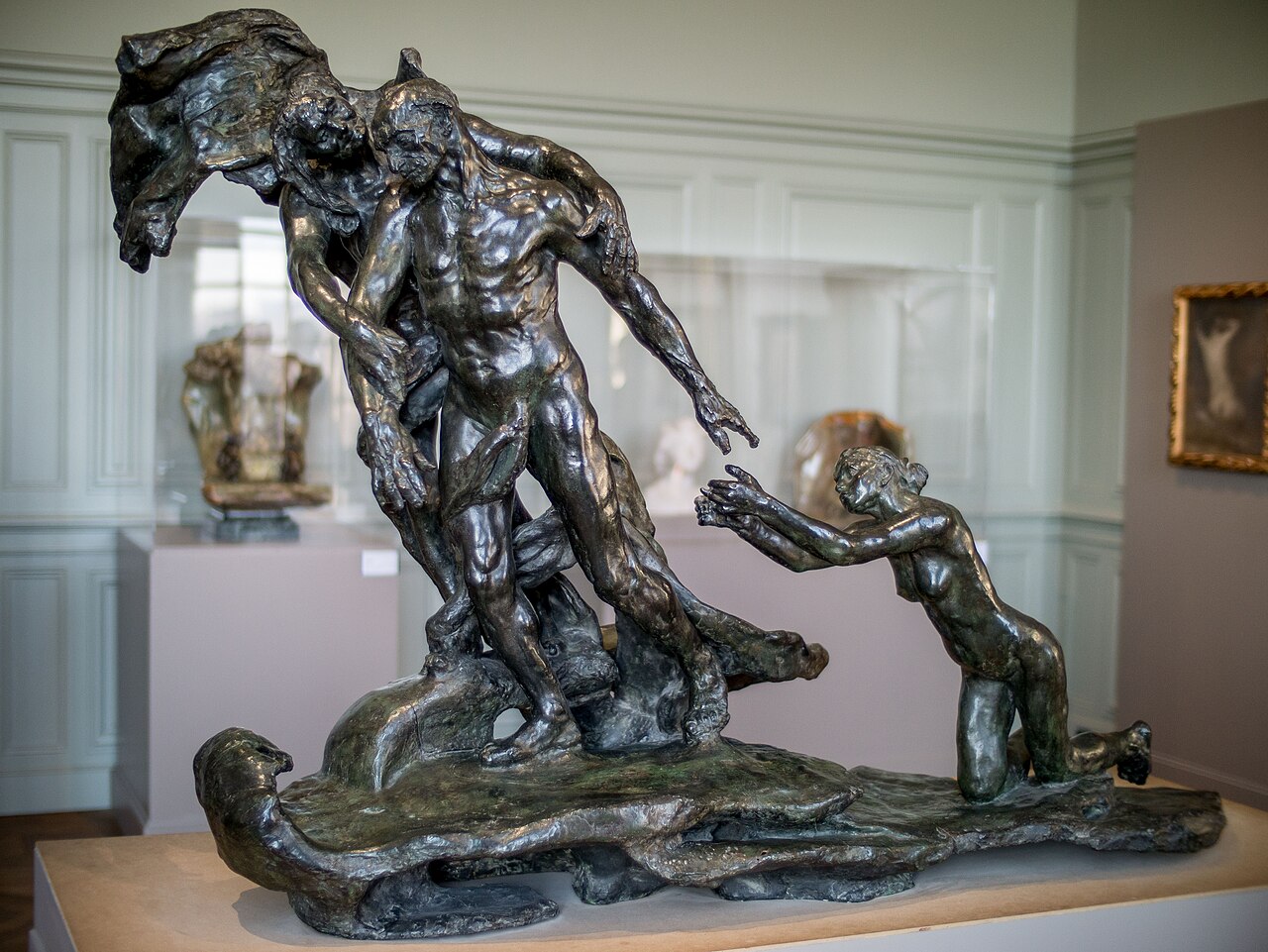
Camille Claudel's The Age of Maturity is often introduced as biography in bronze: Claudel, Auguste Rodin, Rose Beuret, abandonment, jealousy, rupture. That reading is not invented from nothing. The Musee Rodin notes the common autobiographical interpretation while also warning that the work is more than personal anecdote, and Khan Academy frames the title itself as an allegory of aging, passage, and death.[1][2] The sculpture lasts because it turns private pain into a structure that can be read without knowing the gossip first.
What Claudel makes visible is not merely a triangle of people. It is a force. An older woman draws a man away. He bends and moves with her, no longer fully resisting. Behind him, a younger kneeling woman reaches forward with empty hands. The narrative could have become melodrama. Instead it becomes a precise engineering of distance: the more the figures strain toward one another, the clearer it becomes that the center has already shifted beyond recovery.[1][2]
The Pull Is Stronger Than The Story
The first thing to notice is that the sculpture does not distribute its three figures evenly. Claudel weights the group toward departure. The standing woman and the man form a moving unit, angled forward as if the floor beneath them has begun to tilt. The kneeling figure is attached by desire but not by mass. Her arms extend, yet the physical center of the sculpture has already left her behind.
This is where the work becomes harsher than a simple scene of pleading. The man is not standing between two fixed choices like a figure in a moral diagram. In the second version described by the Musee Rodin, he is pulled from the young woman's reach by old age and death, and the earlier resistance has weakened.[1] That shift matters. Claudel does not freeze indecision. She sculpts the moment after decision has become momentum.
The title helps, but only if it is not made too tidy. The Age of Maturity can sound like an allegory of aging, with youth abandoned as life moves toward decline. The alternate titles - destiny, the path of life, fatality - widen that frame.[1] Yet the sculpture refuses calm allegorical balance. Maturity here is not wisdom seated in the middle. It is a body being carried into consequence.
The Kneeling Figure Is Not Weak
The young woman is easy to misread because she kneels. She can appear defeated, and Khan Academy's reading of the group treats the kneeling figure as the abandoned youthful presence from whom the man is moving away.[2] But her pose is not passive. She is the most emotionally exposed figure in the group and also the figure who makes the whole composition legible.
Her arms set the measure of loss. Without them, the departing pair would simply move forward. With them, the space behind the man becomes charged, almost audible. She does not hold him, yet her reach defines what has been severed. That is why the kneeling body is not a sentimental accessory. She is the point at which feeling becomes sculptural pressure.
The hands matter most. They do not clutch fabric. They do not successfully seize the man. They hover at the edge of contact. Claudel understands that the most painful distance is not vast distance but missed nearness. The figure is close enough for the viewer to imagine rescue and too late for rescue to happen.
Drapery Turns Emotion Into Weather
The bronze surface also does essential work. The Musee Rodin points to the tormented drapery and strong shadow as part of the second version's Art Nouveau force.[1] That drapery is not decorative turbulence around otherwise stable bodies. It is the sculpture's weather system.
Around the older woman and the man, cloth seems to accelerate movement. It wraps, sweeps, and darkens the forward pull, making the two figures feel less like individuals walking than like bodies caught in a current. Around the kneeling woman, the absence of that same forward envelope matters. She remains exposed, open, held down by the very clarity of her plea.
This is one reason the work feels modern. Claudel does not rely on facial expression alone. She lets bronze, void, shadow, limb, and fabric distribute emotion across the entire group. The sculpture is not asking the viewer to identify one symbolic code and stop there. It asks the eye to feel how form itself carries compulsion.
A Commission That Did Not Resolve
The work's history intensifies that reading without replacing it. The Musee Rodin records that the second version was commissioned by the French state in 1895, completed and paid for in 1898, but never delivered by Claudel; the first cast went instead to the private client Captain Tissier, and the plaster is thought to have been lost when a later bronze was cast in 1913.[1] Getty's exhibition overview adds the larger public story: the plaster model was a success when first exhibited in 1899, yet the state canceled the bronze order.[3]
Those facts do not turn the sculpture into a document about bureaucratic failure. They reveal how unstable its passage into public form was. Claudel had made one of her major works out of departure, and the work itself moved through delay, cancellation, private patronage, lost plaster, and later casts. The object we see now carries a history of interrupted arrival.
The Getty's exhibition overview gives the broader career frame. Claudel worked in and around Rodin's studio as assistant, collaborator, model, and lover, while also producing and exhibiting her own sculpture; her proximity to Rodin brought opportunity and also encouraged critics to diminish her independence.[3] The Age of Maturity is powerful partly because it breaks that frame from inside it. It uses a Rodin-adjacent life story, but it does not need Rodin's authorship to make the work matter. Claudel's form is the authority.
Why The Work Still Cuts
The strongest art-historical mistake would be to rescue Claudel from biography by pretending biography is irrelevant. The stronger move is to see how she outbuilt it. The Age of Maturity may begin in a recognizable wound, but its achievement lies in making that wound spatial, repeatable, and impersonal enough to exceed one life.
Anyone can understand the three positions before reading a wall label: the one who leaves, the one who leads, the one who reaches too late. But the longer one looks, the less the work behaves like a fixed lesson. Is the older woman cruelty, destiny, time, death, necessity, or simply the next claim on a human body? Is the man victim, coward, aging self, beloved, or passage itself? Is the kneeling woman abandoned youth, rejected lover, artist, soul, or consciousness watching the future depart? Claudel keeps all of these readings active because the sculpture is organized by relation rather than by one closed allegory.[1][2]
That is why the work remains so difficult to neutralize. It is not content to say that love ends or age comes. It shows the physical grammar of being pulled past the person one once faced. The central man is still near enough to be addressed, but already governed by another vector. The kneeling woman still has enough life to reach, but not enough leverage to alter the motion. The older woman is not triumphant in any simple sense; she is the inevitability that makes triumph irrelevant.
In The Age of Maturity, separation is not an event after which people can be arranged into memory. It is the active medium. Claudel makes bronze behave like a sentence whose subject is moving away while the object of desire remains behind, arms extended, unable to complete the grammar. The sculpture's cruelty is also its intelligence: the break is not only represented. It is built.[1][2][4]
Sources
- Musee Rodin, "The Age of Maturity or Destiny or The Path of Life or Fatality" - official object page with date, dimensions, material, second-version history, and interpretation of destiny, age, drapery, and shadow.
- Khan Academy, "Camille Claudel, The Age of Maturity" - art-history essay on the sculpture's allegory of aging, the departing man, and the young imploring figure.
- J. Paul Getty Museum, "Camille Claudel" - exhibition overview on Claudel's career, Rodin studio role, technical force, public reception, and the 1899 success of the lost plaster model.
- Wikimedia Commons, "File:Claudel-2014-05.jpg" - source page for the 2014 photograph of Camille Claudel's The Age of Maturity at the Musee Rodin used with this article.