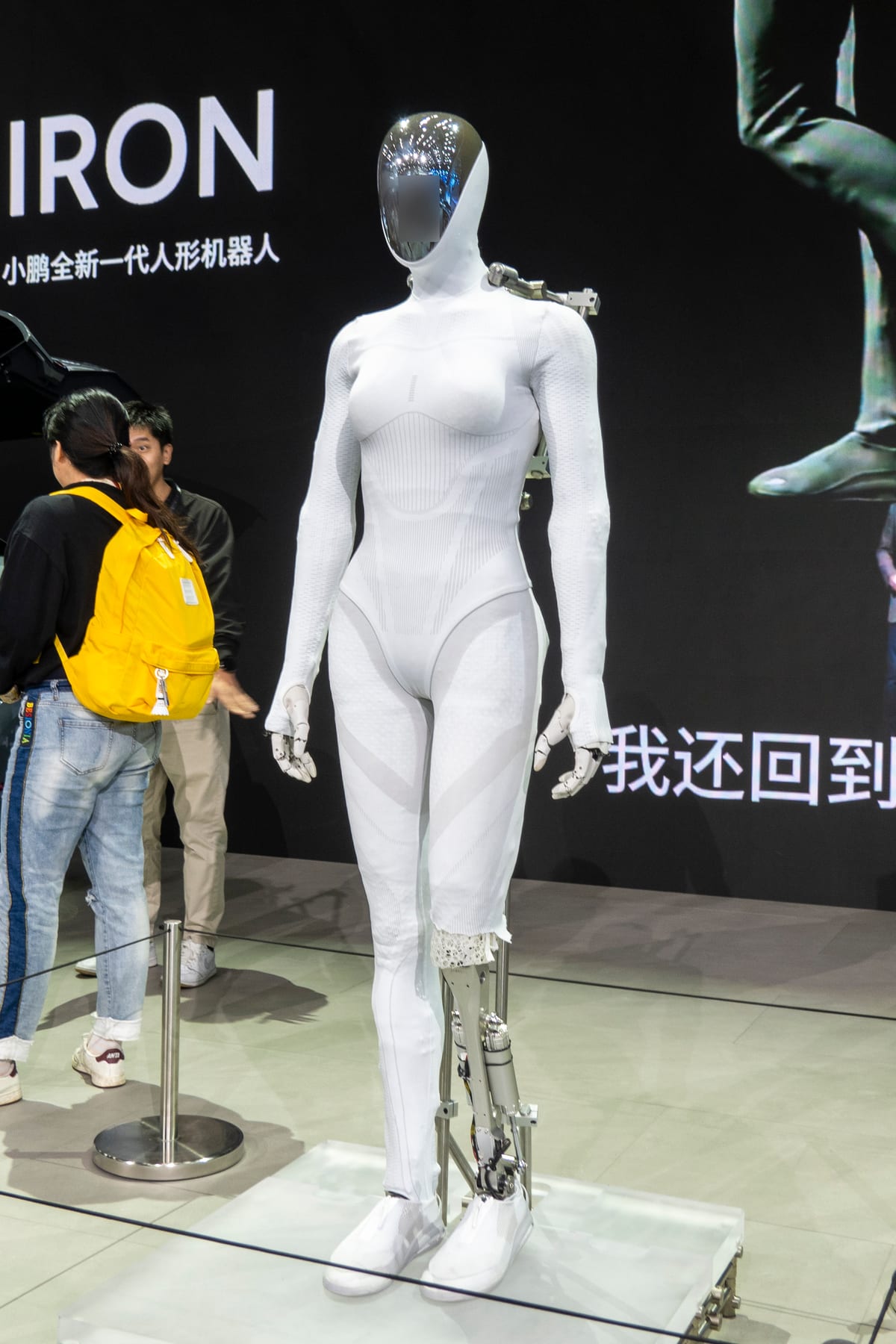

As of 2026-06-25 UTC, the useful way to watch XPENG's "Cutting Open IRON--The Truth Behind this Robot" is not as a strange internet spectacle.[1] The video is doing something more strategic than proving that one humanoid robot is not a person in a suit. It is trying to make physical AI feel inspectable. In a market crowded with beautiful robot clips, staged walks, and claims about future service work, XPENG is arguing that the body, model stack, battery, chips, and commercial use case should be read together.
The surrounding source trail makes that frame clear. XPENG's official AI Day release says the company unveiled VLA 2.0, robotaxi plans, Next-Gen IRON, and flying-car systems as four applications of "Physical AI," while also repositioning itself as a mobility explorer in the physical-AI world.[2] The IRON section describes a humanoid spine, bionic muscles, full flexible skin, 82 degrees of freedom, 22 degrees of freedom in the hand, all-solid-state battery use, three Turing AI chips, a physical-world large model, and a combined VLT + VLA + VLM intelligence stack for conversation, walking, and interaction.[2]
That is why the embedded video is worth annotating. A humanoid robot can go viral because it looks eerily smooth; a deployable robot has to survive a harder question: what is inside the smoothness? XPENG's stage answer is theatrical, but the theater has an engineering purpose. By opening the robot body, the company shifts attention from surface realism to mechanism, trust, and the uncomfortable reality that humanoids must be judged as machines in public spaces, not as magic stage characters.
The disassembly is a trust demo, not just a reveal
The clip's obvious hook is the moment XPENG opens IRON's body.[1] That gesture works because the robot had already been framed around "ultra-realistic anthropomorphism": a catwalk-like gait, human-shaped body language, flexible skin, and a design language that deliberately approaches the uncanny boundary.[2] If the body is too convincing, the audience stops asking whether the machine is useful and starts asking whether the machine is really a machine.
That sounds like a social-media problem, but for physical AI it is also a product problem. A delivery robot, factory arm, or autonomous vehicle can be trusted through visible limits: wheels, grippers, lanes, fences, warning lights, supervisors. A humanoid robot is harder because it borrows the human form. If it enters retail, reception, guided-tour, or industrial-inspection settings, people will judge it through human expectations: balance, intention, personal space, response timing, privacy, and failure behavior. The disassembly scene says: look behind the face and skin before you decide what kind of actor this is.[1][2]
XPENG's official release reinforces that reading by adding a privacy claim to the robot narrative. The company says IRON extends its safety framing with a fourth law: "Privacy data does not leave the robot."[2] Whether that line becomes a real operational control depends on implementation, auditing, and deployment discipline. But it belongs in the same trust performance as the cut-open body. XPENG is not only asking viewers to believe the robot is technically real. It is asking them to believe that the robot can eventually stand near people without becoming an ungoverned sensor platform.
The body is being sold as a data and generalization strategy
The most important claim in the official release is not cosmetic. XPENG says humanoid form helps with commercialization, generalization, and training-data acquisition.[2] That is a strong AI-China signal because it ties robot design to model strategy. The body is not only a shell for motors. It is an attempt to put an action model into environments built for people: counters, corridors, storefronts, reception areas, factories, and vehicles.
That is also where the video should be watched carefully. Smooth walking is impressive, but the deeper question is whether the body can collect, interpret, and act on the kind of messy physical data that makes commercial robots useful.[1][2] XPENG says it has built an embodied-intelligence data factory in Guangzhou, and it presents the lack of training data as one of the humanoid field's core challenges.[2] In other words, IRON's body is supposed to solve a data problem as much as a mobility problem.
There is a catch. Human-shaped movement can make a demo more legible, but it does not automatically make the robot economical. Electrek reported that XPENG had tried an earlier IRON version in manufacturing work, including screw-driving on an assembly line, and concluded the task was not efficient at scale because the robot did not perform as well as employees on a cost basis.[4] That sentence is a useful brake on the hype. The practical robot market is not won by looking human. It is won when the full loop of dexterity, uptime, repair cost, task fit, supervision, and safety beats the alternatives.
The model stack is the real "physical AI" pitch
XPENG's public framing tries to connect IRON to a larger model system rather than isolate it as a robot side project. The company describes VLA 2.0 as a physical-world large model that moves from vision signals to action commands and can be applied across AI cars, humanoid robots, and flying cars.[2] For vehicles, XPENG says VLA 2.0 is trained on nearly 100 million real-driving clips and is being rolled toward Ultra models; for robotaxis, it places VLA and VLM capabilities inside a broader autonomous-driving plan.[2]
IRON then becomes the most body-like endpoint in the same thesis. The robot is described as using VLT, VLA, and VLM capabilities for conversation, walking, and interaction, with the VLT model presented as a robot-specific engine for autonomous action.[2] CnEVPost and Electrek both summarized the robot as an attempt to combine physical dexterity with conversation and real-time interaction rather than as a walking shell alone.[3][4]
This matters because China's AI competition is increasingly moving beyond web chat. The durable question is how model capability leaves the browser and enters cars, factories, shops, logistics, and service counters. XPENG's edge is that it already builds embodied products with safety cases, supply chains, sensor stacks, and physical operations. The weakness is the same: every embodied product makes AI claims accountable to hardware, maintenance, and public failure.
Commercial humility is the strongest part of the story
The official release says XPENG aims for large-scale mass production of high-level humanoid robots by the end of 2026, and it says IRON will first prioritize commercial-service scenarios such as guided tours, shopping guidance, and traffic diversion.[2] CnEVPost also reports that XPENG plans to release IRON's SDK to collaborate with developers.[3] That pairing is important: initial roles are relatively bounded, while the SDK language suggests XPENG knows it needs a wider application ecosystem.
Electrek's reporting adds a sharper boundary: XPENG appears more conservative than companies promising broad consumer humanoids, with near-term use focused on its own commercial operations, such as guides, reception, and sales-like roles.[4] That conservatism makes the AI Day video more credible, not less. A robot that can walk across a stage is not yet a household worker. A robot that can greet visitors, guide traffic, answer questions, and survive repeated deployments in controlled commercial sites is a more plausible bridge.
That is the right standard for the video. The cut-open moment proves only that IRON is physically constructed as a robot.[1] The higher proof would be boring: public documentation of service uptime, task success rates, remote-assist frequency, privacy logs, SDK constraints, battery endurance, repair cycles, and what happens when the robot loses balance, misunderstands speech, or encounters a crowd. XPENG has shown a machine body. The next test is whether it can show a dependable operating envelope.
What the video tells us to watch next
The clip belongs in the AI-China file because it compresses a larger strategic pivot into one memorable scene.[1] XPENG is not presenting IRON as an isolated robotics demo. It is using the robot to make a physical-AI argument: the same company wants models, chips, vehicles, robotaxis, humanoids, flying systems, and developer ecosystems to share a technical origin.[2]
The strongest future signal will not be another more human-looking walk. It will be whether XPENG can turn inspectability into evidence. Can developers actually build useful behaviors through the SDK? Can commercial sites run IRON without treating every shift as a supervised demonstration? Can privacy stay local in a way outsiders can verify? Can the VLA/VLM/VLT stack generalize across cars and robots without becoming a vague brand umbrella?[2][3][4]
For now, the disciplined conclusion is this: XPENG's video is most valuable when watched as a trust performance. The company cuts open the robot because physical AI cannot live on smooth motion alone. It has to show its body, expose its assumptions, and prove that the impressive stage surface can become a governed machine in the world.
Sources
- XPENG, "Cutting Open IRON--The Truth Behind this Robot," official YouTube video.
- XPENG, "XPENG Shares Achievements in Physical AI Emergence: Unveils XPENG VLA 2.0, Robotaxi, Next-Gen IRON, and Flying Car" (November 5, 2025; official AI Day release covering VLA 2.0, physical-AI positioning, IRON hardware, model stack, commercialization, SDK, and mass-production claims).
- Phate Zhang, CnEVPost, "Xpeng unveils next-gen Iron humanoid robot at 2025 AI Day" (November 5, 2025; independent event report on IRON's gait, hand degrees of freedom, chips, all-solid-state battery, commercial-service targets, and SDK plans).
- Fred Lambert, Electrek, "Xpeng AI Day: new AI model powering robots, robotaxis, and flying cars" (November 5, 2025; reporting on XPENG's physical-AI frame, IRON's role, near-term commercial caution, and manufacturing-task limitations).
- Wikimedia Commons, "File:XPeng Iron at Auto Guangzhou 2025 20251123.jpg" by Tim Wu (real photograph of XPENG IRON displayed at Auto Guangzhou 2025; source page for the article image).