As of 2026-06-25T09:31:56Z UTC, the useful AI-China signal in KTransformers is not that it makes one more local-chat demo possible. The sharper signal is that it reframes China's largest open and semi-open Mixture-of-Experts models as a memory-placement problem. If a model has hundreds of billions of total parameters but only a small active path per token, then the supply-chain question becomes concrete: which parts deserve scarce GPU VRAM, which parts can sit in CPU DRAM, and which runtime can keep the handoff fast enough to feel usable?[1][3]
That matters because China's model race has moved toward huge sparse models. DeepSeek, Kimi, GLM, Qwen, Hunyuan, MiniMax, and related families increasingly compete not only on benchmark tables, but on whether builders can actually run, inspect, fine-tune, or serve them in constrained environments. A model card can say "open." A local operator still has to pay the hardware bill. KTransformers' stack says the expensive part is not only the model. It is the routing layer between CPU memory, GPU memory, expert activation, serving framework, and workload shape.[1][2]
The KTransformers repository describes the project as a CPU-GPU heterogeneous framework for efficient inference and fine-tuning, with current user-facing paths for Inference and SFT from the kt-kernel tree.[1] Its maintainer list ties the project to MADSys Lab at Tsinghua University, Approaching.AI, and community contributors, which makes it more than a generic local-LLM utility in this feed's taxonomy. It is a Chinese systems project sitting at the point where model ambition meets hardware locality.[1]
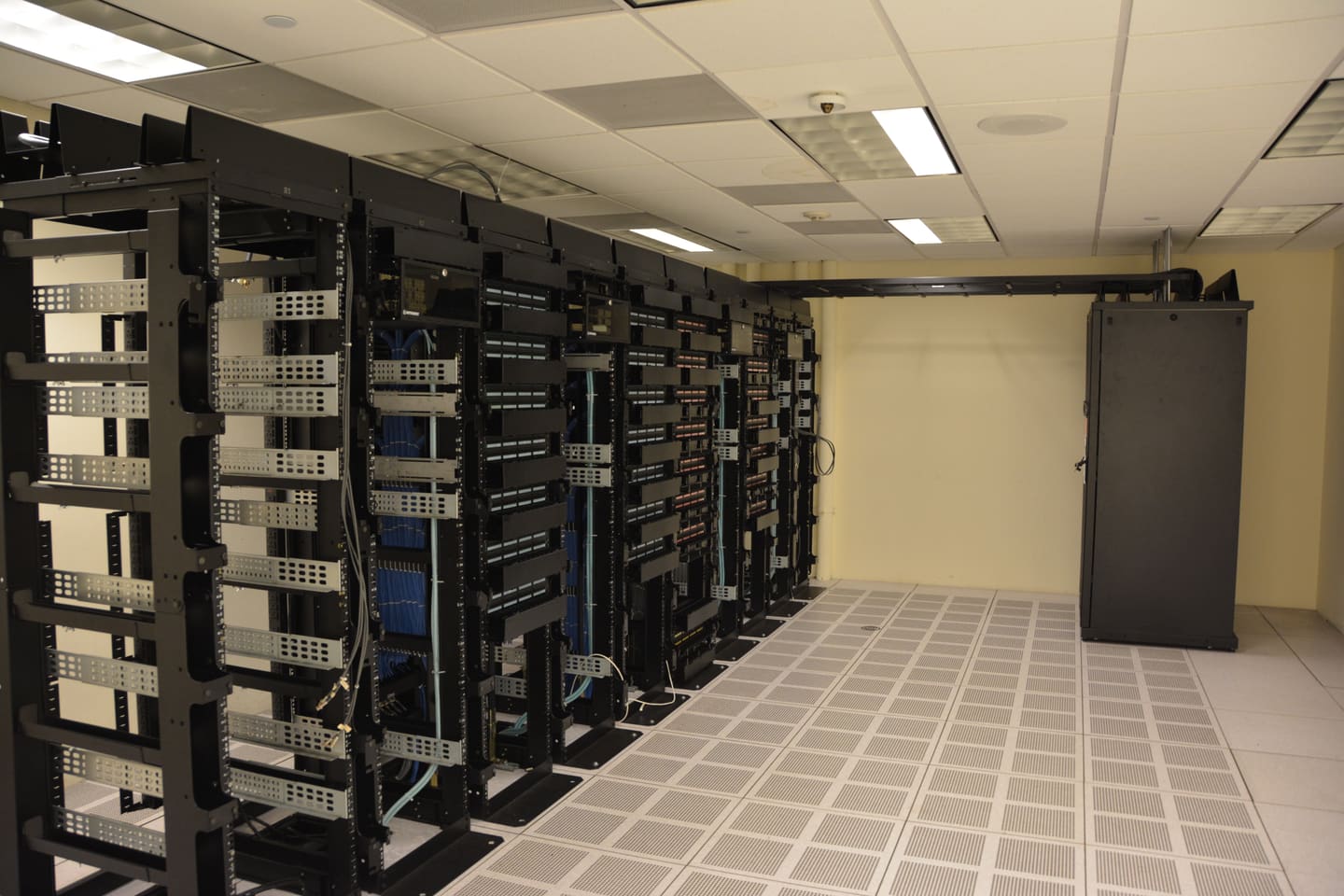
Image context: the cover is a real Wikimedia Commons photograph of server racks, not a generated illustration or diagram. It is used because KTransformers' core claim lives in physical infrastructure: DRAM capacity, VRAM scarcity, CPU vector instructions, GPUs, NUMA placement, storage, and networked serving paths all decide whether a giant MoE release is runnable outside a large cluster.[7]
The stack begins with heterogeneity
KTransformers' own product page is unusually blunt about the intended user. It says the framework uses CPU/GPU heterogeneous computing to deploy 100B+ parameter models locally with a single RTX 5090 with 32GB VRAM, and frames the project around low-VRAM full-precision inference plus full-parameter fine-tuning on consumer GPUs.[2] Treat those as first-party positioning claims, not independent guarantees. Still, the direction is important: the framework is trying to move large-model access from "rent a serious cluster" toward "compose CPU memory and GPU compute carefully."
The research paper behind the project explains why MoE models make this plausible. In sparse MoE inference, not every expert is active for every token. KTransformers exploits that asymmetry by keeping dense/shared work and hot paths close to the GPU while moving colder or bulkier expert work into CPU-side memory and optimized CPU kernels.[3] The paper reports a 1.66x to 4.90x decoding speedup and says the system can serve trillion-parameter-scale MoE models on a single server with one consumer-grade GPU.[3] The exact numbers depend on model, quantization, CPU, GPU, batch shape, and benchmark setup. The larger point is architectural: MoE sparsity gives local deployment something to schedule.
That is why the project belongs in an AI-China supply-chain update. The bottleneck is no longer a simple binary of "has GPU" or "does not have GPU." It is the placement policy. CPU DRAM is abundant but slower. GPU VRAM is fast but scarce. CPU vector instructions such as AVX512, AVX2, and Intel AMX change the economics of offloaded experts. NUMA behavior matters on dual-socket systems. The runtime has to make those decisions without turning every new model into a bespoke engineering project.[1][3][4]
Expert scheduling is the control surface
The CPU-GPU expert scheduling tutorial shows the practical shape of that control surface. It describes a KTransformers feature for SGLang that uses a GPU expert mask to place MoE experts across CPU and GPU according to workload patterns.[4] The documented minimum configuration is not casual: an RTX 4090-class GPU with at least 24GB available VRAM, an x86 CPU with AVX512 support, at least 256GB of system memory, and enough storage for weights.[4] That is still serious hardware. But it is a different budget class from fully resident multi-GPU serving.
The placement strategies are the revealing part. The tutorial lists uniform, frequency, front-loading, and random expert-placement strategies.[4] In other words, KTransformers is not pretending that one automatic offload recipe erases the MoE problem. It is exposing a knob that lets operators decide whether they want no-statistics distribution, hot-expert placement, a test-oriented front-loaded layout, or a baseline. That turns local inference into an operations problem: observe activation, place experts, measure latency, then revise the placement.
For China AI builders, this is strategically useful because the model-release tempo is fast. A team testing Kimi one week, GLM the next, and Qwen after that does not want to learn a different local-serving stack for each family. KTransformers' update log points in that direction: 2026 entries include support notes for MiniMax-M3, GLM-5.2, DeepSeek-V4-Flash, MiniMax-M2.5, GLM-5, Kimi-K2.5, CPU-GPU expert scheduling, native precision work, and Ascend NPU support in late 2025.[1] Those entries do not prove production maturity by themselves. They show the project is trying to follow Chinese model releases at the runtime layer.
Kimi and Qwen show why "open" needs hardware grammar
The Kimi-K2 tutorial makes the constraint easy to see. It says KTransformers supports Kimi-K2 and Kimi-K2-0905, and that a Q4KM run on a single-socket CPU with one consumer-grade GPU yields roughly 10 tokens per second while requiring about 600GB of DRAM. With dual-socket CPU hardware and NUMA optimization, the doc reports roughly 14 tokens per second.[5] This is not "runs on a laptop." It is "runs if you can provide a memory-rich server and accept the throughput envelope."
That distinction is healthy. Too much local-AI rhetoric collapses into fantasy hardware claims. KTransformers' docs are more useful because they expose the cost. A giant MoE can become locally runnable, but only after the operator supplies system memory, uses quantized or supported formats where needed, installs the right runtime, and accepts that throughput is bounded by placement and memory movement.[5] The supply-chain gain is not free compute. It is optionality.
The Qwen3.5 tutorial points to the same pattern through a different model family. It documents Qwen3.5, framed there as an MoE-400B inference path, running through SGLang integrated with KT-Kernel so large MoE models can offload experts to CPU.[6] That matters because Qwen is one of the dominant Chinese open-model ecosystems. A working offload path for a Qwen MoE model is not just a hobbyist trick. It is a sign that China's model layer is pressuring the serving layer to become more heterogeneous, more memory-aware, and more interchangeable.
SGLang integration moves it beyond a standalone runner
KTransformers would be less interesting if it were only a parallel local runner. The stronger signal is integration. Its README describes clean Python API integration with SGLang and other frameworks, and the CPU-GPU expert tutorial uses SGLang launch commands for serving.[1][4] The official site also says GPU inference is powered by SGLang.[2] That matters because SGLang is already part of the broader LLM serving vocabulary. Attaching KTransformers to it makes hybrid expert placement easier to route into existing serving habits.
This is the infrastructure lesson: a runtime wins influence when it becomes a backend, not only an app. If KTransformers can supply CPU-side kernels, expert placement, and low-VRAM paths while SGLang owns a familiar serving layer, then developers can think in terms of model support and deployment posture rather than rewriting the entire inference stack. That is how local MoE work becomes a supply-chain component.
The caveat is important. KTransformers is not a magic substitute for large GPU clusters. Its own examples still require hundreds of gigabytes of DRAM for the largest models, recent CPUs for the best kernel paths, careful installation, model-specific tutorials, and performance measurement under real prompts.[4][5][6] It also does not solve governance questions around model license, data privacy, tool access, or production reliability. It solves a narrower but valuable problem: making the physical placement of giant sparse models tractable enough for more teams to test.
What to watch next
Three watch items decide whether KTransformers becomes a durable AI-China infrastructure layer rather than an impressive systems demo. First, support cadence: the project needs to keep following new DeepSeek, Kimi, GLM, Qwen, MiniMax, and related MoE releases without turning each one into a fragile branch.[1] Second, serving convergence: SGLang integration needs to feel like a normal backend path, not a special-case experiment.[1][2][4] Third, hardware breadth: AVX512, AVX2, AMX, NVIDIA GPUs, AMD paths, Ascend support, and NUMA-aware server layouts need clear limits so operators can predict whether their box is suitable.[1][4]
The falsifier is straightforward. If the largest examples remain dependent on unusually specific machines, opaque tuning, or repo-local forks that do not survive model updates, KTransformers will stay a specialist tool. If the expert-placement and SGLang backend paths become routine, then its importance grows. It would give China's giant sparse-model ecosystem a practical middle lane between hosted APIs and full GPU residency.
That middle lane is the real story. KTransformers does not make giant Chinese MoEs small. It makes their size negotiable. By turning VRAM, DRAM, expert activation, CPU kernels, and serving integration into explicit knobs, it lets more teams ask a better question: not "can we afford the full cluster?" but "which parts of this model need to live where for our workload to be worth running?"[1][3][4]
Sources
- KVCache.AI,
kvcache-ai/ktransformersGitHub repository (project overview, 2026 update log, inference and SFT capabilities, kt-kernel framing, SGLang integration, maintainer/team note, and Apache-2.0 license). - KTransformers official site, "Low-VRAM, Full-Precision Inference" (CPU/GPU heterogeneous positioning, 100B+ local deployment claim, model-family support, SGLang note, and benchmark framing).
- Hongtao Chen et al., "KTransformers: Unleashing the Full Potential of CPU/GPU Hybrid Inference for MoE Models," SOSP 2025 paper PDF hosted by MADSys Lab, Tsinghua University (CPU/GPU hybrid MoE inference design, speedup claims, and single-server framing).
- KVCache.AI, "CPU-GPU Expert Scheduling Tutorial" in the KTransformers documentation (GPU expert mask, SGLang launch path, hardware requirements, and placement strategies).
- KVCache.AI, "Kimi-K2" KTransformers tutorial (Kimi-K2 and Kimi-K2-0905 support, rough tokens-per-second claims, DRAM and GPU memory requirements, and NUMA note).
- KVCache.AI, "Running Qwen3.5 with SGLang and KT-Kernel" tutorial (Qwen3.5 MoE-400B serving path, SGLang integration, and CPU expert offload framing).
- Carl Lender, "Datacenter Server Racks (22370909788).jpg," Wikimedia Commons, photographed November 4, 2015 (article image source; real server-rack photograph).