As of 2026-05-28 UTC, the useful way to read xLLM is not as one more inference framework trying to imitate vLLM with a local logo. The sharper AI-China signal is that JD has put a production-shaped runtime into the open at exactly the layer where China's model race meets its hardware constraint. xLLM's own README describes it as an efficient LLM inference framework optimized for Chinese AI accelerators, with a service-engine decoupled architecture, dynamic PD disaggregation, hybrid multimodal and high-availability mechanisms, graph fusion, speculative inference, dynamic load balancing, and global KV cache management.[1]
That wording matters because the accelerator question is often framed too simply: does China have enough chips, and how do they compare with NVIDIA? For builders, the next question is more concrete. Can a serious model workload run across domestic hardware with predictable latency, usable memory behavior, model compatibility, and production failure handling? xLLM is a signal that the answer will depend as much on serving software as on silicon supply.[1][2]
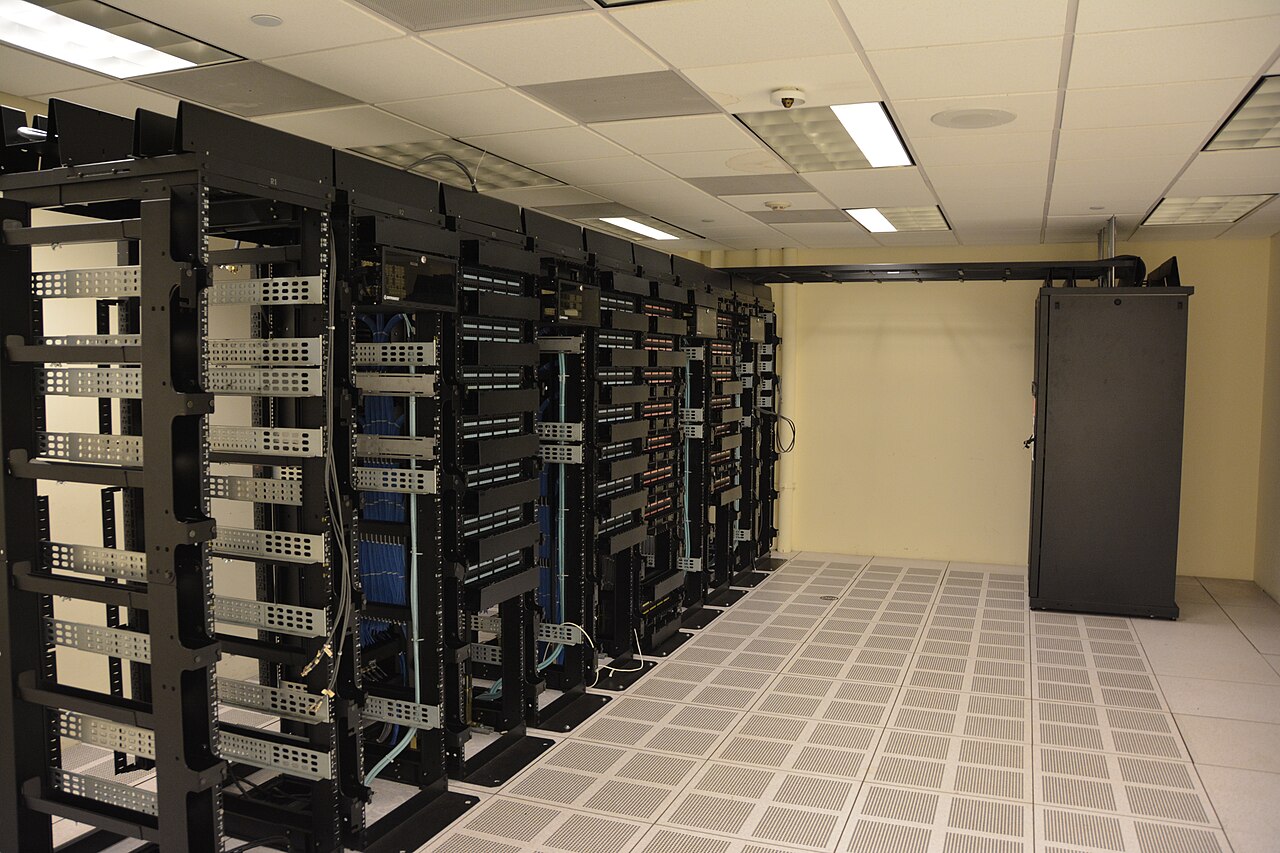
Image context: the cover uses a real Wikimedia Commons photograph of data center server racks, not a generated illustration or diagram. The article is about the machine-room layer of AI deployment: request scheduling, accelerator adaptation, memory movement, and service reliability.[6]
The runtime is where chip policy becomes engineering
xLLM's public materials keep pointing below the model card. The project says it supports deployment of mainstream large models such as DeepSeek and Qwen on Chinese AI accelerators, and says it has already been deployed in JD.com's real retail businesses including intelligent customer service, risk control, supply-chain optimization, and ad recommendation.[1] Those are first-party claims, so they should be treated as product evidence rather than neutral adoption proof. Still, they define the intended operating environment clearly: not research demos, but dense enterprise traffic.
The important design choice is the separation between service and engine. At the service layer, xLLM emphasizes elastic scheduling for online and offline requests, dynamic prefill/decode disaggregation, and high-availability machinery. At the engine layer, it names multi-stream parallel computing, graph fusion optimization, speculative inference, load balancing, and global KV cache management.[1][2] That split is the whole story. A domestic accelerator stack has to solve both the outside shape of traffic and the inside shape of execution. If either side is brittle, the model headline will not survive contact with production.
This is also why xLLM is more interesting as a field signal than as a benchmark object. A benchmark can say one model served one prompt set at one speed. A runtime has to answer uglier questions: what happens when context lengths vary, when MoE experts are unbalanced, when prefill and decode have different bottlenecks, when VLM requests mix image work with text generation, when KV cache has to move between nodes, and when one service has to carry both real-time and batch demand.[1][2][4]
The hardware table is the message
The supported-models page makes the domestic-hardware strategy explicit. xLLM lists support across NPU, MLU, and ILU lanes, with model coverage that includes DeepSeek-V3/R1/V3.1, DeepSeek-V3.2, Qwen2/2.5/QwQ, Qwen3, Qwen3 MoE, Kimi-k2, Llama2/3, GLM4.5, GLM4.6, GLM-4.7, and GLM-5 in different hardware combinations.[3] For vision-language models, it lists MiniCPM-V, MiMo-VL, Qwen2.5-VL, Qwen3-VL, Qwen3-VL-MoE, GLM-4.6V, and VLM-R1 with the same hardware-column logic.[3]
The point is not that every model runs everywhere. The point is that the compatibility matrix itself has become a strategic artifact. If a Chinese enterprise is trying to reduce dependence on one hardware supplier, the deployment question becomes a routing problem across accelerator families. Some workloads may land on Ascend-class NPUs, some on MLU devices, some on ILU devices, and some still on CUDA. A runtime that exposes this as a model-hardware support table is doing more than listing features. It is turning portability into an operating plan.[3]
The v0.9.0 release notes reinforce that reading. The release added model support for GLM-5, GLM4.7-Flash, Qwen3-next, OneRec, Qwen3.5 and Qwen3.5-MoE on NPU; LongCat image models on CUDA; DeepSeek-V3.2 and GLM-5 variants on MLU; and Qwen3 models on ILU. It also lists features such as CANN 8.5 and PyTorch 2.7.1 adaptation, graph mode for VLM LLM components on NPU, context parallelism for NPU DeepSeek-V3.2 and GLM-5, scalable multi-model serving, remote-to-local KV cache transfer, Anthropic Messages API support, and unified request statistics logging.[4]
That release shape tells us where the work is. The hard part is not only "support Qwen" or "support DeepSeek." It is the moving matrix of model families, accelerator backends, graph modes, quantization behavior, cache policy, APIs, and service accounting that decides whether a deployment can be operated for months instead of demoed for minutes.[4]
xLLM is joining a broader Ascend-serving layer, not replacing it
xLLM should not be read in isolation. The vLLM-Ascend project exists as a dedicated vLLM plugin for Ascend NPUs, and its repository frames itself around adapting the vLLM serving stack to Ascend hardware.[5] That context is important because it shows the category forming: China's inference stack is no longer only model weights plus vendor SDKs. It is becoming a layer of open runtimes, plugins, cache managers, graph executors, model adapters, and deployment images that translate model demand into accelerator work.[1][4][5]
xLLM's differentiating signal is that it is explicitly company-shaped and workload-shaped. JD is not presenting the project only as a community runtime. The README ties it to retail scenarios, recommendation, risk control, customer service, and supply-chain work.[1] That vertical pressure matters. A retailer's serving stack does not only need chat completions. It needs throughput under peaks, mixed online/offline lanes, recommendation paths, failure containment, and observability that can be explained to platform teams.
The risk is just as clear. Public support matrices and release notes are not proof of broad third-party production adoption. They tell us what the project is trying to make possible. The clean falsifier would be if xLLM remains mostly an internal JD deployment artifact with limited outside operator traction, slow model adaptation, or hardware-specific paths that fragment faster than the framework can unify them.
For now, the field signal is strong enough to name. xLLM shows that AI-China's infrastructure race is moving into the runtime boundary. The next durable advantage will not come only from publishing a strong model or acquiring a scarce accelerator. It will come from making many models run across many domestic devices with sane scheduling, cache behavior, graph execution, API compatibility, and service reliability.[1][3][4][5]
Sources
- JD Open Source,
jd-opensource/xllmGitHub repository README (project overview, service-engine decoupled architecture, domestic accelerator positioning, JD deployment claims, hardware table, and core feature list). - Liu et al., "xLLM Technical Report," arXiv:2510.14686 (technical report linked by the official xLLM repository, covering design blueprints and implementation details).
- xLLM documentation, "Model Support List" (LLM, VLM, rerank, DiT, and recommendation model support across NPU, MLU, and ILU hardware lanes).
- JD Open Source, xLLM release
v0.9.0(2026-04-14; model-support additions, CANN/PyTorch adaptation, graph mode, context parallelism, KV cache transfer, API support, and runtime fixes). - vLLM Project,
vllm-ascendGitHub repository (Ascend NPU serving plugin context for the broader Chinese accelerator inference ecosystem). - Wikimedia Commons, "File:Datacenter Server Racks (22370909788).jpg" by Robert from Scotts Valley, California (source page for the real server-rack photograph used as the article image).