Before teaching a robot to swim, Dixia Fan helped teach a water tank to choose its next experiment. At MIT, a carriage towed submerged objects through water, measured their behavior, and let a learning algorithm decide which conditions to investigate next. By December 2019, MIT reported roughly 100,000 experiments during the facility's first year.[1]
Fan established his Fluid Intelligence and Informatics Laboratory at Westlake University in 2022.[2] Its research offers a distinctive view of China's embodied-AI work: intelligence develops through the equipment that produces experience, as well as through the model that learns from it. The swimming robot and its school belong in the same story.
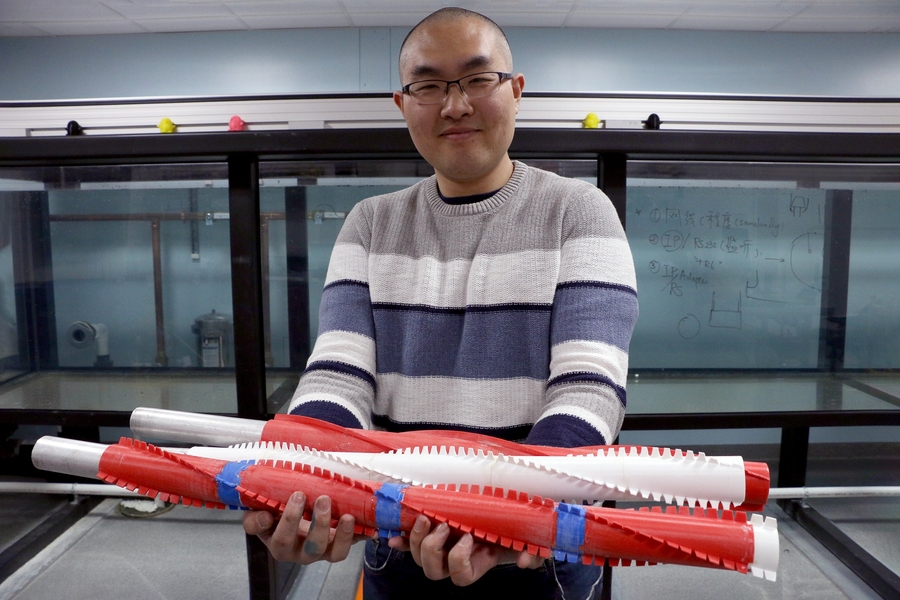
A tank that spends experiments carefully
The early problem was how flowing water makes structures vibrate. That matters for equipment such as the long risers connecting offshore wells to platforms. Testing every combination of relevant conditions quickly becomes impractical: MIT illustrated the difficulty with eight adjustable parameters and ten settings each, producing 100 million combinations.[1]
In a later account for MathWorks, Fan explained how the tank used Gaussian process regression to estimate outcomes and uncertainty between measured points. The system could then direct a new experiment toward a poorly understood region. Researchers still chose the parameters and their useful ranges, and established how much measurement variation the apparatus produced.[3]
That last responsibility is easy to overlook. A sensor reading carries both information about the water and imperfections in the measurement. Fan stopped collecting data once total uncertainty fell below a threshold tied to measured variability. The software therefore needed an experimentalist who understood the machine.[3]
The lesson for a laboratory is practical: collecting more observations and choosing better observations are different achievements. Automation supplies repetition; a well-designed learning process decides where repetition is worth the time.
Giving the swimmer room to improvise
A 2024 Physics of Fluids paper by Xinyu Cui, Boai Sun and collaborators, including Fan, moved the learning problem into propulsion. Their fish consisted of three linked sections in a two-dimensional computational flow, at Reynolds number 6,000. These were simulation experiments, subsequently deposited on arXiv in June 2025.[4]
Instead of only adjusting the amplitude or timing of a predetermined swimming pattern, the controller could choose movements step by step. It received body-motion information and pressure readings around the simulated fish. A transformer processed recent observations, giving the controller a history rather than an isolated instant.[4]
The freedom needed preparation. The researchers first trained the policy to imitate existing periodic motions, then improved it through reinforcement learning. Their comparisons found that starting without this preparation delayed the emergence of forward propulsion. The experiment made an appealing engineering point: familiar swimming motions can give exploration a useful beginning without prescribing its final form.[4]
A marine laboratory's broader ambitions
At an Ocean University of China lecture on May 16, 2025, Fan placed reinforcement learning within a larger program of underwater engineering. The host's Chinese-language report describes four ambitions: stability in turbulent water, accurate movement along complex trajectories, quiet operation, and maneuverability. It also records discussion of the Xigu submersibles and their sea trials.[2]
Those ambitions make the laboratory's identity clearer. A vehicle may need to move efficiently, hold position, approach something delicately, and tolerate changing conditions. Each requirement asks a different question of its controller. A good propulsion experiment can advance that program while leaving navigation, power and the rest of the vehicle to other work.
The lecture is evidence of the team's agenda, rather than a standardized performance test. It helps explain why the research crosses mechanics, sensing and learning: an underwater machine has to make all three cooperate.
Bringing the lesson into real water
The September 13, 2026 REEF preprint describes a physical learning system coauthored by Fan. Its SHOAL apparatus runs eight experimental channels in water. V-STAR organizes learning into imitation, offline improvement using collected experience, and adaptation with live feedback.[5]
On a flapper with three controlled motions, the authors report a maximum cycle-averaged thrust coefficient of 10.42, against 4.94 for their strongest parameterized baseline. That comparison used a specified apparatus and a baseline searching a nine-parameter family of sinusoidal motions. It measures the tested force-producing strategies, not an across-the-board doubling of robot capability.[5]
The transfer experiments also deserve a close reading. Policies were applied without retraining to moving platforms, but the quadrupedal robots traveled along guide rails; the fin module used air bearings in a circulating channel. These are controlled demonstrations, reported in a preprint, rather than unrestricted ocean swimming.[5]
My reading of this trajectory is that the laboratory's lasting contribution may be its way of organizing experience. The next convincing step would show what remains useful when more constraints are removed: how much relearning a different body needs, and how reliably it handles unfamiliar currents. A swimming lesson becomes valuable when the swimmer can leave the school.
Sources
- MIT Sea Grant, “Intelligent Towing Tank propels human-robot-computer research” (December 9, 2019) — experimental origins, parameter count and Lily Keyes's photograph.
- Ocean University of China, College of Engineering, report on Dixia Fan's underwater-robotics lecture (Chinese original; May 26, 2025, reporting the May 16 event) — laboratory founding and research agenda.
- MathWorks, “When a Robot Designs Its Own Experiments” (accessed November 6, 2026) — first-hand interview about experiment selection, measurement uncertainty and human setup.
- Xinyu Cui, Boai Sun and colleagues, “Enhancing Efficiency and Propulsion in Bio-mimetic Robotic Fish through End-to-End Deep Reinforcement Learning,” Physics of Fluids 36, 031910 (2024); author manuscript deposited June 5, 2025 — simulation setup and training comparisons.
- Fei Han and colleagues, “Embracing Flow Unsteadiness: A High-Throughput Learning Platform Enables Vortex-Exploiting Bioinspired Propulsion” (September 13, 2026 preprint), Sections 2–3 — apparatus, learning stages, force comparison and constrained transfer tests.