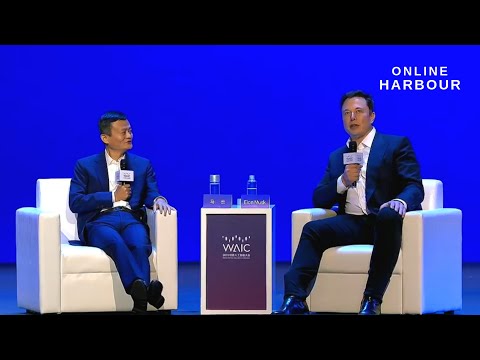
As of 2026-06-07 UTC, the 2019 World Artificial Intelligence Conference dialogue between Jack Ma and Elon Musk is worth replaying for a reason that has little to do with either speaker's later celebrity arc.[1] The clip is a compact record of two instincts that still run through AI-China coverage. One instinct treats artificial intelligence as an industrial and social deployment problem: use it, regulate it, route it into education and services, and assume that practical adaptation will matter more than speculative doom. The other treats AI as an intelligence discontinuity: once machines outrun human cognition, all deployment talk becomes secondary to control, safety, and civilizational risk.
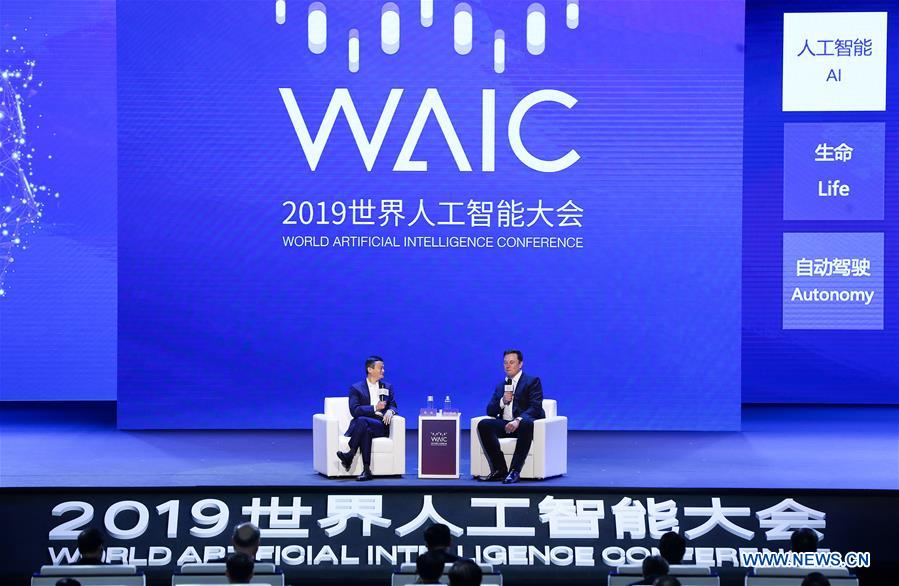
The setting matters. WAIC 2019 opened in Shanghai on August 29, 2019, under the theme "Intelligent Connectivity, Infinite Possibilities," with government officials, scientists, entrepreneurs, and investors gathered around a mix of frontier research, autonomous driving, AI chips, 5G, robotics, and industrial applications.[2] China Daily's Pudong account said the exhibition covered 15,000 square meters and drew about 400 companies, while Xinhua framed the Ma-Musk dialogue as the opening ceremony's headline exchange.[2][3] This was not a neutral podcast room. It was a state-backed technology showcase asking global viewers to read China as a serious AI venue.
That context makes the video more useful than a transcript of disagreements. Ma's side of the exchange keeps pulling AI back toward jobs, education, service work, and human adaptation.[3][4] Musk keeps pulling the frame toward superhuman capability and the danger of underestimating machine intelligence.[4] Put the clip beside China's June 2019 AI governance principles, which emphasized harmony, fairness, inclusion, privacy, safety, shared responsibility, openness, and agile governance, and the debate becomes a public rehearsal of a wider tension: China wanted to sound globally responsible while also presenting AI as a development engine.[5]
Image context: the article uses a real Xinhua/China Daily event photograph from the opening ceremony, not a generated stage mockup. That matters here because the post is about a specific institutional moment: WAIC turning AI optimism, governance language, and international tech rivalry into a visible conference scene.[2]
Around the opening, the stage does policy work before either speaker does
The first thing to notice is not a line of argument. It is the room. WAIC gives the conversation the trappings of an international summit rather than a company demo.[1][2] That framing is important because in 2019 China was already trying to hold two messages together. The 2017 New Generation Artificial Intelligence Development Plan had made AI a national development priority through 2030, while the 2019 governance principles tried to show that rapid deployment could be paired with ethical language and multilateral responsibility.[5][6]
So when Ma and Musk sit down, they are not merely offering personal philosophies. They become proxies for two public AI grammars. Ma speaks from the position of the platform entrepreneur whose confidence rests on application, market scale, and social adjustment. Musk speaks from the position of the frontier-risk founder who believes the main error is underestimating how far machine intelligence could exceed human intelligence.[4] The useful reading is not that one side "wins." It is that the Shanghai stage needs both voices: optimism to justify deployment, caution to make the forum sound globally serious.
Around the labor discussion, Ma turns disruption into a service-economy story
One of Ma's strongest recurring moves is to convert AI anxiety into a story about human work changing shape. Xinhua's write-up highlighted his claim that smarter machines could give people more time to enjoy life, with future work centered on making people happier and helping them experience being human.[3] TechNode noted the same labor theme, including Ma's optimistic contrast between industrial-era education and the kind of human-centered work he believed AI would leave behind.[4]
This is where the video captures a durable AI-China instinct. Deployment optimism often depends on treating labor disruption as a transition problem rather than a legitimacy problem. If AI is understood mainly as a way to move people out of unwanted, repetitive, or physically demanding work, then policy and business can talk about reskilling, services, education, elder care, and productivity without pausing the industrial push.[3][4] That does not settle whether the optimism is justified. It shows why the optimism is politically and commercially useful.
The tension is that Ma's argument works best when the affected work is abstract. Once the discussion gets closer to concrete workers, wages, platform incentives, and local government targets, "more time to enjoy being human" becomes a promise that needs institutions behind it. The 2019 governance principles help explain the gap: they name harmony, inclusion, shared responsibility, and agile governance, but principles alone do not decide who absorbs the cost when automation arrives unevenly.[5]
Around the intelligence-risk passages, Musk refuses the deployment frame
Musk's most important contribution is not a precise forecast. It is his refusal to stay inside the deployment frame. TechNode reported his warning that people underestimate AI's capabilities and his claim that humans would be surpassed in intellectual pursuits.[4] In the video, that makes him structurally awkward on the WAIC stage in a useful way. A conference built to showcase industrial AI wants applications, investment, and policy confidence. Musk keeps moving the conversation back to the possibility that capability growth could make ordinary policy metaphors too small.[1][4]
That interruption still matters for AI-China analysis in 2026. It is easy to cover Chinese AI as a sequence of model releases, cloud products, benchmarks, app surfaces, robotics demos, and export controls. Those are necessary details, but they can flatten the deeper governance question: is AI primarily a technology to diffuse across sectors, or is it a capability class that may outrun the institutions trying to diffuse it? Musk represents the second concern in blunt form.[4]
The article's point is not that the 2019 clip anticipated every modern safety debate. It did not. The useful point is simpler: the Ma-Musk split shows why AI governance conversations often talk past each other. One side asks how quickly useful systems can be adopted. The other asks whether adoption accelerates a loss of control. Both questions are real, but they imply different clocks.
Around education and adaptation, the argument becomes a systems question
Education is the place where the two frames nearly meet. Ma argues that people need a different kind of preparation for the AI era, less rooted in industrial-era routines.[4] Musk, approaching from the risk side, emphasizes technical depth and the shrinking set of tasks where humans remain superior.[4] Read generously, both are saying that old human-capital assumptions are fragile. They disagree on whether the solution is cultural adaptation or technical control.
For AI-China, that distinction has practical consequences. A deployment-first system tends to ask whether schools, firms, and local governments can absorb AI into existing development goals. A risk-first system asks whether those same institutions have enough technical understanding to evaluate systems they are eager to deploy. WAIC's institutional language, the Chinese governance principles, and the 2017 development plan all lean toward managed acceleration: build capacity, broaden applications, and govern through principles and administrative adaptation.[2][5][6]
That is why the clip is still more than a celebrity exchange. It shows a country-level AI story trying to speak both languages at once. The event markets China as an application powerhouse. The governance materials show awareness that ethics and safety language are required. The visiting global entrepreneur then pushes the risk premise harder than the stage itself does.[1][4][5]
What to watch for if you replay it now
Replay the video as a document of framing, not as a hunt for the best one-liner. Notice how often Ma translates AI into social usefulness: work, education, happiness, services, and human adaptation.[3][4] Notice how often Musk pulls the conversation away from usefulness and toward the asymmetry between human and machine intelligence.[4] Then notice the venue around them: Shanghai, WAIC, a national-development conference, and an exhibition ecosystem built to make AI look investable, governable, and already moving into industry.[2][3]
That is the lasting value of the clip. It captures a split that still structures AI-China coverage: deployment optimism versus intelligence-risk anxiety. The most serious reading keeps both in view. China's AI system cannot be understood only through safety warnings, because much of its momentum comes from practical adoption, cloud platforms, robotics, state planning, and local industrial use. It also cannot be understood only through deployment metrics, because capability growth keeps reopening the governance question. The 2019 WAIC debate works because it lets those two clocks run on the same stage.
Sources
- Online Harbour, "WAIC 2019 - Elon Musk and Jack Ma - Artificial Intelligence Debate," YouTube video.
- China Daily / Pudong, "World AI conference kicks off in Shanghai" (August 30, 2019).
- Xinhua, "Jack Ma comments on AI era in a dialogue with Elon Musk" (August 29, 2019).
- TechNode, "AI will soon surpass human intellect in every way: Elon Musk at WAIC" (August 29, 2019).
- China Daily, "Governance Principles for the New Generation Artificial Intelligence--Developing Responsible Artificial Intelligence" (June 17, 2019).
- DigiChina / New America, "Full Translation: China's 'New Generation Artificial Intelligence Development Plan' (2017)."