As of 2026-06-07T09:32:27Z UTC, the useful AI-China signal in OpenXLab is not one benchmark score, one chat model, or one repository. It is the way Shanghai AI Lab's open ecosystem keeps trying to turn research artifacts into a shared lab layer: models, datasets, application showcases, algorithm toolboxes, and evaluation-adjacent project families that developers can reuse without rebuilding every piece from scratch.[1][2][3]
That sounds less exciting than a new frontier model. It is also more durable. China's public AI race often appears as a stream of names: Qwen, DeepSeek, GLM, InternLM, Hunyuan, ERNIE, MiniCPM, and many smaller specialist systems. But the supply-chain question underneath those names is different. Where do model weights, datasets, demos, benchmarks, toolboxes, and project communities meet? OpenXLab's current framing points to that middle layer, with a content platform, model center, dataset center, and project map rather than a single product lane.[1][2]
The historical clue is visible in the 2021 launch. Yicai reported that Shanghai AI Laboratory released OpenXLab at the 2021 World Artificial Intelligence Conference, presenting it as an open-source platform system that included OpenMMLab and decision-intelligence work rather than just a code drop.[3] The quote worth keeping in mind is not a slogan about openness. It is the broader design principle: the lab was already treating open source as knowledge sharing, community formation, academic activity, and talent cultivation, not merely as a GitHub repository.[3]
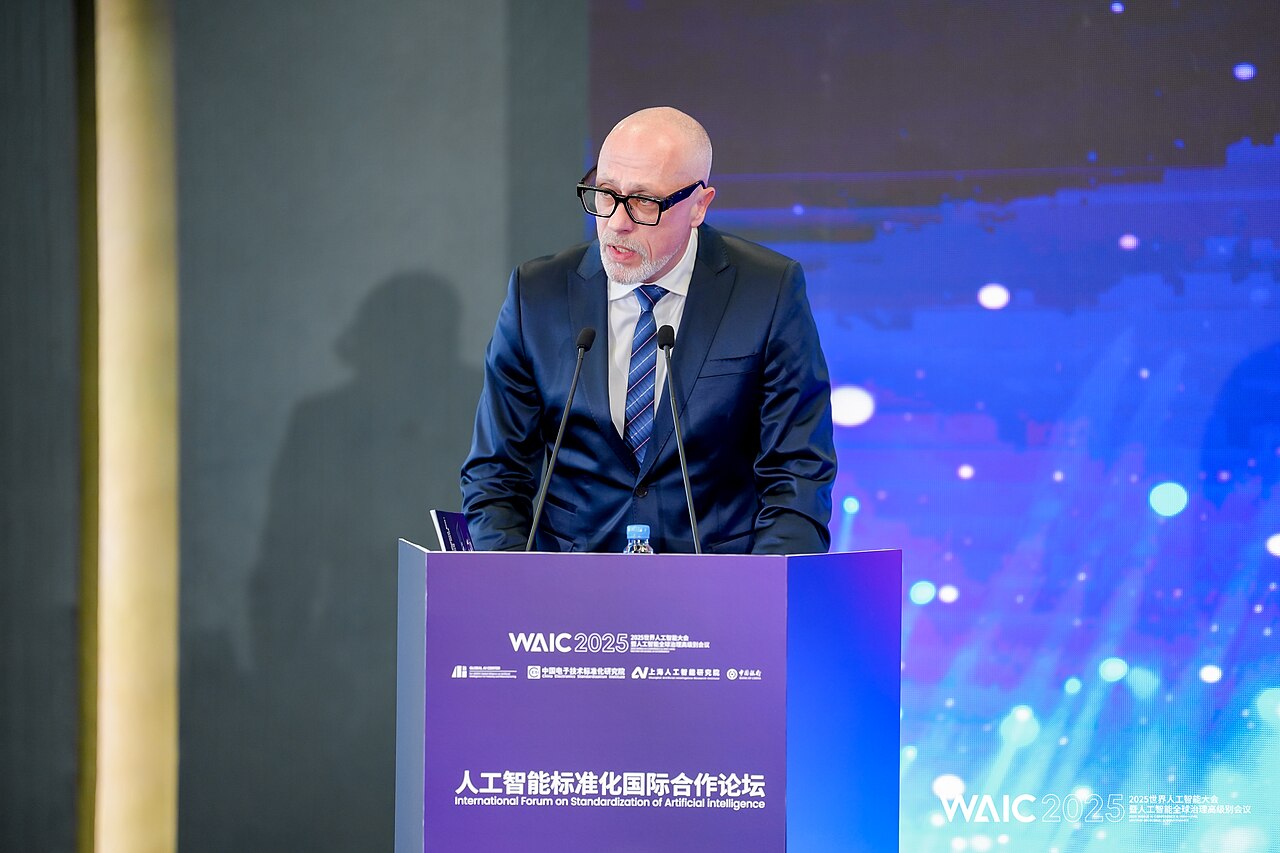
Image context: the cover is a real photograph from WAIC 2025 in Shanghai, not a generated AI image or diagram. It is used because OpenXLab's origin story is tied to WAIC 2021, and the article is about the conference-to-platform path by which Chinese AI infrastructure becomes publicly legible.[6]
The platform is a junction, not a shelf
OpenXLab is easiest to misread as a model shelf. The official home page does show a model center, but the surrounding pieces matter more: dataset access, application showcases, and a content platform for displaying and sharing AI results.[1] The project page makes the bundling clearer. It places OpenMMLab, OpenGVLab, OpenXRLab, and OpenDataLab in the same OpenXLab map, which means the platform is not only asking "which checkpoint do you want?" It is asking which part of the research-to-application chain needs to be reusable.[2]
That distinction matters because China's open-model stack has too many moving layers for a plain repository index to be enough. A vision model may depend on annotation conventions, pretrained checkpoints, deployment libraries, and downstream demos. A dataset may need structured presentation, high-speed download paths, and enough metadata discipline to survive reuse. An application demo may be the proof that a model can be understood by people who will never inspect the training code. OpenXLab's supply-chain value is that it gives those pieces a common public surface.
The OpenMMLab part of the map shows why this is not a theoretical problem. OpenMMLab describes itself as a computer-vision open-source algorithm system built to reduce reimplementation difficulty, provide deployment toolchains, and bridge academic research and industrial applications.[5] Its public GitHub organization says the ecosystem has released more than 30 vision libraries, implemented more than 300 algorithms, and included more than 2,000 pretrained models since its 2018 beginning.[5] Those numbers are not a leaderboard. They are a maintenance burden made visible.
OpenDataLab turns data into infrastructure
The OpenDataLab layer is the sharper delta from the old "model zoo" idea. The 2024 OpenDataLab paper starts from a practical bottleneck: AI data is fragmented across sources and formats, making retrieval and processing inefficient.[4] Its proposed answer is not simply "more datasets." It is a data platform with intelligent querying, high-speed downloading, and a description language meant to standardize multimodal and multi-format data.[4]
That is exactly the kind of layer China's AI stack needs if open weights are going to become repeatable systems. A model release can be copied quickly; the data assumptions behind it cannot. When datasets are hard to find, slow to move, or inconsistently described, downstream teams waste effort on the same preparation tasks. OpenDataLab's DSDL framing is important because it treats dataset representation as an interoperability problem, not just as a storage problem.[4]
OpenXLab's project page describes OpenDataLab as a large-scale, high-quality multimodal open dataset platform for AI developers, with intelligent search, high-speed download, structured presentation, and format standardization listed as product attributes.[2] Those are boring words in the best sense. They are the verbs of production data work. They also show why OpenXLab belongs in a stack-and-supply-chain update: the platform is trying to make data access a managed layer between research publication and application building.
Why this matters for Chinese AI operators
For operators, OpenXLab's value is not that every component is uniquely Chinese or that every project must beat every global alternative. The value is locality plus coordination. Shanghai AI Lab's ecosystem can connect OpenMMLab-style toolboxes, OpenDataLab-style data handling, OpenGVLab-style vision foundation work, and public model or app surfaces under one institutional umbrella.[1][2][5] That gives Chinese universities, startups, and enterprise labs a domestic path for browsing, testing, and reusing AI building blocks.
The important caveat is that OpenXLab should not be treated as proof of production readiness by itself. A model page, project page, or demo reduces discovery friction; it does not answer serving cost, license compatibility, security review, data lineage, or benchmark-transfer questions. The platform makes the stack easier to inspect, but each component still needs its own operational due diligence.
That boundary is where OpenXLab becomes strategically interesting. In 2026, Chinese AI competition is no longer only about who has the most dramatic model announcement. It is about who can turn releases into repeatable work: data prepared in standard forms, toolboxes maintained across versions, models discoverable by developers, demos that make capabilities understandable, and ecosystem pages that signal where the active communities are.[1][2][4][5]
OpenXLab's deeper message is that open AI infrastructure is becoming a venue. It is a place where a model, a dataset, an application, and a project lineage can be seen together. If the platform keeps those layers current, it can reduce the coordination tax around China's research ecosystem. If it becomes only a catalog, its value will flatten. The watch item is therefore not one headline release. It is whether OpenXLab continues to make the path from lab artifact to reusable component shorter, clearer, and easier to verify.[1][2][3]
Sources
- OpenXLab, official home page (content platform, model center, dataset center, application showcase framing).
- OpenXLab, "Projects" page (OpenMMLab, OpenGVLab, OpenXRLab, OpenDataLab, and platform capability map).
- Jin Yezi, "Shanghai AI Lab Releases OpenXLab," Yicai Global, July 9, 2021 (WAIC launch context and OpenXLab's original open-source ecosystem framing).
- Conghui He et al., "OpenDataLab: Empowering General Artificial Intelligence with Open Datasets," arXiv:2407.13773, June 2024 (dataset fragmentation, DSDL, querying, downloading, and toolchain framing).
- OpenMMLab GitHub organization README (computer-vision toolchain scope, libraries, algorithms, pretrained models, and academic-to-industrial bridge framing).
- Emmanuel.goffi, "Emmanuel R. Goffi, keynote at the World AI Conference (WAIC) 2025 in Shanghai.jpg," Wikimedia Commons, photographed July 16, 2025 (article image source).