As of 2026-06-15T03:33:39Z UTC, the useful AI-China signal in vLLM-Ascend is not simply that Huawei Ascend NPUs can run another popular inference framework. The sharper change is architectural: Ascend support is being carried as a community-maintained hardware plugin inside the vLLM orbit, with its own docs, releases, installation matrix, model tutorials, feature guides, accuracy paths, and performance/debug surfaces.[1][2][3]
That matters because China's AI supply chain is now crowded with model families that need more than a checkpoint page. Qwen, DeepSeek, GLM, Kimi, MiniMax, Hunyuan, PaddleOCR-VL, InternVL, and other systems increasingly compete on whether they can be served, quantized, batched, profiled, and swapped under real application traffic. In that environment, the serving layer becomes part of national AI infrastructure. A model that runs only on one blessed cluster is less useful than a model whose runtime path can be inspected and adapted by operators.
vLLM-Ascend's public positioning is explicit. The docs call it a community-maintained hardware plugin for running vLLM on Ascend NPUs, and describe it as the recommended approach for supporting Ascend within the vLLM community.[1] That wording is important. It frames Ascend not as a parallel fork where compatibility has to be rediscovered on every release, but as a backend boundary that can move with vLLM while keeping NPU-specific work in a separate project.
The plugin is the supply-chain move
The vLLM hardware-plugin blog gives the cleanest explanation of why this matters. As more backends arrived, vLLM faced a predictable maintenance problem: each hardware backend tends to bring its own executor, worker, model runner, attention path, and communicator logic.[4] If every backend has to patch the core project invasively, the center gets harder to maintain and the edge gets slower to evolve. The hardware-plugin answer is to make backend code independent enough that generic vLLM work and platform-specific work can proceed with a cleaner boundary.[4]
For Ascend, that boundary is strategic. Huawei's hardware story cannot be reduced to TOPS or a chip-roadmap slide. The hard part is making the software path tolerable for model operators who already expect vLLM's batching, serving interface, model coverage, and ecosystem habits. vLLM-Ascend lets the NPU-specific pieces live in the plugin while exposing a familiar operator target above it: vLLM commands, model tutorials, feature documentation, and the same broad mental model for serving.
The docs show how much machinery has already moved into that boundary. The vLLM-Ascend site lists tutorials for dense Qwen3 models, Qwen-VL, Qwen3 MoE variants, DeepSeek models, GLM, Kimi, MiniMax, Hunyuan, PaddleOCR-VL, InternVL, embeddings, rerankers, and feature guides for quantization, LoRA adapters, dynamic batching, context parallelism, speculative decoding, KV cache offload, and multiple profiling paths.[1] The list should not be read as a promise that every model-family edge case is solved. It is better read as an adoption map: here are the families and features the Ascend plugin team is turning into documented work paths.
That is a different kind of AI-China progress from a single model release. The visible model race still matters, but the harder economic question is whether Chinese model supply can land on domestic or China-controlled hardware without each deployment becoming a custom port. vLLM-Ascend is one answer to that question. It gives operators a place to ask which CANN, torch-npu, model, quantization, graph, and communication path they are really using.
The dependency stack is not incidental
The installation page makes the stack boundary concrete. It requires Linux, Python 3.10 through below 3.13, Ascend NPU hardware, and normally Atlas 800 A2-series hardware. The listed software stack includes Ascend HDK, CANN, torch-npu, torch, and NNAL, with current developer-preview docs pointing at CANN 9.0.0 and matching NPU software dependencies.[2] That is not boilerplate. It is the contract surface for anyone trying to make vLLM behavior reproducible on Ascend.
In NVIDIA-centered deployments, many teams have learned to treat CUDA, driver versions, container images, kernel choices, and NCCL behavior as operational infrastructure. Ascend deployments need the same discipline, just with a different vocabulary: CANN, torch-npu, HCCL-style communication, Ascend graph paths, operator support, and NPU memory behavior. vLLM-Ascend's value is partly that it makes those dependencies visible rather than burying them in vendor-specific examples.
Huawei Cloud's own Ascend-vLLM best-practice page reinforces the same direction from the vendor side. It describes vLLM's appeal through continuous batching and PagedAttention, then frames Ascend-vLLM as an NPU-optimized inference framework that inherits vLLM advantages while adding NPU-specific optimizations.[5] The feature table points to page attention, continuous batching, quantization, auto-prefix caching, chunked prefill, speculative decoding, graph mode, guided decoding, and beam search.[5] Some of those are now expected in modern inference. The point is that Huawei's cloud documentation is aligning its NPU serving story around the same operational vocabulary.
This is where the supply-chain angle sharpens. China does not need every developer to love a new hardware API. It needs enough compatibility layers that application teams can keep serving models while hardware procurement, export controls, cloud availability, and domestic accelerator strategy shift underneath them. vLLM-Ascend does not erase the friction. It makes the friction trackable.
Release notes are the real status page
The release history is a better signal than a launch headline. The GitHub repository notes that the vLLM community created the vllm-project/vllm-ascend repo in February 2025, that the first official version arrived in May 2025, and that later releases followed in September 2025, December 2025, February 2026, and May 2026.[3] That cadence matters because hardware support is not a one-time merge. Every new vLLM engine change, model architecture, quantization path, and communication optimization can reopen the compatibility question.
Recent release notes show the work becoming more operator-level. The May 2026 v0.18.0 release line references vLLM 0.18.0, CANN dependency changes, Qwen3-family performance work, Kimi-K2 performance work, Qwen3-VL operator enablement, DeepSeek and GLM performance optimizations, 310P enhancements, A2/A3 attention changes, async scheduling, KV-cache work, and custom operator improvements.[3] That list is dense, but the pattern is clear: the plugin is not only trying to boot models. It is chasing the details that determine whether models feel usable at production boundaries.
For Chinese model ecosystems, that is especially consequential. The model families most relevant to AI-China are not static. Qwen releases dense, MoE, vision-language, embedding, reranker, coder, and omni-style variants. DeepSeek changes attention and long-context behavior. GLM, Kimi, MiniMax, Hunyuan, and other families push their own architecture and serving assumptions. A hardware plugin that has to support these families must keep up with model-specific kernels, graph behavior, quantization, KV-cache accounting, communication, and debugging.
The risk is also visible. A plugin boundary can become a compatibility promise that moves faster than the underlying hardware software stack. If CANN, torch-npu, graph mode, custom operators, or multi-node communication lag behind vLLM core changes, teams will still feel the gap. The right way to read vLLM-Ascend is therefore not "Ascend is now drop-in equivalent to every CUDA path." The stronger claim is narrower: Ascend support has a public, versioned, community-facing place to converge.
Why builders should watch it
For builders outside China, vLLM-Ascend is a reminder that the China AI race is not only model weights and API prices. It is also a portability contest around serving contracts. The same application may want an OpenAI-style serving surface, Qwen or DeepSeek model support, domestic accelerator options for China deployments, and a fallback path on other hardware elsewhere. Hardware-plugin architecture makes that kind of split less chaotic than maintaining a private fork per platform.
For builders inside China, the importance is more direct. Procurement and policy pressure can make Ascend hardware attractive or necessary, but adoption still depends on whether the software stack behaves like infrastructure rather than an experiment. vLLM-Ascend's model tutorials, release notes, install requirements, and feature guides give teams a shared troubleshooting language. That shared language is underrated. It is what lets issues move from "the NPU is weird" to "this model needs a newer CANN path, this quantization method is unsupported, this operator is falling back, or this graph mode creates a host-device sync problem."
The conclusion is not that vLLM-Ascend has solved China's inference stack. It is that the battle has moved to a more practical layer. Domestic AI hardware becomes more credible when it can attach to the inference frameworks operators already understand. vLLM-Ascend is one of the clearest examples of that shift: Huawei NPUs are not being presented only as chips, but as a plugin boundary with docs, versions, model coverage, feature work, and visible maintenance pressure.[1][2][3][4][5]
Sources
- vLLM Ascend team, "Welcome to vLLM Ascend Plugin" (project positioning, hardware-plugin framing, model/tutorial surface, feature and developer-guide map).
- vLLM Ascend team, "Installation" (Linux, Python, Ascend NPU hardware, CANN, torch-npu, torch, NNAL, and multi-node setup requirements).
- vLLM Project,
vllm-ascendGitHub releases and repository notes (release cadence, v0.18.0 dependency notes, model/operator optimization highlights, and project history). - The Ascend Team on vLLM, "Introducing vLLM Hardware Plugin, Best Practice from Ascend NPU," vLLM Blog, May 12, 2025 (hardware-plugin motivation, architecture, and Ascend integration path).
- Huawei Cloud ModelArts, "Introduction to Ascend-vLLM," updated June 1, 2026 (Ascend-vLLM overview, vLLM inheritance, continuous batching, PagedAttention, quantization, graph mode, and decoding features).
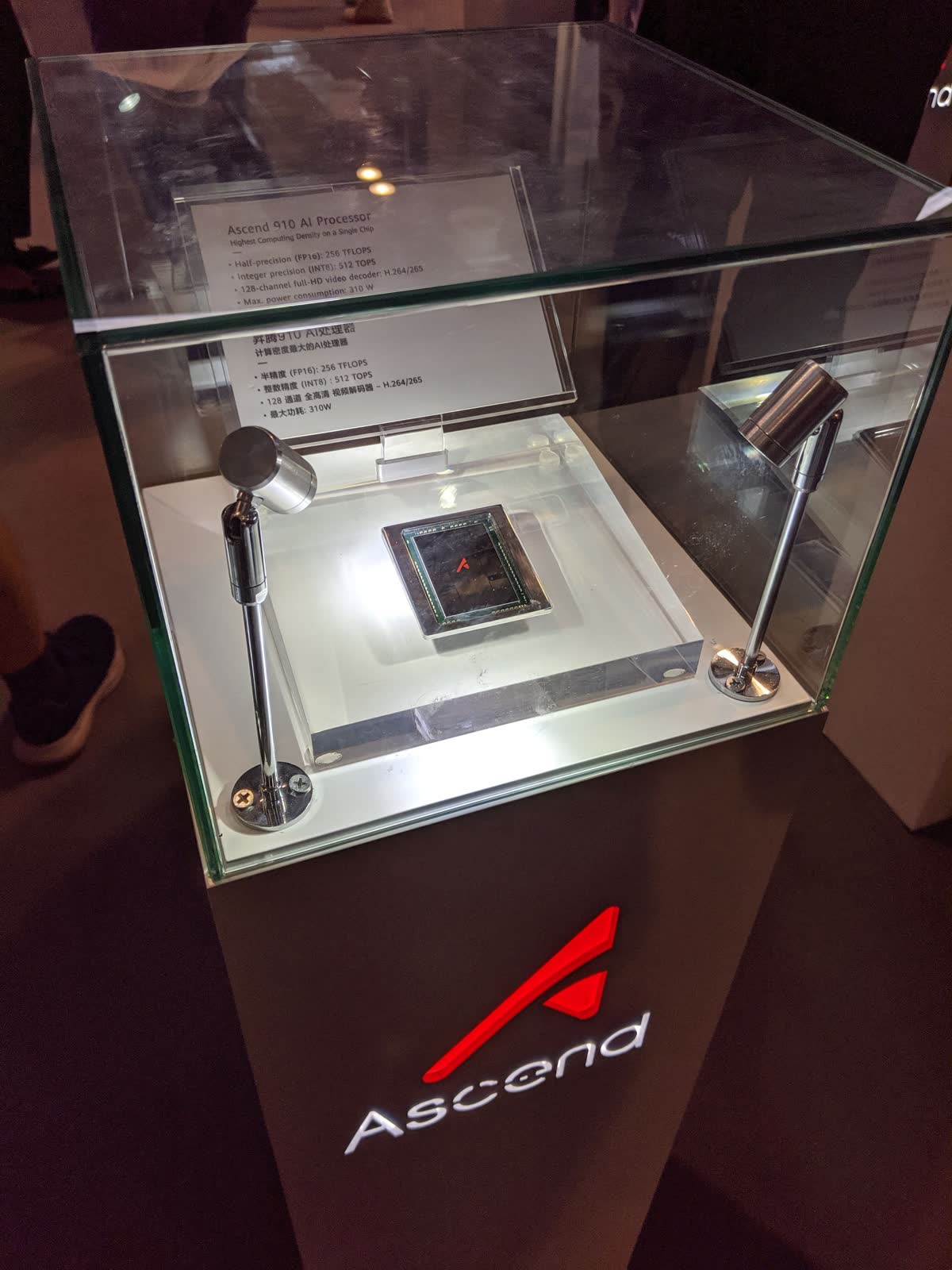
- Data Center Dynamics media, "Ascend310.original.jpg" (real photograph of a Huawei Ascend AI processor display used as the article image).