As of 2026-06-15T16:32:17Z UTC, the useful signal in Alibaba Cloud's LoongSuite agent-observability materials is not the existence of another monitoring product. It is the way observability is being pulled into the China AI stack as a deployment dependency. Alibaba Cloud's June 10, 2026 writeup frames agent observability around three runtimes: local coding agents such as Claude Code, Cursor, Codex, Qoder, and QoderWork; personal assistants such as OpenClaw, Hermes Agent, and QwenPaw; and framework-based agents built on LangChain, AgentScope, Dify, MCP, and other application libraries.[1]
That classification matters because Chinese AI deployment is no longer just a model-routing problem. The model layer is crowded; the runtime layer is where risk accumulates. An agent can read files, run commands, call tools, spend tokens, fetch memories, and hand work to other agents. Traditional request-level metrics do not explain why a ten-round ReAct run changed a config file, called an external API, or burned through a budget. LoongSuite's pitch is that the observable unit has to become the agent run itself: entry, agent, step, LLM, tool, MCP, retrieval, embedding, and workflow spans tied into one traceable chain.[1][2]
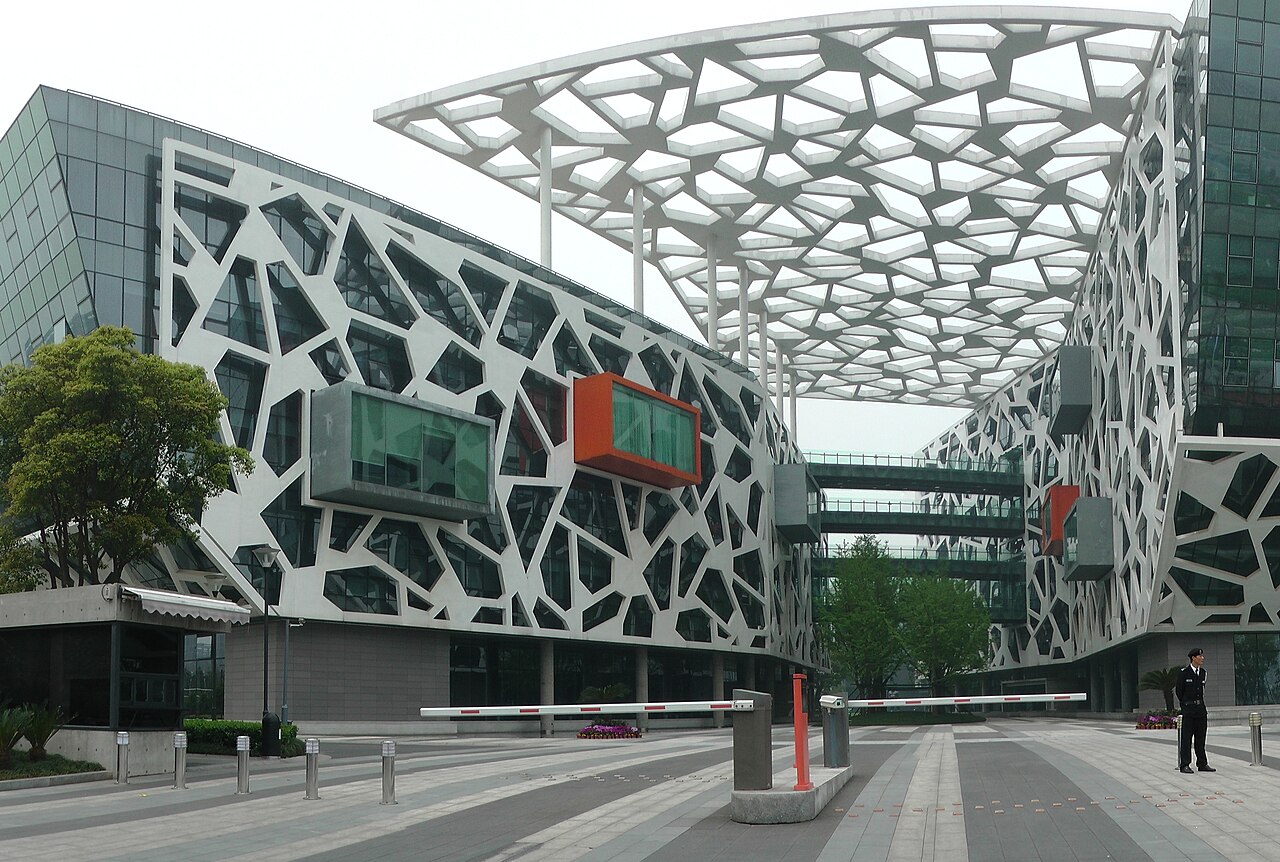
Image context: the cover is a real photograph of Alibaba Group headquarters in Hangzhou, not a diagram, chart, dashboard screenshot, generated image, or symbolic AI graphic. It fits the article because the piece is about Alibaba Cloud's operational layer around agent deployment rather than a single model interface.[5]
The stack is moving below the chatbot surface
The strongest detail in Alibaba Cloud's June article is the split between collection strategies. For coding agents, LoongSuite Pilot is described as a local client-side collector that runs as a background daemon, detects installed coding agents, and records behaviors such as LLM invocation, tool execution, and code modification without forcing developers to change how they use the tools.[1] Alibaba says the collector can vary collection granularity: detailed content and tool parameters for audit-heavy deployments, or metadata such as model name, token consumption, and duration when data sensitivity is higher.[1]
That is a China AI supply-chain signal because coding agents sit at the edge of enterprise data. They touch repositories, terminals, local databases, and build systems before the platform team has a clean server-side control point. If observability only begins at the API gateway, the most consequential actions may already have happened on a laptop or workstation. A one-time local collection layer is therefore less glamorous than a new model release but more relevant to adoption: it gives security, platform, and R&D effectiveness teams a way to see what AI-assisted development is doing.
The second lane covers personal general-purpose assistants. Alibaba's example is OpenClaw: built-in observability can emit metrics and traces, but LoongSuite's plugin tries to organize events into a parent-child trace tree that connects request entry, agent invocation, ReAct steps, LLM calls, and tool execution.[1] That hierarchy is the practical difference between "something happened" and "this request moved through these steps before this tool call failed." In agent products, the latter is the minimum unit needed for debugging and audit.
The third lane is framework instrumentation. Alibaba's Cloud Monitor documentation for AgentScope, last updated March 20, 2026, says the Python probe monitors AgentScope execution traces, LLM calls including token usage and model-call content, tool-calling traces, and ReAct loop observations.[2] The newer LoongSuite article broadens that into a zero-code Python-agent story: install loongsuite-distro, run loongsuite-bootstrap, and launch the application through loongsuite-instrument with OTLP traces and a service name.[1] The framework list is wide enough to show the target surface: LangChain, LangGraph, AgentScope, Dify, MCP, OpenAI Agents, Claude Agent SDK, Google ADK, CrewAI, Qwen-Agent, QwenPaw, Hermes Agent, Agno, LiteLLM, DashScope, Mem0, and Vertex AI.[1]
Semantics are becoming infrastructure
The more durable part of LoongSuite is not the install command. It is the semantic layer. Alibaba says its GenAI observability data model builds on OpenTelemetry GenAI semantic conventions and extends them for real agent workloads.[1] OpenTelemetry's own documentation now points GenAI semantic conventions to a dedicated repository, while its registry includes GenAI areas such as agent spans, MCP, metrics, events, exceptions, and model-provider conventions.[4] LoongSuite is trying to stay compatible with that ecosystem while adding Alibaba's own operational vocabulary.
The public alibaba/loongsuite-semantic-conventions-genai repository describes itself as an open-source GenAI semantic conventions project from Alibaba, built on OpenTelemetry GenAI foundations, specialized for LLM applications, model interactions, and AI service observability, and based on production experience from Alibaba's internal AI infrastructure.[3] That matters because agent monitoring will fragment quickly if every framework names the same behavior differently. One product calls a loop an iteration, another calls it a step, another records only a tool span, and another hides the tool's arguments behind a generic HTTP call. Semantic conventions are the adapter layer that lets dashboards, alerts, audits, and cost controls talk about agents in a common shape.
Alibaba's extensions reveal where it thinks the community standard is too thin for production. The June article names Entry Span and Step Span as additions that make long agent call chains readable; Entry Span preserves the original user request and output boundary, while Step Span represents each ReAct reasoning-action loop.[1] It also adds a gen_ai.skill.* family so a business function domain, such as an add_to_cart skill, can be grouped, versioned, compared, and analyzed.[1] The point is not nomenclature. It is that enterprise AI operations need to know which skill version failed, whether a canary degraded, how much time a function spent inside LLM calls, and which session produced a risky behavior.
This is why the LoongSuite Python repository is relevant beyond Python packaging. It describes LoongSuite Python Agent as part of Alibaba's unified observability data collection suite, alongside LoongCollector, Go Agent, Java Agent, and other language agents, and says the Python agent is a customized distribution of upstream OpenTelemetry Python Agent with enhanced support for popular AI agent frameworks.[6] Its support table includes AgentScope, Claude Agent SDK, QwenPaw, CrewAI, DashScope, Google ADK, LangChain, LangGraph, LiteLLM, MCP Python SDK, Mem0, and more.[6] That makes LoongSuite look less like a single product and more like a bridge between cloud monitoring, open-source observability, and agent-framework sprawl.
The operating buyer is changing
For model labs, observability is often a debugging feature. For enterprise buyers, it is a purchase condition. Alibaba's summary maps LoongSuite to enterprise security administrators, R&D effectiveness teams, FinOps and cost administrators, AI application developers, platform operations staff, compliance auditors, and agent product teams.[1] That list is instructive. Once agents leave demos, the buyer is not only the AI engineer choosing a model. It is the security team asking who touched a file, the platform team asking why latency jumped, the finance team asking where token spend went, and the auditor asking whether a high-risk action after prompt injection was reviewed.
The Cloud Monitor AgentScope guide shows how this gets productized. It offers an ACK/ACS route using labels such as aliyun.com/app-language: python, armsPilotAutoEnable: 'on', and an application workspace name, plus a manual route using aliyun-bootstrap, environment variables such as ARMS_APP_NAME, ARMS_REGION_ID, ARMS_LICENSE_KEY, and aliyun-instrument python app.py.[2] Those are ordinary platform knobs. That is the point. The agent observability layer becomes useful when it can be installed by the same teams that already manage clusters, deployments, regions, license keys, and workspaces.
There is a competitive angle here as well. China's AI stack has been converging around model hubs, OpenAI-compatible endpoints, domestic inference runtimes, RAG frameworks, agent workbenches, and cloud deployment lanes. LoongSuite adds an operations layer above all of that. If Alibaba can instrument AgentScope and DashScope deeply while also supporting non-Alibaba frameworks, it gets two advantages: its own stack becomes easier to govern, and its cloud monitoring surface becomes the neutral place where mixed agent deployments are reviewed.
The counterweight is obvious. Observability can become surveillance if the data boundary is not clear. Alibaba's own material says collection granularity can include message content and tool parameters for complete audit needs, or only metadata in sensitive scenarios.[1] That choice cannot be an afterthought. Teams need retention rules, redaction policy, role-based access, export controls, and a decision about when prompt or tool-argument content is too sensitive to collect. More traceability is not automatically better if it creates a second copy of secrets, personal data, or proprietary code in the monitoring system.
The other risk is semantic overreach. Vendor extensions are useful when they fill real gaps; they become expensive when every vendor creates a parallel dialect. LoongSuite's best path is therefore the one its materials imply: build on OpenTelemetry, open-source the GenAI semantic extensions, and upstream what proves broadly useful.[1][3][4] If it stays compatible, the stack gains a common language. If it drifts, teams may get another observability island.
What to watch
The first watch item is adoption outside Alibaba-native applications. AgentScope and DashScope support is expected. The bigger signal is whether LoongSuite instrumentation remains strong for LangChain, LangGraph, MCP, Dify, LiteLLM, CrewAI, and Qwen-Agent without forcing teams into a single framework path.[1][6]
The second watch item is cost attribution. Alibaba names token usage, input and output token fields, cache token fields, and cost extensions as key observability outputs.[1] In 2026, token cost is not just an API bill; it is a routing, caching, evaluation, and product-design constraint. If LoongSuite can split spend by agent, user, task, skill, and model path, it becomes a FinOps control plane for agent work.
The third watch item is security event quality. Alibaba's article treats high-risk tool calls after prompt injection as a high-confidence incident signal, because injected instructions that drive tool execution are more urgent than generic high-risk actions.[1] That is the right direction: agent security dashboards need fewer vanity counters and more event chains that explain cause, action, and blast radius.
The narrow conclusion is that LoongSuite is a stack update, not a model update. It shows Alibaba Cloud pushing AI infrastructure toward a more governed shape: agents are not only prompts and tools, but observable executions with sessions, steps, skills, costs, traces, and audit trails. In China's crowded AI market, that operating layer may become a quieter but durable differentiator. Models win demos; traceable agents win production reviews.[1][2][3][6]
Sources
- Alibaba Cloud Native Community, "From Black Box to Transparent: Alibaba Cloud Agent Observability and Audit Data Collection in Practice" (June 10, 2026 LoongSuite article on coding agents, personal assistants, framework agents, OpenTelemetry GenAI extensions, cost tracking, security audit, and agent trace trees).
- Alibaba Cloud Documentation Center, "Cloud Monitor: Integrate AgentScope (Python) Applications" (last updated March 20, 2026; Python probe integration, ACK/ACS labels, manual instrumentation, LLM calls, tool traces, and ReAct observations).
- Alibaba,
loongsuite-semantic-conventions-genaiGitHub repository (open-source GenAI semantic conventions built on OpenTelemetry, production-tested Alibaba AI observability experience, docs/model folders, and Apache 2.0 license). - OpenTelemetry, "Moved: Generative AI semantic conventions" and semantic-convention registry navigation (GenAI conventions moved to a dedicated repository; registry includes GenAI agent spans, MCP, events, metrics, and provider areas).
- Wikimedia Commons, "Alibaba group Headquarters (cropped).jpg" (real photograph of Alibaba Group headquarters in Hangzhou; image source for the article cover).
- Alibaba,
loongsuite-pythonGitHub repository (LoongSuite Python Agent, supported framework instrumentation, loongsuite-distro, GenAI utilities, and OpenTelemetry Python distribution relationship).